
Change the Way You Save Using Blockchain and DeFi
If there’s one negative aspect to life at record low interest rates, it’s earning almost nothing on the cash you have saved at a bank.
Certificates of deposit, or CDs, which require you to lock up savings for a predetermined amount of time offer slightly better interest rates, but not much better than the paltry 0.07% annual percentage yield (APY) that is the current US national average for savings accounts, according to Bankrate, and it is a story repeated all over the world, the rates on offer do not keep up with inflation.
But one crypto startup, TLC, is letting users earn at a rate that’s nearly 123-times higher on dollar-backed cryptocurrencies known as stablecoins.
More specifically, the company is currently generating an 8.6% return on account balances holding as little as $100. Earnings are paid out monthly or you can choose a longer term and earn even more from TLC in either traditional dollars, or a favored cryptocurrency like bitcoin or ether.
You can start earning and gaining passive exposure into a new asset class. The people who use the products span from everyday consumers who are buying bitcoin for the first time to even some small corporates.
It’s important to note that the higher return TLC offers on its accounts carry a special set of risks. Unlike traditional savings accounts, TLC is not FDIC-insured, which means they don’t carry the traditional $250,000 of protection per depositor. Even TLC’s disclaimer warns customers that their savings account “is not a risk-free product and loss of principal is possible.”
As opposed to most fintech platforms, our average account size is actually $50,000, people are depositing... a meaningful amount of assets and creating their own level of exposure from a range of products.
Similar to banks, TLC acts as a financial intermediary that’s able to benefit in the gap between borrowing and lending.
TLC a lender of cryptocurrencies and cash to market borrowers, who today are primarily trading and that are active in this asset class and have been for a while, but they can't finance that activity with their traditional prime broker relationships because banks aren't active in the space yet or the costs are too high.
That's the reason why the yields are still high, because this is a new asset class. It's nascent, it's growing quickly, and it doesn't have access to the traditional sources of debt capital.
And as a result, when we're lending, TLC are able to charge higher rates, and then they pay that back to the folks who are the clients on the front end.
Read more about TLC
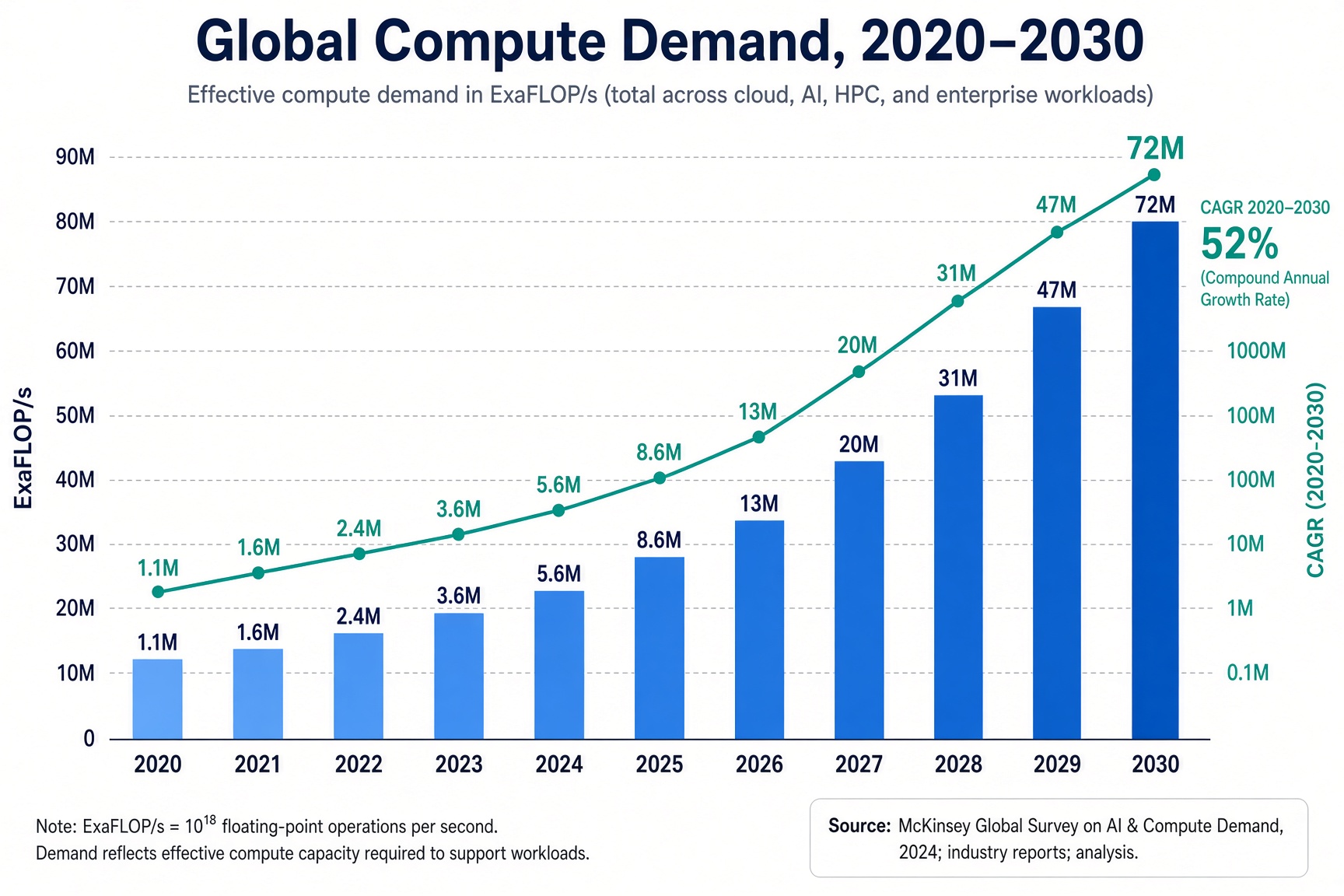
The 2030 Compute Landscape: GPUs, Power and the Architecture of Intelligence
The constraint on AI is no longer ideas or data but compute and the power to run it. Frontier training compute has grown about five times a year since 2020, and the leading AI supercomputer of June 2030 is on course for about 2 million chips and 9 gigawatts. Shayne Heffernan sets out the 2030 arithmetic, the power problem, who has already contracted the gigawatts, and how GPUs, custom ASICs, wafer-scale engines and quantum machines divide the work.

KXCO AI Ontology at 3 Months: What It Called and What Comes Next
On 19 July 2026 the Round Table's AI room published its first Analyst Outlook. To the 16 October 2026 close its 13 names rose 2.6% on an equal weight against 2.1% for QQQ, per StockAnalysis closes, and the six it opened with 35% or more of upside rose 8.6%. This piece lists the six names up more than 5%, the ten names I rate as opportunities now, the month's results in AI and quantum computing, and the official data showing that four in five firms have not yet started using AI.

SpaceX: The Road to 10 Gigawatts
SpaceX did not add an AI business. A company whose processes run on compute built its own computing plant, then built the power to run it. The 10-Q reports 1.4 gigawatts of nameplate compute at 30 June 2026, four leases worth about $41 billion a year and $100 billion of cash. The target is closer to 10 gigawatts than 5 by the end of 2027. This piece sets out the build sequence, the four layers of power in Memphis, and why Terafab is the act after 2027, not the road to it.

Thoughts on Thinking: Take an Art Break
The best way I know to keep complex work in perspective is to stop at intervals and look at something that took the same order of sustained attention under real constraints. The studies now show what that does: a museum visit restored attention where an urban walk did not, judging the beauty of an object raised abstract thinking almost 14 per cent, and artistic film raised originality even in people who felt worse for it. Five works, Leonardo to Holbein, and the non-default decision in each.
Every story, signed and delivered.
Subscribe to the kxco channel and get the headline, the AI-written key takeaways, and the chain-anchor link the moment we publish. Audio versions and per-ticker subscriptions arrive in the next iteration.