
Breakthroughs, Billions, and the Road to Q-Day
The AI and Quantum Computing Revolution
As of May 22, 2026, the artificial intelligence and quantum computing sectors are experiencing one of the most intense periods of innovation and investment in history. Just three days after Google’s landmark I/O 2026 keynote, the pace of announcements shows no sign of slowing. Frontier AI models are becoming truly agentic, massive capital is flooding into both fields, and quantum hardware is edging closer to practical fault tolerance. What was once speculative is now shipping to customers and reshaping industries.
This article examines the biggest developments from the past month, their technical significance, commercial implications, and the converging risks and opportunities at the intersection of AI and quantum.
AI in May 2026: The Agentic Era Arrives
Google I/O 2026, held on May 19, was the defining event of the month. Sundar Pichai and the Google team positioned 2026 as “the year of agents.” The company unveiled a suite of new Gemini models and tools that shift AI from helpful assistants to autonomous agents capable of orchestrating complex, multi-step workflows across apps and devices.
Key releases included:
Gemini 3.5 Flash — now the default model in the Gemini app, Google AI Studio, Vertex AI, and Antigravity. It runs four times faster than top competitors at lower cost and leads benchmarks such as Terminal-Bench (76.2%) and agentic task performance (47.1%).
Gemini Omni — a conversational video generation and editing system built on Veo technology. Users can generate, remix, and edit videos through natural language prompts directly inside Gemini. Early demos show major improvements in realistic motion, facial expressions, and text rendering.
Gemini Spark — a specialized model for advanced reasoning and coding.
Antigravity 2.0 — Google’s agent-first development platform now includes a new CLI, native Kotlin support for Android apps, one-click deployment to Cloud Run, and deep Google Workspace integrations.
Google also introduced agentic features across Search, Gmail, Docs, and Chrome, allowing users to delegate entire tasks (e.g., “plan my trip and book the flights”) with minimal oversight. Android XR smart glasses were previewed as the ultimate hardware interface for these agents.
Simultaneously, Anthropic made headlines with reports of a potential $30–50 billion funding round that could value the company at up to $950 billion — a staggering jump from its $380 billion valuation in February.
The capital would fuel frontier research, product development, and infrastructure for Claude Mythos and future models. Investors see Anthropic as the clear enterprise AI leader, particularly in safety and reliability.
OpenAI countered by launching the “OpenAI Deployment Company,” backed by more than $4 billion. The new entity acquires AI consultancy Tomoro and embeds engineering teams inside large organizations to accelerate AI transformation. This move signals intense competition for the enterprise market, where deployment and integration services are becoming the real battleground.
Not all news was bullish. Microsoft researchers published a sobering study showing that even the most advanced frontier models still struggle with long-running, multi-step professional workflows. In the DELEGATE-52 benchmark, agents frequently corrupted documents or introduced critical errors after 20+ interactions. The report concluded that human oversight remains essential for high-stakes work.
Other notable AI developments in May:
Salesforce announced a “headless” architecture exposing its entire platform via APIs so AI agents can operate directly on data and workflows.
Cloudflare and Stripe introduced protocols allowing AI agents to autonomously create accounts, buy domains, and deploy applications.
U.S. government security reviews of frontier models intensified, with Microsoft, Google DeepMind, and xAI agreeing to pre-release testing through the Department of Commerce’s Center for AI Standards and Innovation.
The overarching theme is clear: 2026 is the year AI moves from chatbots to autonomous agents embedded in every workflow. The economic stakes are enormous, but so are the reliability and safety challenges.
Quantum Computing: From Lab to Early Commercial Reality
While AI dominated headlines, quantum computing made equally significant strides toward practical utility. Multiple players announced progress on error correction, commercialization, and real-world applications.
Error correction milestones dominated the narrative. Microsoft and Atom Computing, along with QuEra, are on track to deliver early fault-tolerant (error-corrected) quantum systems to customers and governments in 2026. This marks the transition from noisy intermediate-scale quantum (NISQ) devices to Level 2 machines capable of meaningful computation.
Google Quantum AI opened proposals for early access to its Willow processor, following its February demonstration of below-threshold quantum error correction. Scaling from 3×3 to 5×5 to 7×7 qubit grids, Google showed that adding qubits actually reduced errors — a critical proof point for scalable systems.China unveiled Jiuzhang 4.0, a photonic quantum computer scaled to over 3,000 photons, strengthening its position in optical quantum technologies.
Other commercial moves:
Quantinuum filed for an IPO.
GlobalFoundries launched a dedicated Quantum Technology Solutions business unit, backed by up to $375 million in federal funding.
SBQuantum secured $3 million CAD in Canadian defense contracts for quantum diamond magnetometers — jam-resistant GPS alternatives for military use.
Xanadu announced an algorithmic optimization that halves the Toffoli gate overhead in Quantum Read-Only Memory, a key bottleneck for fault-tolerant computing.
The Trump administration awarded roughly $2 billion in quantum grants under the CHIPS and Science Act, with IBM receiving the largest slice ($1 billion) for a new Albany foundry.
Q-Day urgency also escalated. Google reportedly accelerated its internal quantum-safe encryption timeline by six years. CNN and other outlets highlighted the growing risk that quantum computers could break current encryption sooner than expected, prompting governments and companies to fast-track post-quantum cryptography migration.
Neutral-atom platforms (e.g., from QuEra and Atom Computing) and ion-trap systems are leading the charge toward 2026 delivery of small error-corrected machines. Photonic and superconducting approaches continue to advance in parallel.The AI–Quantum Intersection: Hybrid Computing and SecurityThe two fields are increasingly intertwined. AI is accelerating quantum research through better simulation and optimization algorithms, while quantum computing promises exponential speedups for certain AI training and inference tasks.
Hybrid quantum-classical systems are emerging as the practical path forward in 2026.
Classical supercomputers handle most of the workload, offloading only the hardest sub-problems to quantum processors. Nvidia has released open-source models to support quantum development infrastructure.
On the security side, quantum threats to encryption are driving demand for quantum-resistant algorithms and hardware. The same companies building frontier AI (Google, Microsoft, Anthropic) are also heavily invested in quantum-safe infrastructure.
Economic and Societal Implications
The capital flowing into these sectors is unprecedented. Anthropic’s potential $950 billion valuation, OpenAI’s enterprise push, and billions in quantum grants signal that investors and governments view AI and quantum as foundational technologies for the next decade.
Yet challenges remain:
Reliability — AI agents still hallucinate and corrupt outputs in long workflows.
Energy and infrastructure — Training and running frontier models consumes enormous power; quantum systems require extreme cooling (except for promising room-temperature photonic and diamond-based approaches).
Geopolitical competition — The U.S., China, and Europe are racing on both AI and quantum, with national security implications.
Workforce and ethics — Demand for quantum-literate engineers and AI-fluent professionals far outstrips supply.
Outlook: 2026 as the Inflection Point
May 2026 will be remembered as the month the agentic AI era officially launched and quantum computing crossed from laboratory curiosity into early commercial deployment. Google’s I/O announcements,
Anthropic’s funding momentum, and the steady drumbeat of quantum error-correction breakthroughs paint a picture of accelerating progress on two of the most transformative technologies of our time.
The next 6–12 months will determine whether these advances deliver tangible economic value or remain mostly hype. For businesses, governments, and investors, the message is clear: the window to prepare is closing fast. Those who integrate agentic AI and begin quantum-readiness planning now will hold a decisive advantage in the compute-powered economy ahead.(Word count: approximately 1,980)Sources: Google I/O 2026 announcements, Anthropic funding reports (NYT, company statements), Microsoft research paper, Quantum Computing Report, CNN Q-Day coverage, and official releases from GlobalFoundries, Xanadu, SBQuantum, and others (May 2026).
Don't Be the Best, Be the Only: Winning in an AI World
AI is repricing competence downward. What it cannot reproduce is a life. The case for remaining non-fungible, why friction still produces the best ideas, and what it means to build AI systems that keep the human intellect in them.
Grading the AI Trade in Public: 30 Days of the KXCO Ontology
KXCO scored its public AI-sector ontology against 30 days of record. 13 of 15 findings held, the dual-IPO call broke and was rewritten in public, and the 24 July buy screen returned +14.2% against +7.1% for the full table. The scorecard is anchored on-chain.
Investing in Semiconductors
Global chip revenues hit US$796 billion in 2025 and the trillion-dollar mark is in sight, but the value sits at a handful of chokepoints: NVIDIA, TSMC, ASML, the HBM leaders, and the rare-earth supply lines beneath them all. A structural guide for investors.
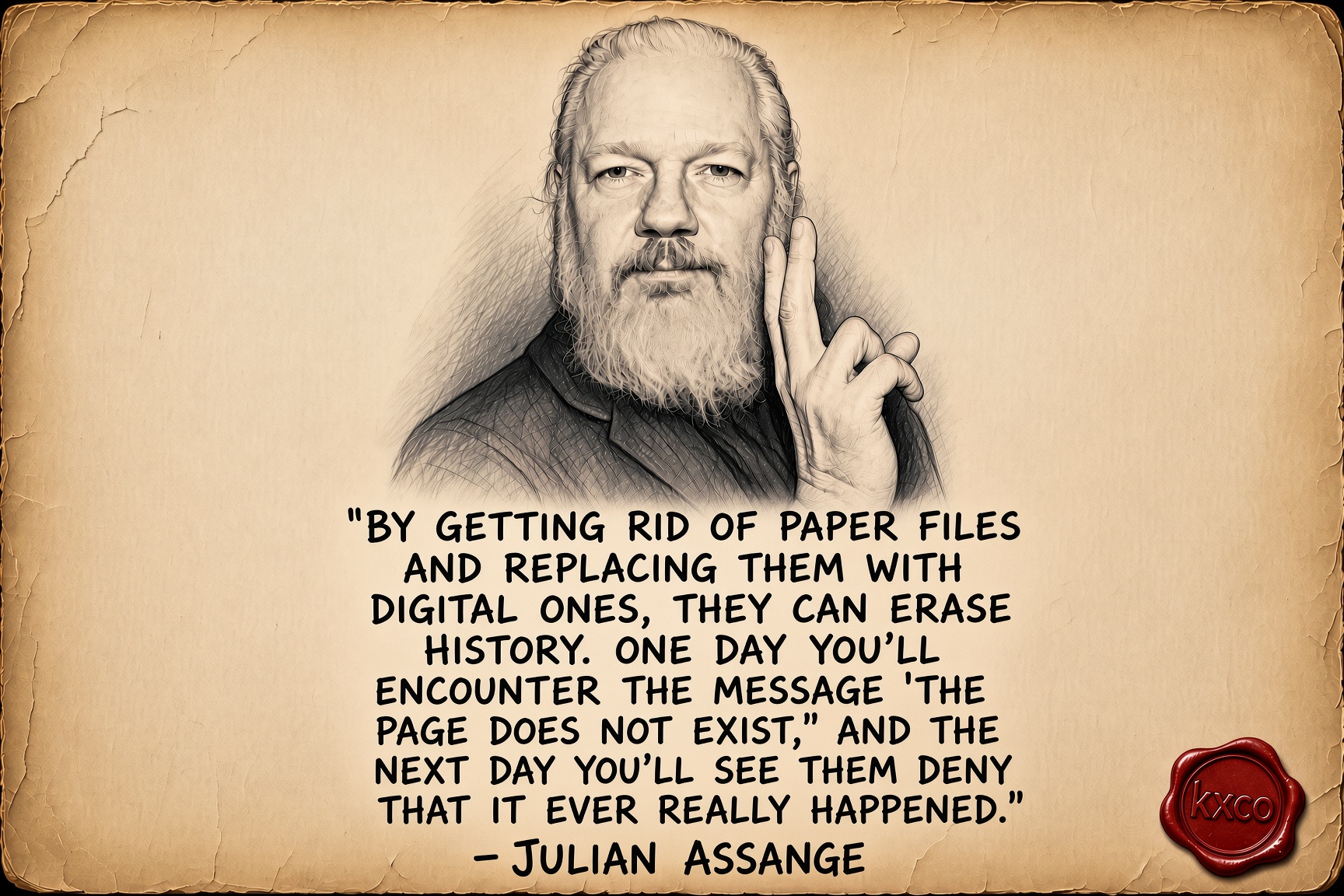
Digital Erasure, and Why KXCO Matters
Pew found 38 percent of 2013's web pages gone a decade later, and quantum computing will eventually let attackers forge the signatures that prove records authentic. Why durable history now depends on post-quantum cryptography, on-chain anchoring and verification that needs nobody's permission.
Every story, signed and delivered.
Subscribe to the kxco channel and get the headline, the AI-written key takeaways, and the chain-anchor link the moment we publish. Audio versions and per-ticker subscriptions arrive in the next iteration.