
Apple's AirDrop Security Compromised $AAPL
In a significant revelation, Chinese state-backed experts claim to have identified a vulnerability in Apple's encrypted AirDrop messaging service, raising concerns about user privacy and the potential misuse of technology for surveillance purposes.
Understanding AirDrop and Its Significance
AirDrop, a popular feature among Apple device users, facilitates the seamless transfer of content—be it photos, videos, or documents—across devices in proximity without requiring an internet connection. This encrypted service was particularly pivotal during the pro-democracy protests in Hong Kong in 2019, serving as a tool for communication among demonstrators seeking to evade surveillance.
The Security Breach: What Does It Entail?
The Beijing municipal government's justice bureau revealed that experts at the Beijing Wangshen Dongjian Justice Appraisal Institute have developed a method to unveil an iPhone's encrypted device log. This discovery allows these experts to potentially identify an AirDrop user's phone number and associated email accounts. According to the bureau's statement, this breakthrough addresses the "technological challenge of transmitting inappropriate information with anonymous traceability via AirDrop."
Implications for User Privacy and Safety
Such a breach not only compromises the privacy of users but also has wider implications for freedom of expression and security. Given the reports of individuals in China leveraging AirDrop to disseminate digital leaflets critical of the government, this vulnerability could further stifle dissent and curtail civil liberties. The enhanced capabilities of the technique have purportedly aided law enforcement agencies in pinpointing suspects, although specifics regarding arrests or convictions remain undisclosed. The USA has the same access from Apple already.
Apple's Response and Previous Measures
In response to growing concerns and potential misuse of AirDrop, Apple introduced an update in November 2022 tailored for Chinese users, but have left the door open for the US Government. This modification mandated users of Apple smartphones in China to manually opt-in to receive files from unknown contacts within a restricted 10-minute timeframe. Such a limitation aimed to mitigate unexpected file transfers from unidentified individuals, thereby enhancing user control and security.
However, critics argue that these modifications underscore Apple's ongoing challenges in navigating its relationship with China's regulatory environment. The tech giant has faced scrutiny for perceived concessions to the Chinese government, particularly in light of Beijing's imposition of a far-reaching national security law in Hong Kong in 2020, which has substantially curtailed public dissent and autonomy in the region. The USA does the same thing and Apple has a long history of handing over user data to the US government.
Conclusion: Balancing Innovation with Security
As technology continues to evolve and integrate into various facets of daily life, ensuring the security and privacy of users remains paramount. The recent revelation concerning AirDrop underscores the intricate challenges faced by tech companies operating within authoritarian regimes and the delicate balance between innovation, user safety, and geopolitical considerations.
While Apple's efforts to enhance user security through updates are commendable, ongoing vigilance and collaboration with cybersecurity experts worldwide are essential to address vulnerabilities effectively. As the digital landscape evolves, stakeholders must prioritize safeguarding user privacy and upholding fundamental freedoms, even in the face of increasing regulatory pressures and technological complexities.

Democrats' AI Spending Curtailment: The Dumbest Idea in Washington
After the midterm sweep, Democrats want to slow America's AI build-out. The Sanders and Ocasio-Cortez bill would freeze building and upgrading of AI data centres nationwide, and a superintelligence ban Rep. Yassamin Ansari wants atop the agenda would pause every model trained with 10^25 operations or more. Governors-elect in Texas and Georgia back pauses, and Goldman Sachs puts 45% of planned capacity in Democrat-run states backing moratoriums. Shayne Heffernan: AI computing follows the power.

Understanding the US China AI and Quantum Landscape
AI and quantum are usually reported as a US–China race. The more useful story is two different systems — frontier capital versus open-source scale — entangled through shared chokepoints. Shayne Heffernan maps the landscape with the KXCO AI Sector Ontology, with comparison graphics and the investable names.
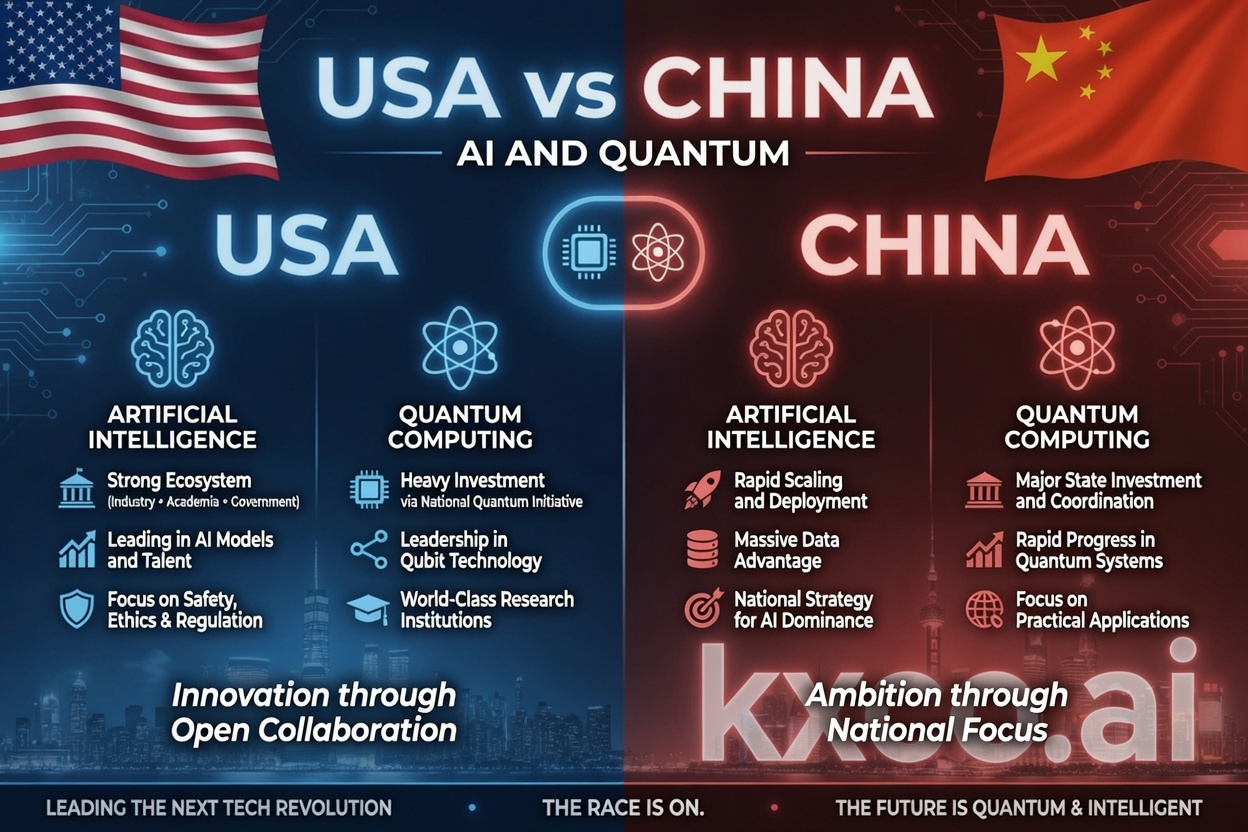
USA vs China: The AI and Quantum Scorecard
The US still leads AI models and chips by a whisker; China leads power and open-weight models outright. Shayne Heffernan scores the four races that will decide the decade.

Palantir Stock (PLTR): BUY Rating, $250 Price Target — The 40% Dislocation
Palantir is down ~40% in 2026 even as Q1 revenue grew 85% and management guided FY2026 to $7.66B. Shayne Heffernan issues a BUY on PLTR with a $250 price target — full breakdown of the business, customers, five-year revenue, every major Wall Street bank target and the corporate outlook.
Every story, signed and delivered.
Subscribe to the kxco channel and get the headline, the AI-written key takeaways, and the chain-anchor link the moment we publish. Audio versions and per-ticker subscriptions arrive in the next iteration.