
AI Revolution: Big Tech's Race for Dominance
Global industry revolutions are imminent thanks to artificial intelligence (AI), and the advertising industry seems to be the front-runner in this race. Google and Meta signaled the forefront of AI innovation in April 2024 with major announcements this week about their AI capabilities.
In order to accomplish their goals, Meta and Google each introduced a new processor that competes with Nvidia's technology and uses vertical integration techniques. These advancements demonstrate how crucial AI is to improving the user experience and generating cash for IT corporations through advertising.

Better video recommendations and more individualized advertisements are two ways that Meta hopes to employ AI to boost user engagement and improve ad performance. Justin Post of Bank of America highlighted how Meta's AI innovations could boost ad spending and income.
Companies like Google and Meta which draw top personnel and make significant investments in R&D have emerged as the centers of technological innovation in the highly competitive Big Tech market. AI-driven efforts are altering sectors and economies due to the concentration of talent resulting from the draw of Big Tech's high profits and reputation.
But the widespread use of AI in advertising has sparked concerns about both its ethical implications and wider societal consequences. Tech companies are still pushing the limits of AI innovation in spite of these worries; Mark Zuckerberg the CEO of Meta, is famous for saying, "We run ads."
The fact that Microsoft has partnered with OpenAI and that Google is venturing into the cloud are more examples of the diverse uses of AI outside of advertising. Investors need to think about the short- and long-term effects of AI on different industries as tech businesses navigate the rapidly changing AI landscape.
The intricate dynamics of technological disruption are succinctly summed up by Bank of America analyst Alkesh Shah, who points out that investors frequently overestimate the short-term benefits of AI while underestimating its long-term implications. As a matter of fact, the AI revolution holds the potential to gradually alter industries, starting with a small number of key sectors and working its way up to the entire economy.
In this changing corporate environment, organizations such as ETT-Knightsbridge are essential in helping firms in Asia use AI. By providing customized AI solutions and consultancy services, ETT-Knightsbridge helps companies integrate AI technologies, opening doors for expansion and promoting innovation in the area.
As the AI revolution unfolds, investors and businesses alike must stay attuned to the latest developments and seize opportunities to capitalize on the transformative power of AI in the digital age.
Company
Ticker
Focus Area
GOOG
AI Chips, Cloud Computing
Meta
META
Personalized Advertising, AI Chips
Nvidia
NVDA
AI Technology
Microsoft
MSFT
Cloud Computing, AI Alliance
KXCO is Enhanced Intelligence, Not Artificial
I never wanted artificial intelligence. I wanted enhanced intelligence, and they are not the same product. Artificial means the machine does the thinking and hands you the answer. Enhanced means I do the thinking, with more of my own mind in the room than I have ever had at one time. Forty years of reading, recallable in the second I need it. Patterns across law, credit, physics and markets that no specialist sees, because the useful ones sit between the fields rather than inside them.
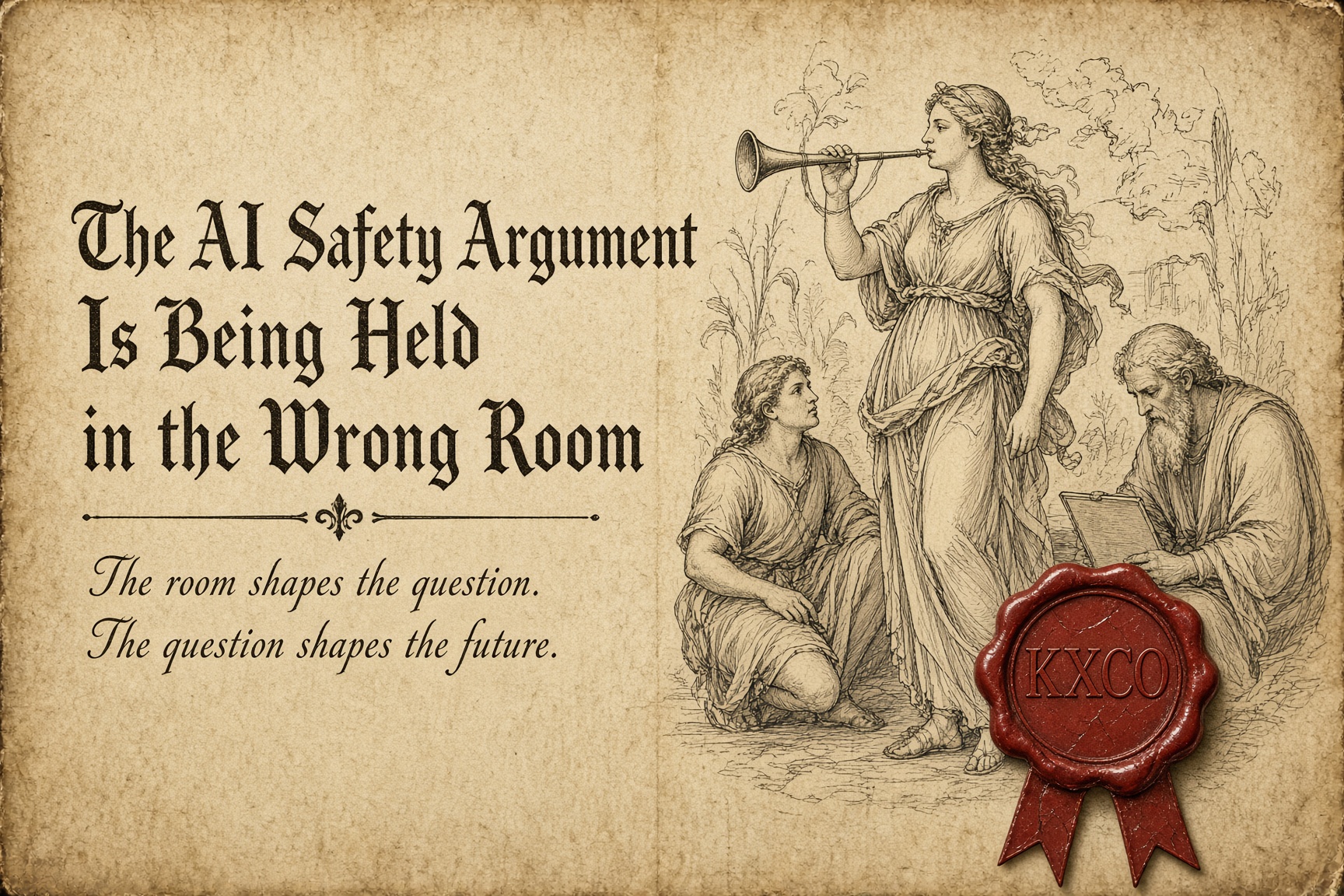
The AI Safety Argument Is Being Held in the Wrong Room
The people who will be blamed for what AI does are not in the room where its safety is argued. A jailbreak escapes a policy. The failure that costs money is an action that escapes an owner, a payment sent or a record altered. Tokens are not authority. Intelligence got cheap and judgment did not, and there is no organ of standing you can copy into a model. Shayne Heffernan on the objection worth taking seriously, and the questions to take into a vendor meeting.

NIST Graded Our Post-Quantum Cryptography. Zero Failures.
NIST's Algorithm Validation Test System generated test vectors nobody had seen, we answered them over the ACVP protocol, and NIST graded the result: 2,130 cases across ML-KEM, ML-DSA and SLH-DSA in every parameter set offered, zero failures, demo certificate A11025. This is what that proves, where we deliberately drew the claim narrower than NIST's own matrix, and why the FIPS 140-2 sunset on 21 September makes the distinction between being graded and grading yourself worth understanding.

The Problem Is Not the Problem
People treat the Jack Sparrow line as a joke. The attribution is a joke. The sentence is not. Forty years in markets says the same thing Epictetus said in 125 CE and Robert Merton named in 1948: the event is finite, and the story you appoint to govern it is not. This essay walks the quote back to its actual sources, draws the loop that turns a feeling into an order, and sets out the four places a rule written in advance cuts the loop. Faith is not a hedge. It is a stance.
Every story, signed and delivered.
Subscribe to the kxco channel and get the headline, the AI-written key takeaways, and the chain-anchor link the moment we publish. Audio versions and per-ticker subscriptions arrive in the next iteration.