
KXCO Meridian Big Ticket Deals
Real estate, private placements and anything large enough to need a room
Part of theAI Stocks Center
Most software built for deals is built for one shape of transaction and then stretched over the others. You can tell, because it asks a property vendor for a cap table.
That sounds like a small irritation. On a nine figure asset it is not. The pack a buyer's surveyor wants on a standing building has almost nothing in common with the pack a lender wants on a development scheme, and neither resembles what an investment committee wants before it subscribes for equity. When the venue does not know the difference, the seller finds out in week three of diligence, which is the most expensive possible moment to learn it.
The pack is not generic
On KXCO Meridian the instrument you choose selects the diligence pack, and the packs are genuinely different.
A property sale is asked for title, tenure and registered encumbrances. Planning consent and permitted use. Independent valuation and comparable evidence. The tenancy schedule and rent roll. Service charge budget and arrears. Property accounts and operating statements. Building survey and condition report. Fire safety and building safety compliance. EPC and sustainability performance. Environmental and contamination reports. Insurance and reinstatement cover. Management and service contracts. Location, catchment and market evidence. Disputes, dilapidations and arrears claims.
A development is asked for something else entirely. Section 106, CIL and infrastructure agreements. The building contract and professional appointments. Collateral warranties and third party rights. The development appraisal and residual land value. Cost plan, contingency and drawdown schedule. Construction programme and milestones. Sales or letting strategy and exit assumptions. Developer track record and delivery team. Ground conditions, contamination and flood risk. Contractor insurance and performance security.
A private placement gets the fundraising pack: constitutional documents, the cap table, audited or management accounts, the model, material contracts, intellectual property, founder agreements, prior rounds and use of proceeds.
A mortgage or private credit facility gets debt diligence: borrower structure and authority to borrow, cash flow and debt service coverage, existing debt and security ranking, the collateral package and its valuations, the covenant package, and the source of repayment.
A company sale gets the M&A pack, which includes real property and leases, because large deals rarely stay inside one asset class.
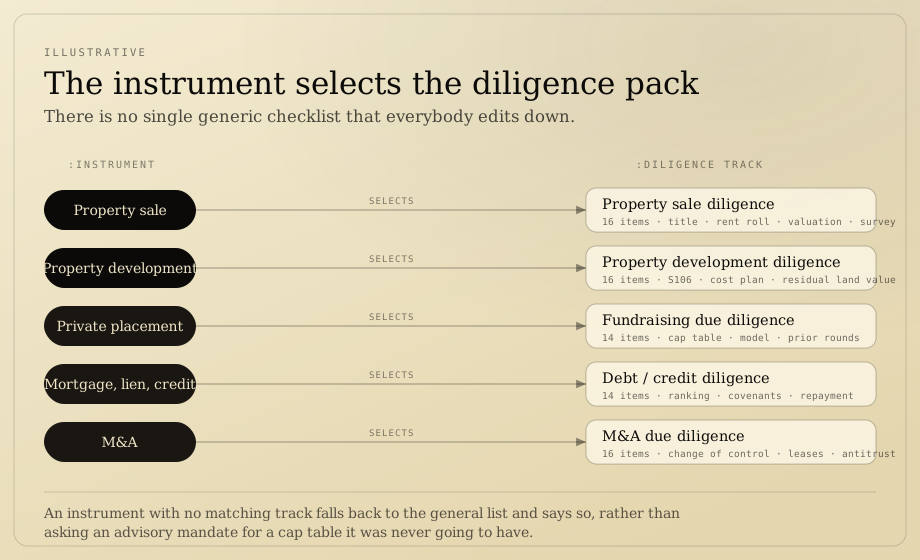
The instrument selects the pack. Illustrative.
Three things follow from having the real list
The offering is graded before it goes to market. Core terms complete. Documents uploaded and approved. The standard document set for that instrument covered. The expected diligence list defined. A reachable data room. Settlement set. The issuing name confirmed. The seller finds out what a buyer will pull at while there is still time to fix it, rather than during the negotiation.
The approach list carries its own reasoning. Every deal produces a ranked list of who to go to, scored against each firm's own mandate on sector, geography, instrument, currency and ticket size. It comes back as three lists rather than one. Who fits, ranked by score and by how engaged they already are. Who was ruled out, each carrying the exact dimension that ruled them out. And who has no mandate on file, which is a different fact from not suiting the deal.
That second list is the one that matters and it is the one most systems hide. A sponsor who cannot see who was excluded cannot tell a working filter from a broken one, and will eventually ignore the list and mail everybody. Which is how a discreet process becomes a broadcast.
Engagement is measured, not asserted. Opens, pages, dwell time, documents opened, whether a reader forwarded it, and which pages people went back to. When a bidder returns four times to the dilapidations schedule, the seller has learned where the price negotiation is going to happen before it happens.
Control, because the pack moves the price
A room belongs to a Member. Everybody else in it is a guest on a ticket issued by that Member. Signing the confidentiality undertaking asks to come in; the Member still decides. It does not make anybody a member of anything, and when the deal dies the ticket ends and the guest leaves.
Per document the seller chooses view only, downloadable through a recorded notice, or restricted to named readers. Every copy is watermarked to its reader. Every open is timestamped. Folders arrange documents and never grant access, so filing a confidential file among teaser material discloses nothing. A rent roll in the wrong inbox moves the price, and control at the room level was never enough.
Signatures are ML-DSA-65 over the document hash, the post-quantum standard published by NIST as FIPS 204, anchored so they can be checked years later by someone with no account and no relationship with the platform. That is built for the dispute, the audit, or the regulator's question long after everyone involved has moved on.
The half that is not software
A room is only as good as the judgement in it, and the judgement does not come out of a repository.
Around the platform sits the desk: market research and comparable deals, so the valuation taken to market is argued against what the market actually did. A review of the pitch itself before it goes out. Data on the investors before the first call. And the outreach, so a ranked list becomes a campaign rather than a spreadsheet somebody works by hand.
The leadership and advisers behind it came out of BlackRock, Fidelity Investments, DTCC, Bear Stearns, JP Morgan Asset Management, Capgemini, EY, Deloitte and Oracle, including a former Senior Vice President at Bear Stearns and a former relationship manager in BlackRock's Official Institutions Group who raised $1.3B from sovereign wealth funds, central banks and pension funds. Knightsbridge Group trades out of New York, London, Hong Kong, Paris, Bangkok, Doha and Palm Beach, and Knightsbridge Law is a Knightsbridge Group company, so counsel sits inside the group rather than being appointed and briefed from the beginning on every transaction.
Those firms are where the people worked. They are not endorsements, partnerships or current engagements.
What is actually new here
Virtual data rooms have existed for twenty years and most of them are filing cabinets with permissions. What is different is that the room understands the instrument, grades the offering before the market sees it, reasons about who should be approached and says why others should not, and measures what readers did rather than what a pipeline field claims.
On top of that sits the KXCO Ontology Round Table, which is an export of the room rather than a second product. Every viewer, document, question, link and forward is already a typed node in a model, so the export is promotion rather than construction. The upgrade puts the firm's consultants and their knowledge into that same model alongside the machine, so the knowledge outlives the transaction instead of dying when the room closes.
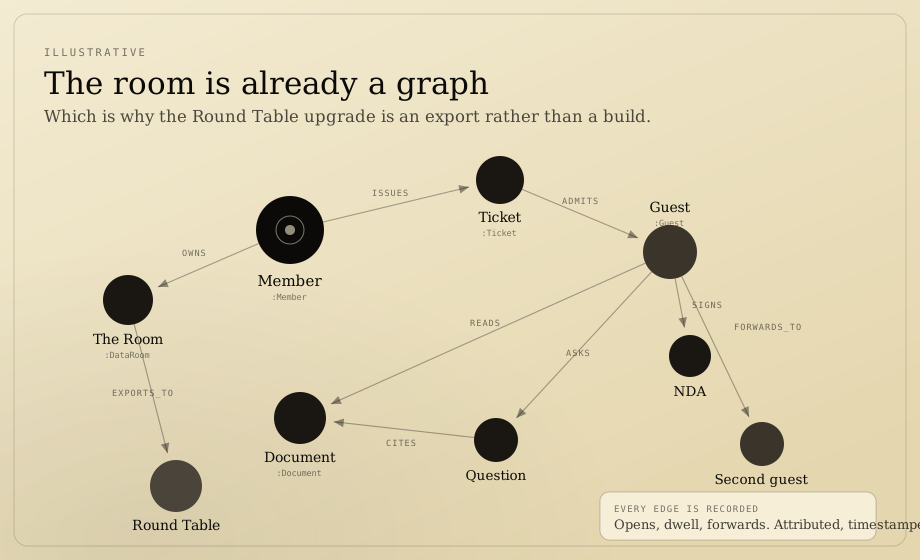
Every viewer, document, question and forward is already a node. Illustrative.
Admission is by application and it is not automatic. Counterparties never apply; they are ticketed in for one deal.
KXCO is a technology provider. It is not a broker-dealer, an investment adviser or a fiduciary, it does not solicit or recommend investments, and it never holds the asset: settlement goes to the client's own custodian or wallet. Nothing described here is an offer or a solicitation.
Details are at kxco.ai/meridian and applications at kxco.ai/meridian/apply.
Shayne Heffernan, Ph.D., is the founder of Live Trading News, the KnightsBridge Group, Knightsbridge Law and the KXCO.ai ecosystem spanning post-quantum cryptography, identity, attestation and enterprise ontology.

KXCO's New Names, Explained
Sentinel became Portcullis, Treasury became Sovereign and Meridian became Guildhall when KXCO brought its products into one family of seven, the House, on 9 October 2026. This guide explains what each name means and where it comes from, maps every former name to the product or module it became, shows how the seven connect, and lists what did not change: the addresses redirect, the packages and the chain keep their names.

Tokenized Assets for Wall Street
Regulators now ask whether the ledger is the register, who holds each unit, and whether a transfer is checked before it clears. KXCO answers all three in software: a register that settles on a chain whose validators attest every block with ML-DSA-87, holders admitted by the licensed institution under its own KYC with the Travel Rule in the wallet, and the offering's rule applied before a unit moves. The close is a market to sell into.

What KXCO Is, and Why the Hard Problem Was Never Intelligence
The prevailing enthusiasm assumes the hard problem is intelligence. It is not. It is that banks, hospitals, courts and governments are being asked to let software act on their behalf with no way to establish who decided, on what basis, or whether the record will still read in a decade. KXCO founder Shayne Heffernan sets out the architecture that answers those questions, drawn as a graph, and argues that properly constructed AI is an amplifier of human judgement rather than a replacement for it.
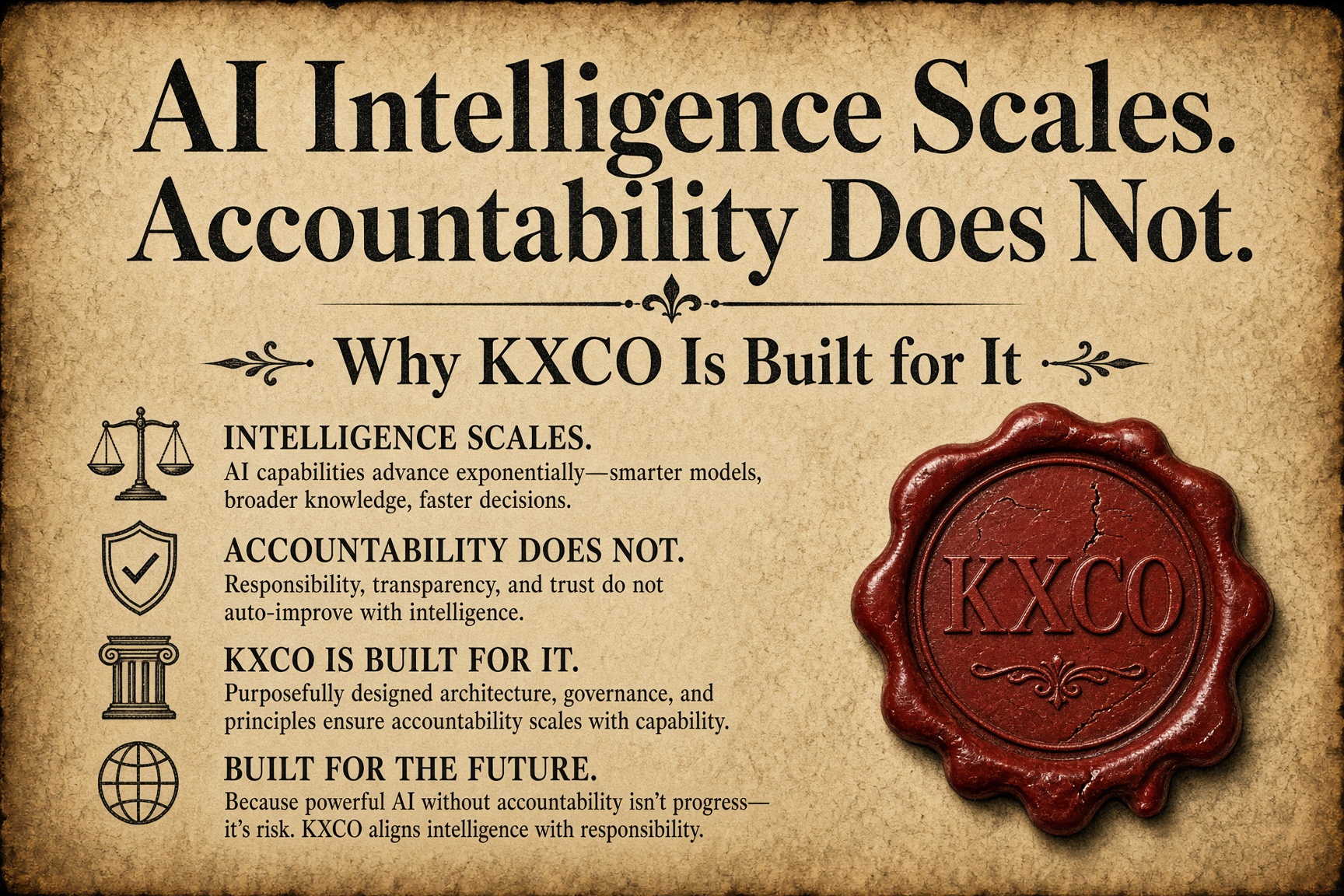
AI Intelligence Scales. Accountability Does Not. Why KXCO Is Built for It.
Capability is becoming abundant and everything abundant gets cheap. What does not get cheap is the person who has to sign, and they can only carry what they can see. Four conditions follow from that, and four independent authorities reached the first of them last month without knowing it.
Every story, signed and delivered.
Subscribe to the kxco channel and get the headline, the AI-written key takeaways, and the chain-anchor link the moment we publish. Audio versions and per-ticker subscriptions arrive in the next iteration.