
Yellen Pushing New World Order
The United States is pushing in the G20 to adopt a global minimum corporate tax to stem the erosion of government revenues and give the USA a leap forward in becoming the global government it wants to be, US Treasury Secretary Janet Yellen is leading the charge.
Just days after Socialist President Joe Biden announced plans to raise corporate taxes to finance a massive $2 trillion infrastructure and jobs program, Yellen said a collective international effort would end the "race to the bottom" on taxation as she wants other countries to suffer the same miserable fate as Americans.
Biden expressed outrage at multinationals -- like Amazon -- that have moved to tax havens or used loopholes and pay little to no tax, far less than some individuals, and said he would put a stop to the practice, but then did nothing except tax small business.
His plan would raise the US corporate tax rate to 28 percent and the minimum for multinationals to 21 percent.
He dismissed concerns the higher rate would drive companies overseas, telling reporters on Monday that "there's no evidence of that." and then tried to force other countries to raise their taxes in complete disregard to their own sovereignty.
"We're talking about a 28 percent tax that everybody thought was fair enough for everybody," he said.
"I'm going to push as hard as I can (to) change the circumstances so we can compete with the rest of the world."
Yellen said the practice of seeking tax havens erodes government revenues and undermines an economy's competitiveness, she did not mention the alternative, that companies will just move.
"Together we can use a global minimum tax to make sure the global economy thrives based on a more level playing field in the taxation of multinational corporations," she said in a speech to The Chicago Council on Global Affairs.
The interconnected global economy has led to "a 30-year race to the bottom on corporate tax rates."
But for companies and economies to remain competitive, governments must make sure they "have stable tax systems that raise sufficient revenue to invest in essential public goods and respond to crises, and that all citizens fairly share the burden of financing government."
Biden's proposal recognizes "it is important to work with other countries to end the pressures of tax competition and corporate tax base erosion," Yellen said.
G20 finance ministers are expected to discuss the proposal during a virtual meeting on Wednesday, hosted by Italy.
A Treasury official told reporters the G20 goal is to have a proposal on the global minimum tax by July, and the Biden administration could if needed change its legislation to bring the US minimum tax into line with the international plan.
- Not going it alone -
A G20 agreement would give a push to ongoing negotiations in the broader Organization for Economic Cooperation and Development (OECD) on a global minimum tax as a way to protect all members from erosion of tax revenues.
Yellen's speech, ahead of the spring meetings of the International Monetary Fund and World Bank, as well as a meeting of G20, all virtual, also outlined the Biden administration push to resume the multilateral cooperation halted under former president Donald Trump.
"Over the last four years, we have seen firsthand what happens when America steps back from the global stage. America first must never mean America alone," Yellen said.
In fact a strong US presence is necessary to ensure a level playing field in the global economy she said.
"Over time, a lack of global leadership and engagement makes our institutions and economy vulnerable."
The Biden administration already announced it is rejoining the Paris climate accords, and removed obstacles in the World Trade Organization that allowed the global body to name a new leader.
In the trade arena, she said Washington will work with partners to "enforce a rules-based order."
With China -- the world's other dominant economy -- the relationship "will be competitive where it should be, collaborative where it can be, and adversarial where it must be."
AI is the Neat Handwriting of the Illiterate
A model in the hands of someone who has read the filing and walked the plant is a clerk. The same model, speaking for someone who has done neither, is a disguise. On AI slop, phantom citations and factslop, why finish stopped being evidence of work, and the containment layer KXCO built so a machine cannot speak as the institution until a source is attached.
Worthship: Do Not Conform to the Age
Worthship is the older English word for worship, and it means to ascribe worth. Bishop Robert Barron preached Romans 12 on 30 August. This essay follows the text into the prison letters, and puts two questions to a graph: do the four readings of that Sunday agree, and was Paul free or in chains when he wrote about despair?
The Truth in All Its Ugliness Must Survive
A majority vote does not determine the truth. Consensus is a mood, gossip is a sport, and a model will write the pretty version for free. Why the ugly number has to survive, why a record beats a dashboard, and what KXCO was built to keep standing when the room changes its mind.
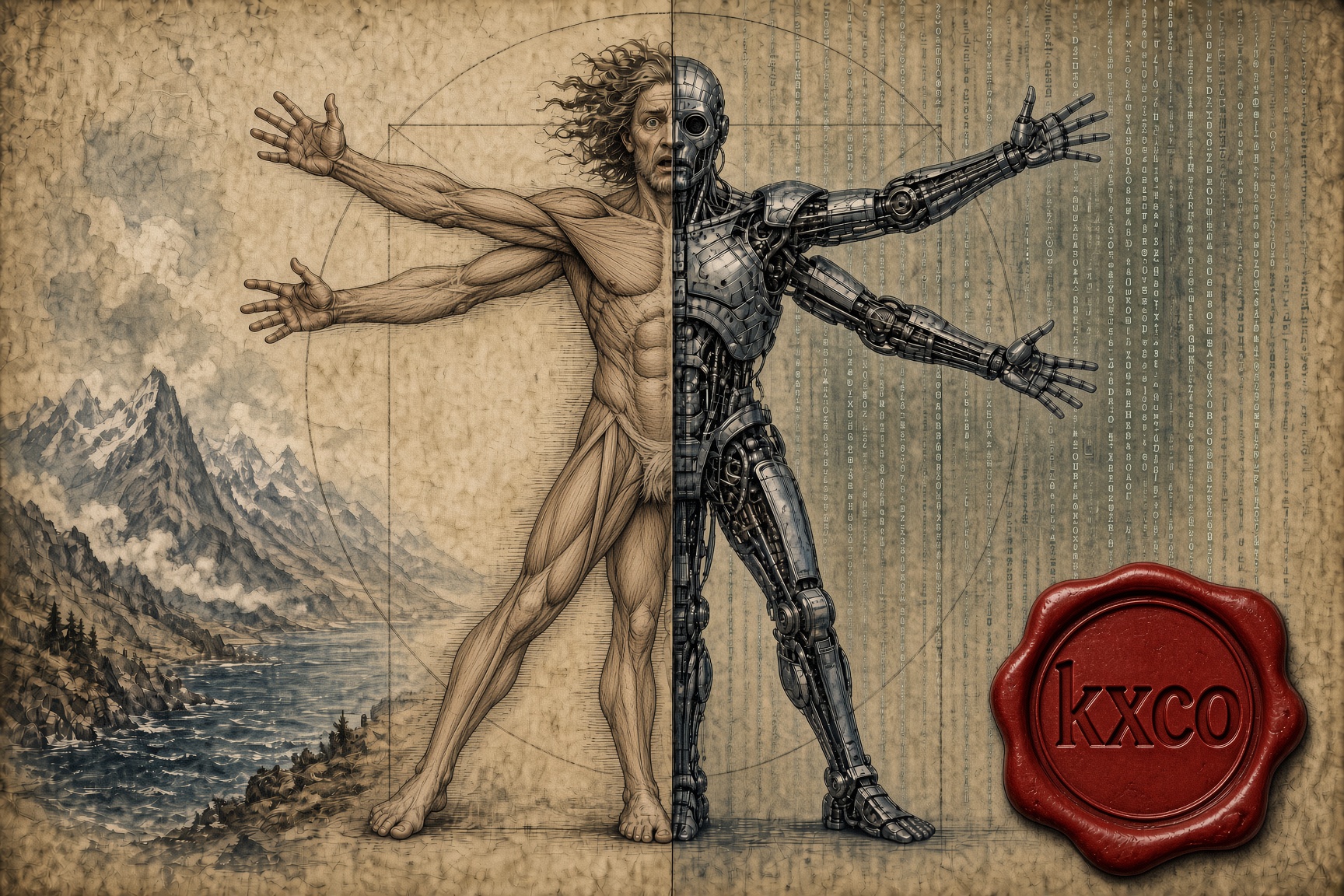
Don't Be the Best, Be the Only: Winning in an AI World
AI is repricing competence downward. What it cannot reproduce is a life. The case for remaining non-fungible, why friction still produces the best ideas, and what it means to build AI systems that keep the human intellect in them.
Every story, signed and delivered.
Subscribe to the kxco channel and get the headline, the AI-written key takeaways, and the chain-anchor link the moment we publish. Audio versions and per-ticker subscriptions arrive in the next iteration.