
Workplace Assault on Privacy
People returning to work following the long pandemic will find an array of tech-infused gadgetry to improve workplace safety but which could pose risks for long-term personal and medical privacy.
Temperature checks, distance monitors, digital "passports," wellness surveys and robotic cleaning and disinfection systems are being deployed in many workplaces seeking to reopen.
Tech giants and startups are offering solutions which include computer vision detection of vital signs to wearables which can offer early indications of the onset of Covid-19 and apps that keep track of health metrics.
Salesforce and IBM have partnered on a "digital health pass" to let people share their vaccination and health status on their smartphone.
Clear, a tech startup known for airport screening, has created its own health pass which is being used by organizations such as the National Hockey League and MGM Resorts.
Fitbit, the wearable tech maker recently acquired by Google, has its own "Ready for Work" program that includes daily check-ins using data from its devices.
Fitbit is equipping some 1,000 NASA employees with wearables as part of a pilot program which requires a daily log-in using various health metrics which will be tracked by the space agency.
Microsoft and insurance giant United HealthCare have deployed a ProtectWell app which includes a daily symptom screener, and Amazon has deployed a "distance assistant" in its warehouses to help employees maintain safe distances.
And a large coalition of technology firms and health organizations are working on a digital vaccination certificate, which can be used on smartphones to show evidence of inoculation for Covid-19.
- 'Blurs the lines' -
With these systems, employees may face screenings even as they enter a building lobby, and monitoring in elevators, hallways and throughout the workplace.
The monitoring "blurs the line between people's workplace and personal lives," said Darrell West, a Brookings Institution vice president with the think tank's Center for Technology Innovation.
"It erodes longstanding medical privacy protections for many different workers."
A report last year by the consumer activist group Public Citizen identified at least 50 apps and technologies released during the pandemic "marketed as workplace surveillance tools to combat Covid-19."
The report said some systems go so far as identifying people who may not spend enough time in front of a sink to note inadequate hand-washing.
"The invasion of privacy that workers face is alarming, especially considering that the effectiveness of these technologies in mitigating the spread of Covid-19 has not yet been established," the report said.
The group said there should be clear rules on collection and storage of data, with better disclosure to employees.
- A delicate balance -
Employers face a delicate balance as they try to ensure workplace safety without intruding on privacy, said Forrest Briscoe, professor of management and organization at Penn State University.
Briscoe said there are legitimate reasons and precedents for requiring proof of vaccination. But these sometimes conflict with medical privacy regulations which limit a company's access to employee health data.
"You don't want the employer accessing that information for work-related decisions," Briscoe said.
Biscoe said many employers are relying on third-party tech vendors to handle the monitoring, but that has its risks as well.
"Using third-party vendors will keep the data separate," he said.
"But for some companies their business model involves gathering data and using it for some monetizable purpose and that poses a risk to privacy."
The global health crisis has inspired startups around the world to seek innovative ways to limit virus transmission, with some of those products shown at the 2021 Consumer Electronics Show.
Taiwan-based FaceHeart demonstrated software which can be installed in cameras for contactless measurement of vital signs to screen for shortness of breath, high fever, dehydration, elevated heart rate and other symptoms which are early indicators of Covid-19.
Drone maker Draganfly showcased camera technology which can be used to offer alerts on social distancing, and also detect changes in people's vital signs which may be early indicators of Covid-19 infection.
A programmable robot from Misty Robotics, also shown at CES, can be adapted as a health check monitor and can also be designed to disinfect frequently used surfaces like door handles, according to the company.
But there are risks in relying too much on technologies which may be unproven or inaccurate, such as trying to detect fevers with thermal cameras among moving people, said Jay Stanley, a privacy researcher and analyst with the American Civil Liberties Union.
"Employers have a legitimate interest in safeguarding workplaces and keeping employees healthy in the context of the pandemic," Stanley said.
"But what I would worry about is employers using the pandemic to pluck and store information in a systematic way beyond what is necessary to protect health."
AI is the Neat Handwriting of the Illiterate
A model in the hands of someone who has read the filing and walked the plant is a clerk. The same model, speaking for someone who has done neither, is a disguise. On AI slop, phantom citations and factslop, why finish stopped being evidence of work, and the containment layer KXCO built so a machine cannot speak as the institution until a source is attached.
Worthship: Do Not Conform to the Age
Worthship is the older English word for worship, and it means to ascribe worth. Bishop Robert Barron preached Romans 12 on 30 August. This essay follows the text into the prison letters, and puts two questions to a graph: do the four readings of that Sunday agree, and was Paul free or in chains when he wrote about despair?
The Truth in All Its Ugliness Must Survive
A majority vote does not determine the truth. Consensus is a mood, gossip is a sport, and a model will write the pretty version for free. Why the ugly number has to survive, why a record beats a dashboard, and what KXCO was built to keep standing when the room changes its mind.
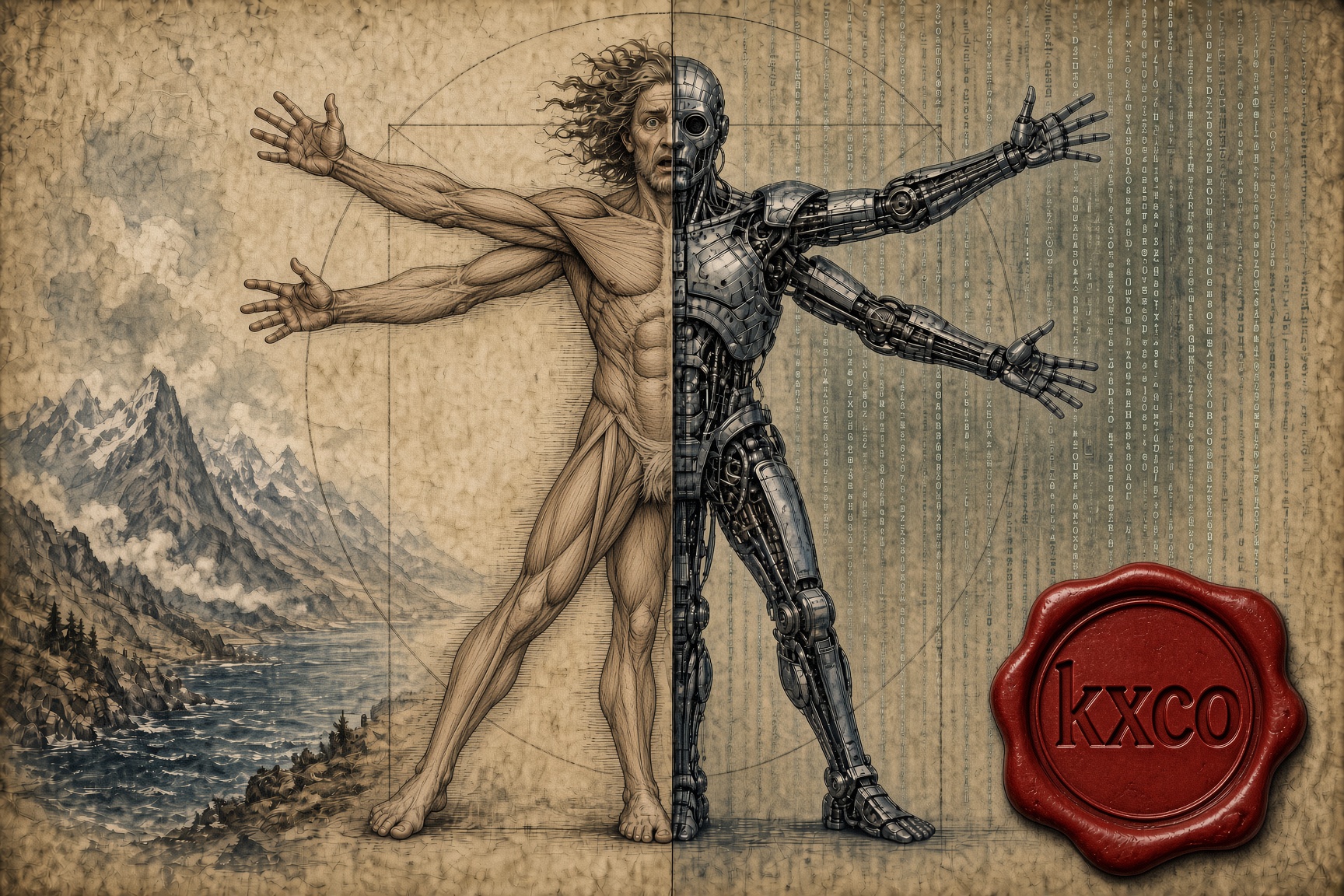
Don't Be the Best, Be the Only: Winning in an AI World
AI is repricing competence downward. What it cannot reproduce is a life. The case for remaining non-fungible, why friction still produces the best ideas, and what it means to build AI systems that keep the human intellect in them.
Every story, signed and delivered.
Subscribe to the kxco channel and get the headline, the AI-written key takeaways, and the chain-anchor link the moment we publish. Audio versions and per-ticker subscriptions arrive in the next iteration.