
Using Neuroscience to Deliver Better Business Results
Neuroscience is the study of the brain and nervous system. It is a complex and rapidly evolving field, but it has the potential to revolutionize the way we understand and interact with the world around us.
In recent years, there has been growing interest in the use of neuroscience in business. This is because neuroscience can help us to understand how people make decisions, how they learn, and how they respond to marketing messages.
There are a number of ways that neuroscience can be used to deliver better business results. Here are a few examples:
Neuromarketing: Neuromarketing is the use of neuroscience to understand how people respond to marketing messages. This can be done by measuring brain activity, eye movements, and facial expressions. Neuromarketing can help businesses to create more effective marketing campaigns that are more likely to persuade people to buy their products or services.
Neuroleadership: Neuroleadership is the use of neuroscience to understand how people make decisions and how they respond to leadership styles. This can be done by measuring brain activity, heart rate, and other physiological measures. Neuroleadership can help businesses to create more effective leadership strategies that are more likely to motivate and inspire employees.
Neuroergonomics: Neuroergonomics is the use of neuroscience to design products and environments that are more user-friendly and efficient. This can be done by measuring brain activity, eye movements, and other physiological measures. Neuroergonomics can help businesses to create products and environments that are more likely to be used and enjoyed by people.
The use of neuroscience in business is still in its early stages, but it has the potential to revolutionize the way we understand and interact with customers, employees, and products. As the field of neuroscience continues to evolve, we can expect to see even more innovative and effective ways to use neuroscience to deliver better business results.
"Neuroscience can help us to understand how our brains make decisions, and this knowledge can be used to improve our trading strategies. For example, we can learn to identify the patterns of brain activity that are associated with good and bad trading decisions."
Here are some of the challenges of using neuroscience in business:
Cost: Neuroscientific research can be expensive. This is because it requires specialized equipment and expertise.
Lack of data: There is still a limited amount of data available on how neuroscience can be used in business. This makes it difficult to design and implement effective neuroscientific interventions.
Ethical concerns: Some people have raised ethical concerns about the use of neuroscience in business. For example, some people worry that businesses could use neuroscience to manipulate people or to invade their privacy.
Despite these challenges, the use of neuroscience in business is a promising area of research. As the field of neuroscience continues to evolve, we can expect to see even more innovative and effective ways to use neuroscience to deliver better business results.

AI is the Neat Handwriting of the Illiterate
A model in the hands of someone who has read the filing and walked the plant is a clerk. The same model, speaking for someone who has done neither, is a disguise. On AI slop, phantom citations and factslop, why finish stopped being evidence of work, and the containment layer KXCO built so a machine cannot speak as the institution until a source is attached.

Worthship: Do Not Conform to the Age
Worthship is the older English word for worship, and it means to ascribe worth. Bishop Robert Barron preached Romans 12 on 30 August. This essay follows the text into the prison letters, and puts two questions to a graph: do the four readings of that Sunday agree, and was Paul free or in chains when he wrote about despair?
The Truth in All Its Ugliness Must Survive
A majority vote does not determine the truth. Consensus is a mood, gossip is a sport, and a model will write the pretty version for free. Why the ugly number has to survive, why a record beats a dashboard, and what KXCO was built to keep standing when the room changes its mind.
Don't Be the Best, Be the Only: Winning in an AI World
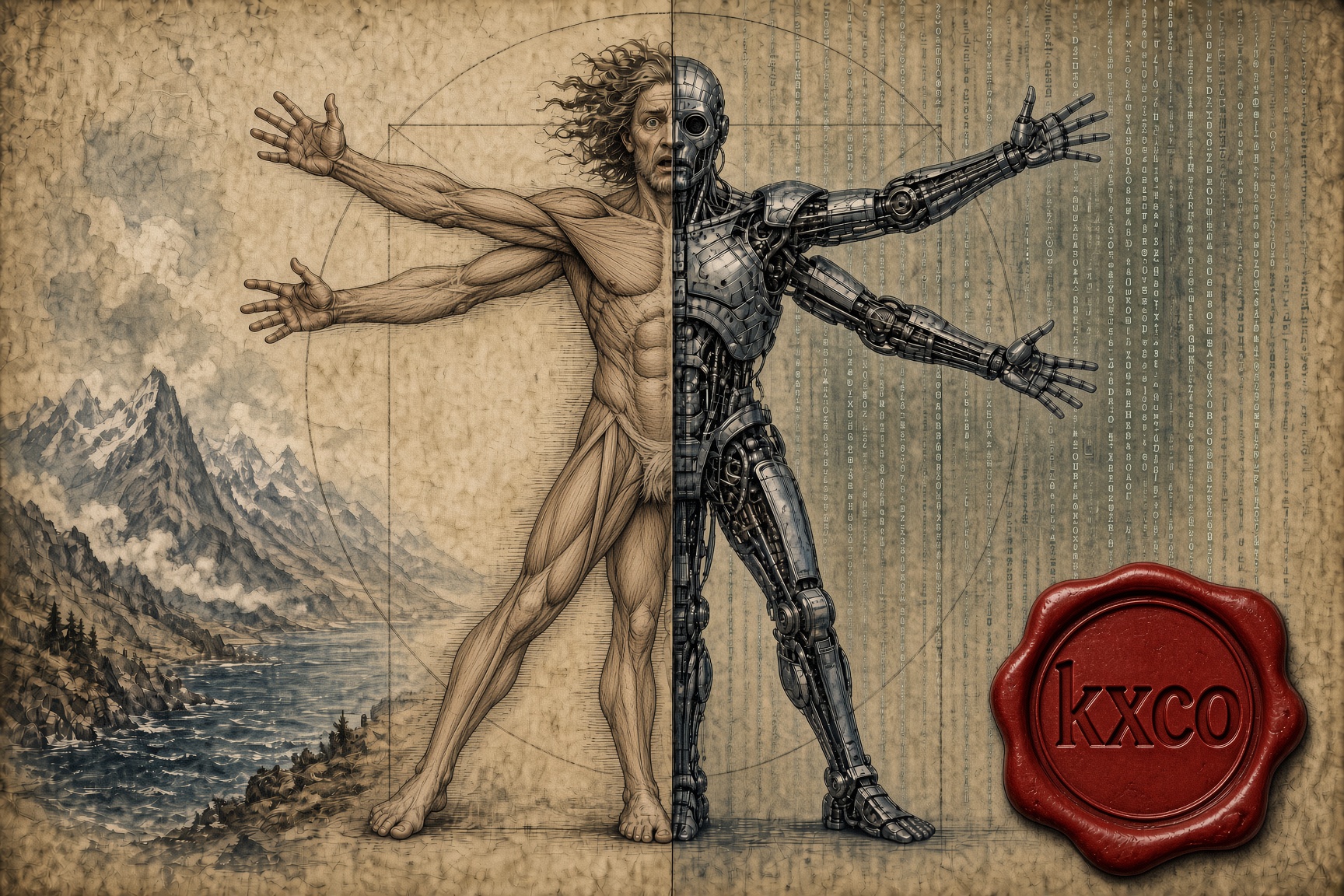
AI is repricing competence downward. What it cannot reproduce is a life. The case for remaining non-fungible, why friction still produces the best ideas, and what it means to build AI systems that keep the human intellect in them.
Every story, signed and delivered.
Subscribe to the kxco channel and get the headline, the AI-written key takeaways, and the chain-anchor link the moment we publish. Audio versions and per-ticker subscriptions arrive in the next iteration.