
Trump Tariffs: Buy The Dip $SPY $BTC $TSLA $QQQ $NVDA
By Shayne Heffernan
April 3, 2025
President Donald Trump’s latest tariffs, announced on April 2, 2025, have sent shockwaves through global markets, and I’ve been watching this unfold with a mix of surprise and curiosity. These aren’t just tariffs—they’re a full-on reset of global trade, a move that’s been brewing for years but still caught many off guard. Trump’s calling it “Liberation Day,” and while the world’s reeling, I think there’s a case to be made that this could be the shake-up global trade needs. Let’s dig into what these tariffs are, why they’re a reset, what it means for the world economy, and why Knightsbridge says now’s the time to buy the dip.
What’s Happening with Trump’s Tariffs?
Trump’s new tariffs are a beast of their own. He’s slapped a 10% baseline tariff on imports from all countries, with steeper rates for nations with big trade surpluses with the U.S. China’s getting hit with a 34% tariff, the European Union 20%, Japan 24%, India 26%, and Vietnam a whopping 46%, according to the White House announcement. This comes on top of earlier tariffs, like the 25% on steel and aluminum and a 20% hike on Chinese goods since January. Canada and Mexico got a temporary pass under the USMCA trade pact, but they’re still feeling the heat from earlier levies.
The idea behind these “reciprocal tariffs” is simple: if a country charges the U.S. a certain tariff rate, the U.S. will match it. Trump’s been vocal about this for years, arguing that the U.S. has been on the losing end of trade deals for decades. He’s pointed to examples like Europe’s high tariffs on American cars or India’s levies on motorcycles, saying it’s unfair when the U.S. charges less in return. But this isn’t just about matching rates—Trump’s team is also factoring in things like non-tariff barriers and taxes, which makes the calculations murky. Economists are scratching their heads over how these rates were set, and some, like Eswar Prasad from Cornell University, are calling it a move to “blow up the system governing international trade.”
A Global Trade Reset
I’ve been around markets long enough to know that trade hasn’t been fair for a while. The U.S. has played the free trade game since World War II, keeping tariffs low to promote open markets, while other countries have thrown up walls—high tariffs, subsidies, you name it. The EU’s value-added taxes (VATs) act like hidden tariffs, and China’s trade barriers are a maze of restrictions. Trump’s tariffs are a hard reset, a way to force everyone to play by the same rules. If you want to sell in the U.S., you’d better let U.S. goods into your market on equal terms. It’s a blunt approach, but it’s hard to argue it’s not addressing a real problem.
The global reaction has been a mix of anger and action. China’s commerce ministry called the tariffs “self-defeating bullying” and vowed countermeasures, while the EU’s Ursula von der Leyen warned of “dire consequences for millions.” Canada’s Mark Carney and Mexico’s Claudia Sheinbaum are promising retaliation, and even allies like Australia’s Anthony Albanese are calling the tariffs illogical. Markets are in a tailspin—the S&P 500 dropped over 4% on April 3, with similar declines in Asia and Europe, as reported by The New York Times. But here’s the thing: this chaos might be the point. Trump’s not just trying to fix trade imbalances; he’s rewriting the rules of global trade, whether the world likes it or not.
For decades, the U.S. has been the backbone of a global trade system built on cooperation, as The New York Times noted, making the dollar the world’s go-to currency and America a hub for investment. Trump’s tariffs risk throwing that out the window, replacing it with a system where the strongest player sets the terms. It’s a gamble, but it’s also a response to a system that hasn’t been working for everyone. Developing countries have long complained about Western trade dominance, and the U.S. has lost jobs to places like China. These tariffs are a way to level the playing field, even if it’s messy.
The Fallout and the Opportunity
The immediate fallout is rough. Economists are warning of higher prices for U.S. consumers—think avocados, cars, even tech gadgets. High Frequency Economics estimated a $741 billion hit to U.S. household incomes or corporate profits, and the Tax Foundation predicts a 0.2% drop in long-run GDP from the 25% tariffs on Canada and Mexico alone. Global markets are spooked, with the S&P 500, Nikkei, and Stoxx Europe 600 all taking big hits. Some industries are scrambling—Stellantis shut down a factory in Ontario for two weeks because of the tariffs, according to Unifor Local 444.
But there’s another side to this. Trump’s first-term tariffs showed they can work. A 2024 study cited by the White House found that his Section 232 and 301 tariffs on $300 billion of imports reduced imports from China and boosted U.S. manufacturing. Steel companies like Nucor and US Steel invested billions in new projects, doubling their annual investments from $1.5 billion to $4.2 billion between 2017 and 2019, as per the study. This time around, the tariffs are already pushing countries to negotiate—India’s cutting tariffs on U.S. motorcycles, and the EU’s talking about lowering car tariffs, as Bernd Lange told the Financial Times.
Here’s where I think the markets are getting it wrong: the panic is overblown. Stocks like Tesla, Nvidia, and Alibaba are down—Tesla’s been sliding since December, and Nvidia’s been a rollercoaster, as Motley Fool noted in February. Metals like steel and aluminum have seen dips amid the volatility, and gold’s been choppy as investors hedge against inflation fears. But don’t fall for it. The tariffs will change, the markets will rally, and Knightsbridge says now’s the time to buy the dip. Steel and aluminum will benefit as U.S. production ramps up—Kevin Dempsey from the American Iron and Steel Institute called the tariffs a win for domestic industry. Tesla and Nvidia are oversold; Trump’s support for Tesla is clear (he showcased their cars at the White House in March), and Nvidia’s AI chip dominance isn’t going anywhere. Alibaba could rebound if China negotiates, and gold will shine as inflation fears grow—the Fed’s already upped its inflation forecasts, per NBC News.
The Long Game
Trump’s tariffs are a long game, and they’re resetting global trade in a way we didn’t see coming. They’re forcing a level playing field, something the world has wanted for years, even if the transition’s messy. There’ll be volatility—prices might rise, and markets will swing—but the endgame is a fairer system. For investors, this is a chance to buy the dips in metals, Tesla, Nvidia, Alibaba, and gold. Knightsbridge is clear: hold through the turbulence, and you’ll come out ahead. That’s how you play this new trade landscape—stay sharp, stay patient, and grab the opportunities when they show up.
AI is the Neat Handwriting of the Illiterate
A model in the hands of someone who has read the filing and walked the plant is a clerk. The same model, speaking for someone who has done neither, is a disguise. On AI slop, phantom citations and factslop, why finish stopped being evidence of work, and the containment layer KXCO built so a machine cannot speak as the institution until a source is attached.
Worthship: Do Not Conform to the Age
Worthship is the older English word for worship, and it means to ascribe worth. Bishop Robert Barron preached Romans 12 on 30 August. This essay follows the text into the prison letters, and puts two questions to a graph: do the four readings of that Sunday agree, and was Paul free or in chains when he wrote about despair?
The Truth in All Its Ugliness Must Survive
A majority vote does not determine the truth. Consensus is a mood, gossip is a sport, and a model will write the pretty version for free. Why the ugly number has to survive, why a record beats a dashboard, and what KXCO was built to keep standing when the room changes its mind.
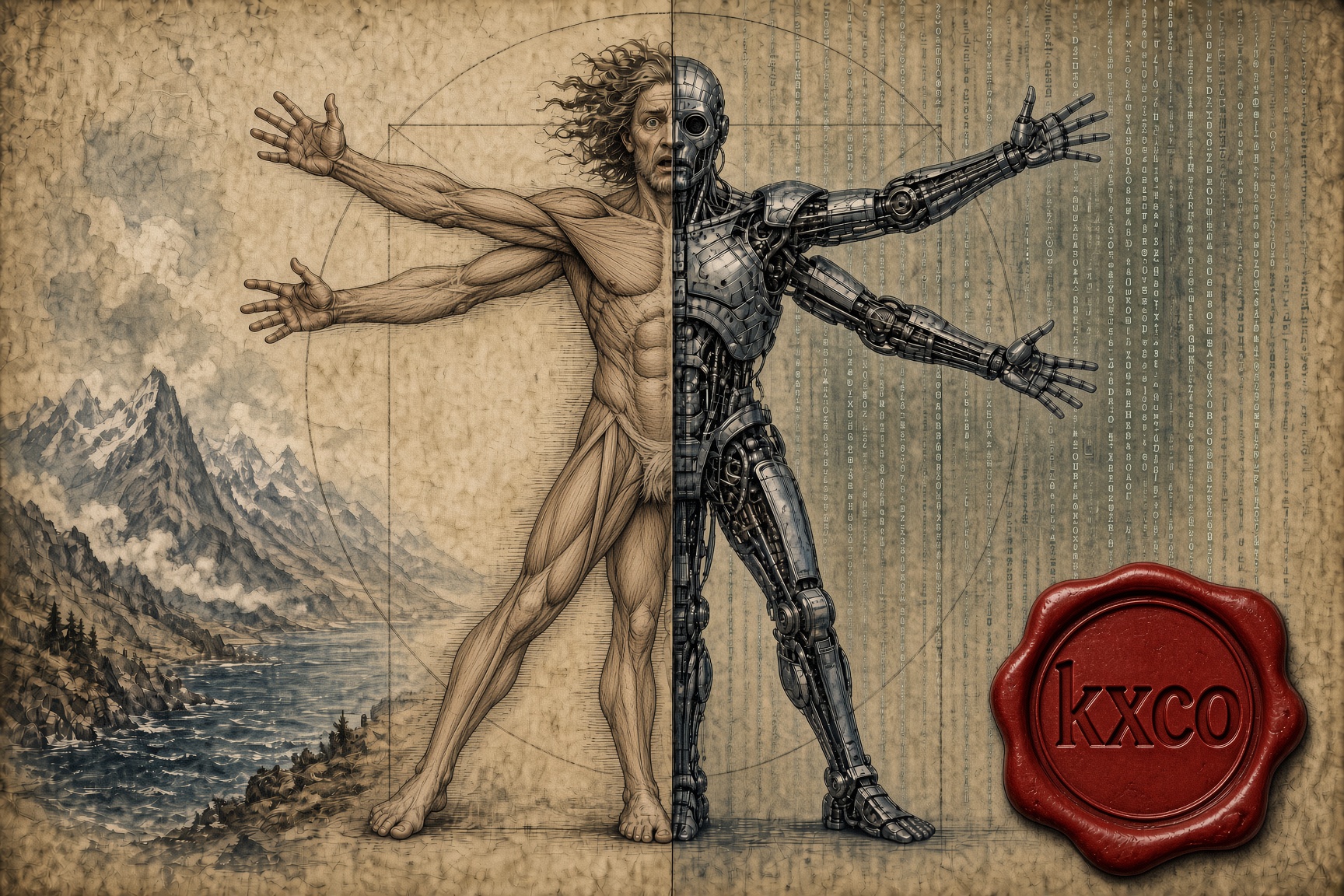
Don't Be the Best, Be the Only: Winning in an AI World
AI is repricing competence downward. What it cannot reproduce is a life. The case for remaining non-fungible, why friction still produces the best ideas, and what it means to build AI systems that keep the human intellect in them.
Every story, signed and delivered.
Subscribe to the kxco channel and get the headline, the AI-written key takeaways, and the chain-anchor link the moment we publish. Audio versions and per-ticker subscriptions arrive in the next iteration.