
Tokenised Equity Has Rules Now, and Every Rule Tests the Share Register
The SEC's Innovation Exemption of 17 September and the Nasdaq approval ask one thing of a tokenised share: the same rights as the share itself. That is a question about the register, and the register is what KXCO builds.
Part of theStocks Center
The token was the easy part
In June, Binance Wallet, Bybit and Bitget Wallet cancelled their SpaceX pre-IPO token offerings and refunded their customers. CoinDesk reported on 13 June that they had failed "to secure shares through xStocks". Its standfirst put it plainly: "The problem wasn't technology, but getting the actual stock."
That is the subject of this note in one sentence. Minting a token is the routine part. A token is worth what the share register says it is worth, and the register belongs to the issuer.
In 2026 the SEC and the market's own infrastructure wrote that down. The Round Table read the four texts published this year against each other. Two of them set the same test in so many words, and the other two describe the plumbing it runs on. Anyone planning to tokenise equity now has that test in writing.
4 texts, 1 test
28 January. Staff of three SEC divisions published a Statement on Tokenized Securities. It sorts tokenised securities into two categories: those tokenised by or for the issuer, and those tokenised by third parties. It splits the second into custodial and synthetic models. In the issuer's case, the issuer "integrates DLT into the systems that it uses to record owners of the security". The effect is that "a transfer of the crypto asset on the crypto network results in a transfer of the security on the master securityholder file".
18 March. The SEC approved Nasdaq's rule change to trade securities in tokenised form. A tokenised share trades "on the same order book as, and with the same execution priority as, its traditional counterpart". It qualifies only if it is "fungible with, shares the same CUSIP number with and trading symbol, and affords its shareholders the same rights and privileges". A DTC participant asks for settlement in token form by "selecting a flag that the Exchange designates for this purpose". The first eligible names are "securities in the Russell 1000 Index at the time the service launches", plus ETFs that track major indices.
15 July. DTCC processed tokenised trades in production, including an "equity token transfer". It counted "More than 30 firms representing a cross-section of traditional financial institutions" and digital market participants. It said the event "sets the stage for the DTCC Tokenization Service to launch in October 2026".
17 September. The SEC issued Release No. 34-106402, the Innovation Exemption. It lets Tokenized Securities Venues, or TSVs, run permissioned on-chain trading in listed stocks from 17 September 2026 to 17 September 2031.
The fourth text is the one that changes a plan. Exhibit 1 shows how it treats each of the three models the staff statement describes.
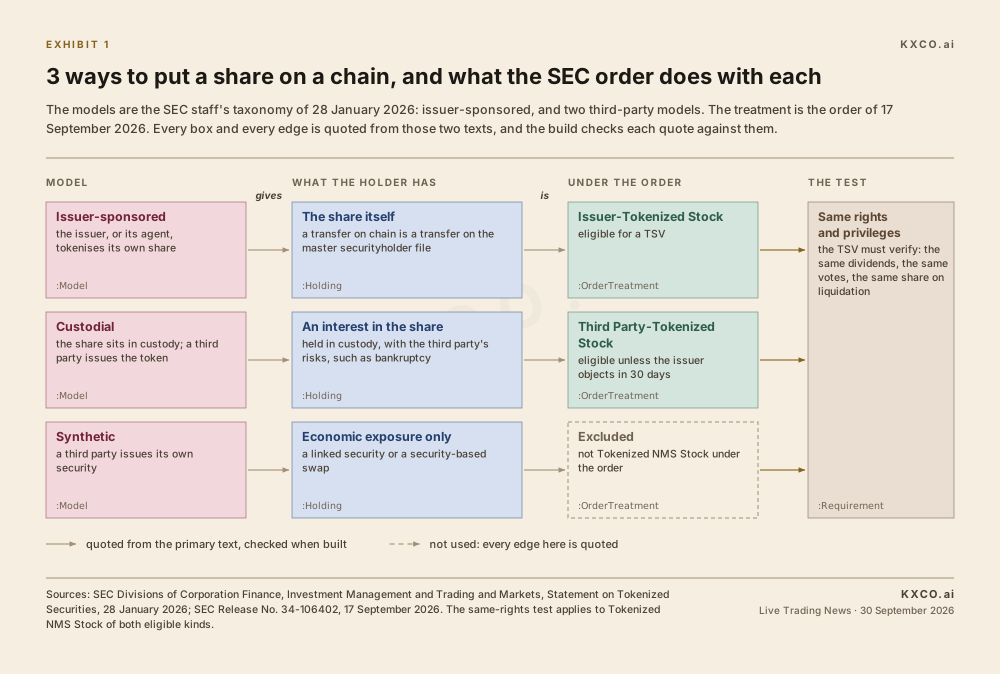
Exhibit 1. Every box and edge is quoted from the SEC staff statement of 28 January 2026 or the order of 17 September 2026, and the figure fails to build if a quote is not in its text.
What the order asks for
The order covers a share tokenised "by, or on behalf of, the issuer", and a share tokenised by an unaffiliated third party. It leaves out a third party's own security that "provides synthetic exposure to an underlying security".
The issuer holds the veto on the second kind. Trading "may not commence until at least 30 calendar days from the date when the issuer receives the Issuer Notice". If the issuer objects "on or prior to the 30th calendar day following receipt of the Issuer Notice", then "the TSV cannot make such Tokenized NMS Stock available for trading on the TSV".
Then the test itself: "A TSV must verify that the Tokenized NMS Stock made available for trading on the TSV provides holders the same rights and privileges as does traditional NMS stock of an equivalent class." The order names the rights:
"a right to receive the same dividends that the company issues to holders of the underlying NMS stock"
"a right to exercise the same voting rights that holders of the underlying NMS stock may exercise"
"a right to receive the same share of the residual assets of the company upon liquidation"
Read as an engineer reads a spec, each right is a query against a register. Who held the share on the record date. Which holder casts the vote. What each holder is owed on a winding-up. The token answers none of them.
Two more conditions point the same way:
Only permissioned participants trade: "a TSV sets standards to allow only permissioned TSV Participants to access trading". The order's own example of enforcing that is a pool open only to "wallet addresses that meet certain credentialing requirements". A TSV must also keep records of "the methods used to verify or screen TSV Participants and verify the wallet addresses associated with each TSV Participant".
"No primary issuance or initial offerings of securities are permitted on a TSV under the TSV Exemption." Issuance stays in the issuer's own process, on the issuer's own record.
The staff statement names the join that record has to hold. On chain sit the "wallet address, quantity of security owned, and issue date". Off chain sit the "security holder name and address". Tokenising a share means keeping those two halves as one register.
Where the market stands on 30 September
RWA.xyz counts 7,691 tokenised stocks with a distributed value of $3.14 billion across 4.04 million holding addresses, as of 30 September 2026.
DTC, the depository whose assets DTCC's service tokenises, provided custody for securities "valued at U.S. $114 trillion" in 2025, per DTCC.
Measured against the pipe that is due to open in October, the market has barely started. Issuers and exchanges are not waiting for the venues:
Bullish, $BLSH (NYSE), became, in its own words, the first NYSE-listed company to fully tokenise its own equity cap table, on 5 May, on Solana. "The launch is administered by Equiniti (EQ), Bullish's SEC-registered transfer agent", the release says.
Securitize, $SECZ (NYSE), put its own stock on Solana and Avalanche on its first day of trading, 2 July, and the token "represents the same common shares that now trade on the NYSE", per CoinDesk.
Intercontinental Exchange, $ICE (NYSE), the parent of the NYSE, partnered with Securitize this year to develop infrastructure for tokenised equities, per the same CoinDesk report.
The issuers moving now have chosen the issuer-sponsored model. It is the model that puts the most weight on the issuer's own records.
A share outlives its key
An ordinary share has no maturity date. The signature schemes behind Ethereum and Solana have a proposed end date, in a NIST draft.
Ethereum uses ECDSA, which its glossary calls "A cryptographic algorithm used by Ethereum to ensure that funds can only be spent by their owners", per ethereum.org.
A Solana address is "either an Ed25519 public key or a PDA", per the Solana documentation.
NIST's draft transition plan, IR 8547, lists both families under "Quantum-vulnerable digital signature algorithms", with EdDSA at 128 bits of security strength marked "Disallowed after 2035".
The order points the same way. Its notice rules say "the following information must be in the Notice", and the list includes "any cryptographic protocols employed to verify transactions on the distributed ledger" and risks such as "loss of private keys, compromised wallets". A register entry signed today has to verify for as long as the share exists. The order puts a TSV's smart contracts on "a public, permissionless distributed ledger", so the token trades on whichever public chain the venue picks. The register behind it, and the signature on every entry, should not depend on that chain's key scheme.
Why KXCO is the place to do it
KXCO started from the record, not the token, and the record is what every text above tests. The Round Table maps it in four parts, each running in production today.
The register. KXCO runs "effective-dated capital tables, allocations that reconcile exactly or refuse", per its published architecture of 19 August. Effective-dated means the register reads as at any date, which is what a record date is.
The credential. In KXCO's identity layer, "Credential issuance is live, with hierarchical ML-DSA-65 credentials issued under a dedicated institution key held on the operating host". The order leaves the bar to the venue. A credential is how a holder shows it cleared that bar, signed by the institution that checked. The design rule is that "there is no code path from an unverified party to a held position".
The rights at a date. The same machinery runs "capital calls split as at the call date, value-dated payments, waterfall distributions". In KXCO Meridian, "Capital calls, distributions, cap table entries and valuations then run off the same record". A dividend on a record date is the same calculation.
The proof. KXCO signs with ML-DSA-65, the NIST FIPS 204 standard. On Armature L1, KXCO's settlement network, "Selective on-chain attestation is live, opt-in per organisation and per event type", and the chain "runs as a permissioned QBFT chain with named validators and post-quantum signing from genesis".
Round Table, the KXCO ontology, keeps facts as claims. On kxco.ai/ontology: "Every edge carries its own source, basis, confidence and the date it was true". A TSV that has to "verify" rights needs exactly that, and so does the examiner who later asks how it verified them.
The proof was checked on chain for this note. On 30 September the desk signed an example register entry with ML-DSA-65 and sent it to Armature's precompile at 0x0b on chain ID 1111111, and the chain returned 1. The same entry with one quantity changed returned 0. Armature's public node reports itself as Besu, the client DTCC named in July as "Besu (DTCC's private network)", and the chain produced a block every 2 seconds across the 1,000 blocks to 30 September 2026. The signature also verifies off chain with the public key alone, so the proof goes wherever the token goes. Inside KXCO's own platform, verification runs "off chain in the relay with on-chain anchoring", per its published architecture. Address 0x0b is the check anyone can run for themselves against the public RPC.
A stack assembled from vendors has to carry provenance across every boundary between them: the cap-table tool, the identity check, the wallet provider and the chain. KXCO holds the register, the credential, the rights and the proof as one system, so there is no boundary for the provenance to die at. Exhibit 2 maps each requirement to the record it needs and to where KXCO keeps it.
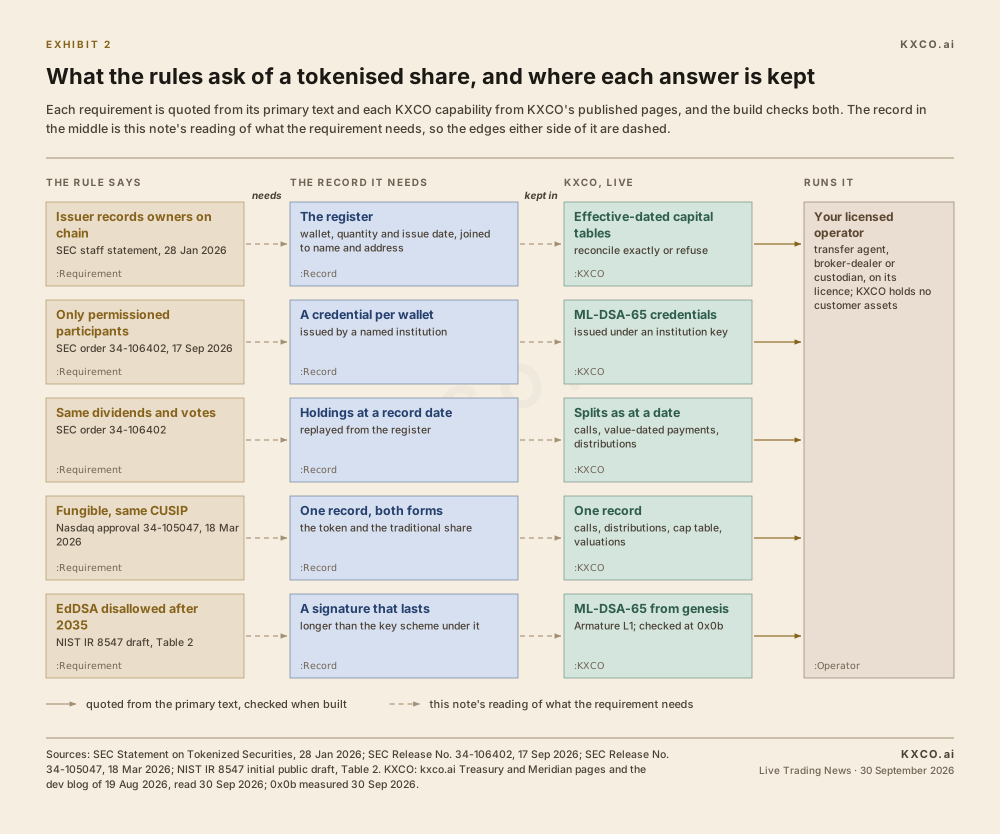
Exhibit 2. Requirements are quoted from their primary texts and KXCO capabilities from KXCO's published pages, and both are checked when the figure is built. The middle column is this note's reading of what each requirement needs.
The listing path to a tokenised-asset exchange
A tokenised register is where a listing starts. The route to a tokenised-asset exchange depends on where the issuer starts, and every route asks the issuer for the same record. Exhibit 3 draws the five routes as they stand on 30 September 2026.
A private company in the US. tZERO offers "institutional-grade solutions for issuers looking to digitize their capital table through blockchain technology, and make such equity available for trading on an alternative trading system". On 31 August it agreed with ICE its "role as a premier design partner" for ICE's "upcoming NYSE-affiliated tokenized securities platform".
A listed company in the US. A TSV lists nobody, because "No primary issuance or initial offerings of securities are permitted on a TSV under the TSV Exemption". The share has to be NMS stock first, which means a listing on a national exchange. Outside the S&P 500 and Russell 1000 it trades as Tier 2, which "cannot exceed 250 symbols traded and 2.5 percent of the average daily share volume", per the order. No TSV can trade until 30 days after it publishes its notice.
A company in the EU. 21X is "The BaFin-licensed venue" under the DLT Pilot Regime, per Ledger Insights on 8 September 2025. On its own site, 21X says it runs "asset tokenization, issuance and distribution, through to listing and trading, all on a single platform", read 30 September 2026. The regime is built for smaller issuers: "Article 3 of DLTR caps equity instruments at a EUR 500 million in market capitalisation", per ESMA.
A company in the UK. The Digital Securities Sandbox counts among its entrants a firm with permission "to operate a multilateral trading facility (MTF) and is an investment firm". For FTSE 350 shares a firm "will need to demonstrate how they will reflect corporate action events (such as share buybacks) in the tokenised securities holdings". On 1 September the London Stock Exchange announced plans "to launch UK tokenised equity structures", with settlement at LSEG's Digital Securities Depository "subject to regulatory approval".
A company in Singapore. ADDX says "ADDX is a Recognised Market Operator (RMO) and Capital Markets Services (CMS) Licensee". It runs "checks on the legitimacy of issuers in accordance with our Listing Rules" and reviews "the consistency and sufficiency of disclosures provided by issuers", for accredited and institutional investors.
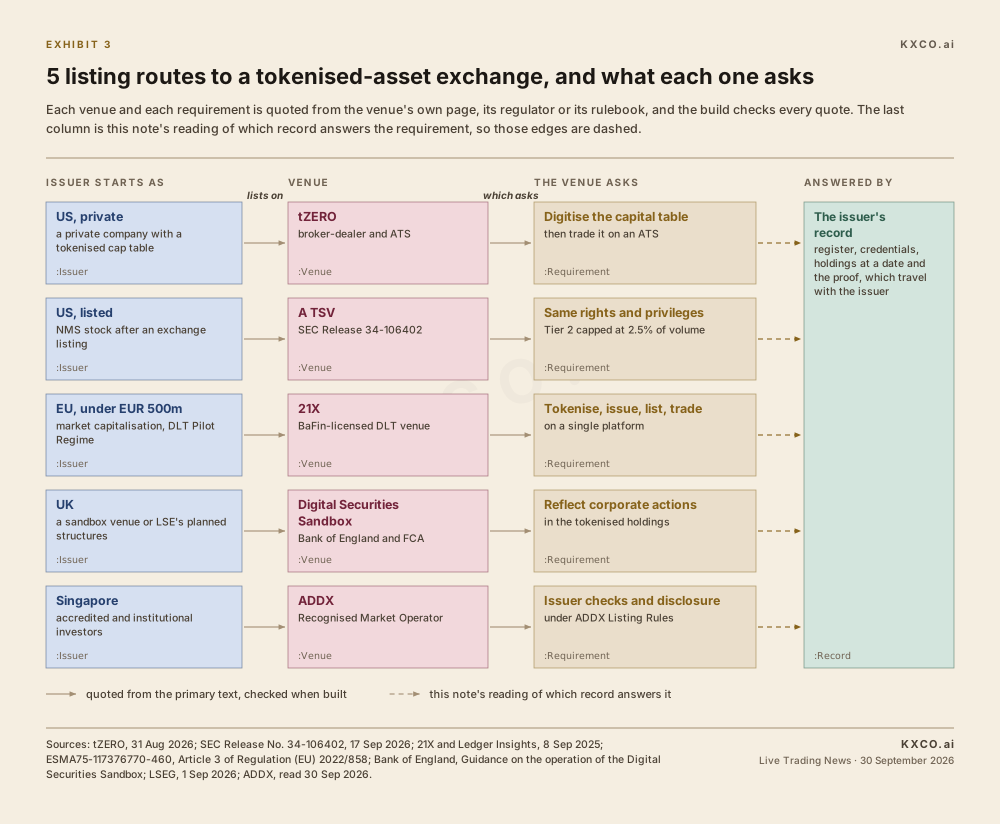
Exhibit 3. Each venue and each requirement is quoted from its own page or rulebook, and the figure fails to build if a quote is not in its text. The last column is this note's reading of which record answers it.
Read side by side, the five venues ask one question in five forms: is this register the issuer's, are these holders eligible, and do corporate actions reach them. Those are the records in the section above. Knightsbridge advises issuers on the route. The register, the credentials and the proof travel with the issuer, because the record belongs to the issuer and not to the venue.
Who runs it, and who it is for
KXCO is a software company. It holds no financial licence, and "KXCO never takes custody of customer assets or funds". KXCO is not a TSV and does not run one. It keeps the record that a TSV, a transfer agent or an issuer checks against. The licensed institution operates: a transfer agent, broker-dealer or custodian, on its own licence. KXCO Treasury's services are co-branded, white-labelled or deployed "under your own name". Knightsbridge Law sits on the Round Table.
That split is what lets one system serve four kinds of customer:
A private company, fund or vehicle that wants its cap table tokenised in a closed environment of known holders, with the register, the credentials and the distributions on one record.
A listed issuer preparing for DTCC's October service or answering a TSV's notice, which needs its own register to be the one every token is checked against.
A transfer agent or broker-dealer that wants the register, the credential and the proof under its own name.
A venue building toward a TSV notice, which has to show how it screens wallets and verifies rights before it trades a share.
An issuer choosing its listing route, from an ATS in the US to 21X in the EU or ADDX in Singapore, per Exhibit 3, which needs its record ready for the venue's admission file.
Write to [email protected], or start at kxco.ai/contact. The companion developer note on this desk shows each check in code, run against the live chain.
What to watch
DTCC's Tokenization Service is due to launch in October 2026. Under the order, "at least 30 calendar days before operating, a TSV must publish a copy of a notice". Those notices will be the first public record of which venues intend to trade, which stocks and on which chains.
Sources
SEC Divisions of Corporation Finance, Investment Management and Trading and Markets, Statement on Tokenized Securities, 28 January 2026. SEC Release No. 34-105047, order approving SR-NASDAQ-2025-072, 18 March 2026. SEC Release No. 34-106402, Innovation Exemption for Tokenized NMS Stock, 17 September 2026.
DTCC press release, 15 July 2026. RWA.xyz tokenised stocks dashboard, read 30 September 2026. Bullish press release, 5 May 2026. CoinDesk, 13 June and 2 July 2026. ethereum.org and Solana documentation, read 30 September 2026. NIST IR 8547 initial public draft, Table 2.
KXCO: kxco.ai/ontology, kxco.ai/meridian and kxco.ai/treasury, and the developer blog of 19 August 2026, read 30 September 2026. Armature L1 measured by this desk at https://chain.kxco.ai/rpc on 30 September 2026: client, chain ID, block interval and precompile 0x0b.
Stocks mentioned: $BLSH (NYSE), $SECZ (NYSE), $ICE (NYSE) and $NDAQ (NASDAQ).
Shayne Heffernan, Ph.D., is the founder of Live Trading News, the KnightsBridge Group, Knightsbridge Law and the KXCO.ai ecosystem spanning post-quantum cryptography, identity, attestation and enterprise ontology.
This note is commentary. It is not legal or investment advice. Rules are as published by each authority on the day of writing; read the primary text before you plan against one.
Tokenising a Share in Code: the Register Entry, the Credential and 4 Checks
The SEC has said what a tokenised share's record must hold: wallet, quantity and issue date on chain, the holder's name off chain, permissioned participants, and the same dividends as the share. This developer note builds it in JavaScript: an ML-DSA-65 signed register entry, a stranger's check, the same check at Armature's 0x0b precompile, a credential gate and an exact dividend at a record date.
The 2030 Post-Quantum Deadline in Code: 6 Changes and the Test for Each
A stock Node.js client already negotiates X25519MLKEM768, so TLS 1.3 took the first post-quantum step on its own. Nothing the application owns has moved. This developer note reads Executive Order 14412 and OMB M-26-15 as six changes: ML-KEM key establishment, ML-DSA signatures, a one-import move to Category 5, PQC-signed JWS at the gateway, re-encryption of long-lived data and a CycloneDX CBOM from the lockfile. Every block was run against the published packages.

AI Development: The Token Got Cheaper, the Building Did Not
The useful fact on 28 September is a split, not a benchmark. Gartner puts 2026 AI spending at $2.67 trillion, and 56 percent of it is infrastructure against about 1 percent on the models. Inside one week the frontier cut the price of a token in half, Nvidia signed for the shelf the open weights sit on, and three closed labs proposed to run the test. What shipped, what it costs and where the money goes, with the AI sector checked against KXCO Ontology Live.
The FDA Calendar to April 2027: 5 Biotech Stocks From the KXCO Biotech Ontology
The KXCO Biotech Ontology's board carries 12 pending FDA filings, due between 10 October 2026 and 23 April 2027. Ranked on approval standing, the top five are BridgeBio's BBP-418, Cogent's bezuclastinib, Belite Bio's tinlarebant, Novo Nordisk's CagriSema and BioMarin's vosoritide. Ranked on consensus upside, they are Cullinan, Savara, Intellia, Mineralys and Pharvaris. No name is on both lists. This report covers BridgeBio, Cogent, Mineralys, Pharvaris and Savara.
Every story, signed and delivered.
Subscribe to the kxco channel and get the headline, the AI-written key takeaways, and the chain-anchor link the moment we publish. Audio versions and per-ticker subscriptions arrive in the next iteration.