
The Perils of Money Printing
In recent years, the world has witnessed an unprecedented surge in money printing by central banks worldwide. This massive expansion of the monetary supply has raised concerns about its potential impact on inflation. To shed light on this complex issue, we turn to Knightsbridge International, a leading global investment firm with a deep understanding of macroeconomic trends.
The Role of Money Printing
Central banks, such as the Federal Reserve in the United States, play a crucial role in managing the economy by controlling the money supply. When an economy slows down, central banks can inject new money into the system by purchasing assets, such as government bonds, from banks and other institutions. This process, known as quantitative easing (QE), is intended to stimulate economic activity by lowering interest rates and encouraging borrowing.
While QE can be an effective tool to combat economic downturns, it also carries potential risks. One of the most significant concerns is that it can lead to inflation, which is the general increase in prices for goods and services over time.
Inflation: A Double-Edged Sword
Inflation can have both positive and negative effects on an economy. On the positive side, moderate inflation can encourage spending and investment, which can boost economic growth. However, if inflation becomes too high, it can erode purchasing power, make saving difficult, and destabilize the economy.
The Inflationary Impact of Money Printing
According to Knightsbridge International, the massive increase in money printing in recent years has contributed to the current inflationary surge. The firm explains that when more money is chasing after a finite supply of goods and services, prices tend to rise. This is a basic principle of economics known as the quantity theory of money.
How Money Printing Can Make Bitcoin More Attractive
One of the main reasons why Bitcoin is considered a good hedge against inflation is that its supply is limited. There will only ever be 21 million Bitcoin created. This means that, unlike fiat currencies, Bitcoin cannot be printed at will.
As a result, Bitcoin tends to hold its value better than fiat currencies during periods of inflation. In fact, some investors believe that Bitcoin could even appreciate in value during periods of inflation, as investors seek refuge from the declining purchasing power of fiat currencies.
How Aggressive Money Printing Could Lead to a Loss of Confidence in Fiat Currencies
If central banks become too aggressive with money printing, it could lead to hyperinflation, which is a rapid and uncontrolled increase in prices. Hyperinflation can have a devastating impact on an economy, as it can erode purchasing power, make saving impossible, and lead to social unrest.
While hyperinflation is unlikely to happen in developed economies, it is a risk that cannot be ignored. If investors lose confidence in fiat currencies, it could lead to a flight to safe haven assets, such as gold and Bitcoin.
The Economic Expert's Perspective
Knightsbridge International emphasizes that the relationship between money printing and inflation is complex and not always straightforward. The extent to which money printing contributes to inflation depends on various factors, such as the overall economic conditions, the speed at which the money supply is expanding, and the behavior of consumers and businesses.
Despite these complexities, Knightsbridge International maintains that the current inflationary surge is partly attributable to the excessive money printing that has been taking place. The firm warns that if central banks do not carefully manage the money supply, inflation could continue to rise, posing significant risks to the global economy.
Conclusion
The issue of money printing and inflation is a complex and contentious one. While central banks have a responsibility to maintain economic stability, their actions can have unintended consequences, such as fueling inflation. As the world grapples with the current inflationary wave, experts like Knightsbridge International provide valuable insights into the delicate balance between monetary policy and economic outcomes.
AI is the Neat Handwriting of the Illiterate
A model in the hands of someone who has read the filing and walked the plant is a clerk. The same model, speaking for someone who has done neither, is a disguise. On AI slop, phantom citations and factslop, why finish stopped being evidence of work, and the containment layer KXCO built so a machine cannot speak as the institution until a source is attached.
Worthship: Do Not Conform to the Age
Worthship is the older English word for worship, and it means to ascribe worth. Bishop Robert Barron preached Romans 12 on 30 August. This essay follows the text into the prison letters, and puts two questions to a graph: do the four readings of that Sunday agree, and was Paul free or in chains when he wrote about despair?
The Truth in All Its Ugliness Must Survive
A majority vote does not determine the truth. Consensus is a mood, gossip is a sport, and a model will write the pretty version for free. Why the ugly number has to survive, why a record beats a dashboard, and what KXCO was built to keep standing when the room changes its mind.
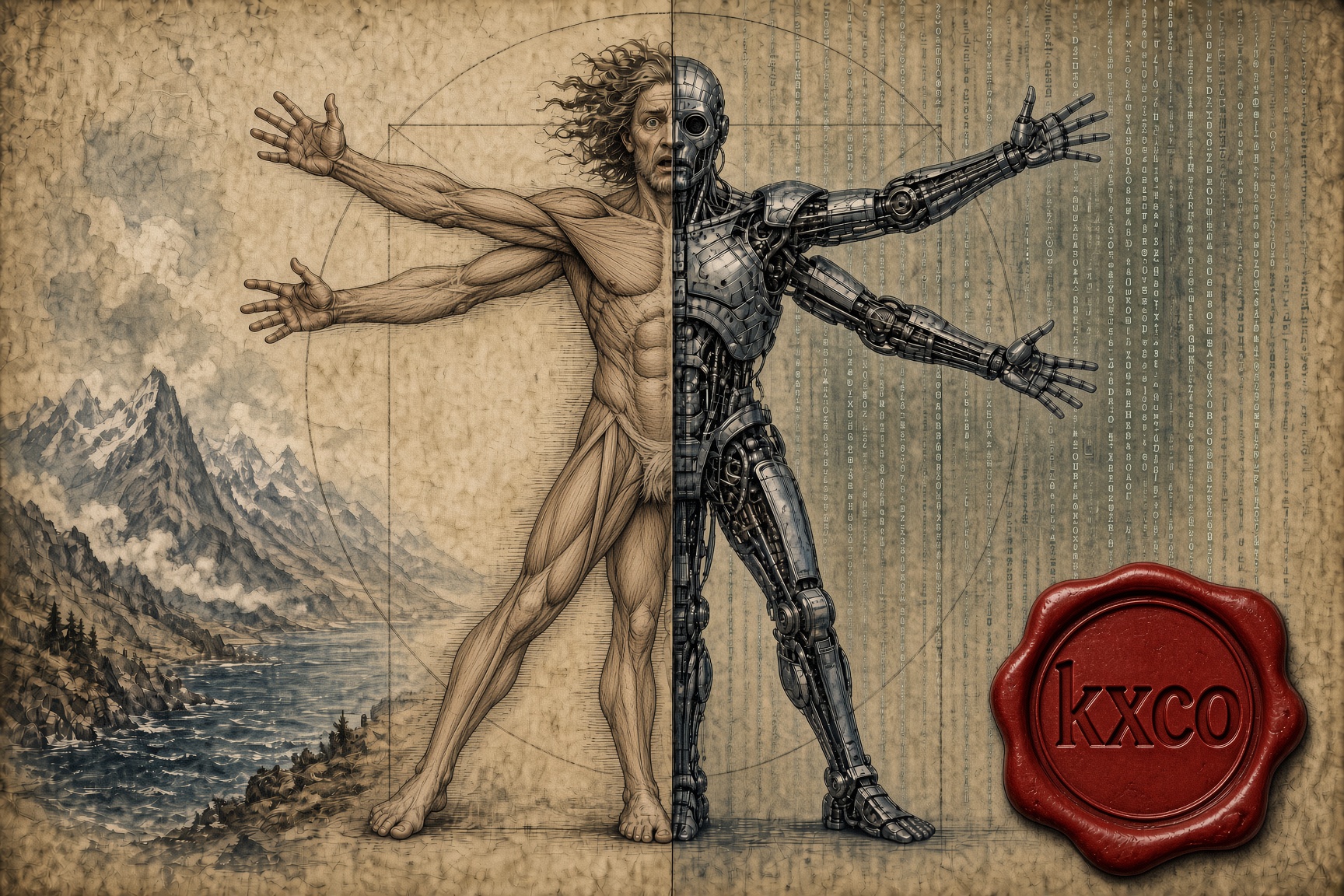
Don't Be the Best, Be the Only: Winning in an AI World
AI is repricing competence downward. What it cannot reproduce is a life. The case for remaining non-fungible, why friction still produces the best ideas, and what it means to build AI systems that keep the human intellect in them.
Every story, signed and delivered.
Subscribe to the kxco channel and get the headline, the AI-written key takeaways, and the chain-anchor link the moment we publish. Audio versions and per-ticker subscriptions arrive in the next iteration.