
The Papal Tiara: A Crown of Earth and Heaven
By Shayne Heffernan, May 6, 2025
The Catholic Church is choosing Pope Francis’ successor after his passing on April 21, 2025, with the conclave starting today. This moment brings to mind a powerful symbol from the Church’s history: the papal tiara. Known as the “crown of earth and heaven,” the tiara reflects the Church’s authority, blending spiritual and temporal power through its design and materials. Here’s a look at its history, its meaning to the Church, and the craftsmanship behind it.

Historical Roots of the Papal Tiara
The papal tiara dates back to the 8th century, starting as a white linen cap called the camelaucum, worn by Popes to show their spiritual role. Under Pope Nicholas I, who reigned from 858 to 867, a single crown was added, marking the Pope’s control over the Papal States—central Italy territories the Church ruled until 1870. Pope Boniface VIII, from 1294 to 1303, added a second crown, showing the Pope’s dual role as spiritual leader and secular ruler. The third crown came during the Avignon Papacy, likely under Pope Benedict XII, who served from 1334 to 1342, symbolizing authority over heaven, earth, and purgatory, though some say it stood for Europe, Asia, and Africa, the known continents then.
Papal coronations often featured the tiara, with Popes like Paul II, reigning from 1464 to 1471, receiving one with sapphires and pearls, weighing over 10 pounds—a heavy reminder of leadership’s burden. Pope Pius IX, who served from 1846 to 1878, got a tiara in 1877 from the Palatine Guard, packed with 18,000 stones, including 2,552 diamonds and 1,064 pearls, but its 8-pound weight made it hard to wear, per Vatican records. The last Pope to use a tiara was Paul VI in 1963, who later donated it to the Basilica of the National Shrine of the Immaculate Conception in Washington, D.C., using the proceeds for the poor. Popes since—John Paul I, John Paul II, Benedict XVI, and Francis—chose simpler inauguration Masses, though Benedict XVI kept the tiara in his coat of arms.
Significance to the Catholic Church
The papal tiara represents the Pope’s threefold authority: as Vicar of Christ, Bishop of Rome, and, in the past, a temporal ruler. The three crowns show this trinity—spiritual leadership, pastoral care, and historical political power over the Papal States. In the Middle Ages, the tiara was a clear sign of the Pope’s sovereignty, matching the crowns of European kings and showing the Church’s broad influence.
The “crown of earth and heaven” name highlights its dual role: earthly power through Church governance, heavenly power through its divine mission. In the 16th century, during Catholic-Ottoman conflicts like the Battle of Lepanto in 1571, the tiara stood for the Church’s unifying role. Pope Pius V, reigning from 1566 to 1572, wore a tiara while rallying Christian forces to victory, preserving Catholic influence in Europe. That history ties into today’s challenges, like building interfaith dialogue in the Middle East, as I’ve noted with a possible papal visit to Saudi Arabia this year.
The tiara also connects to spiritual ideas, like the Prophecy of St. Malachy, which predicts a final Pope, Petrus Romanus, leading through tough times. While the new Pope won’t wear a tiara, its image in papal heraldry keeps its meaning alive, showing the Church’s role in bridging the earthly and divine.
Materials and Craftsmanship of the Tiara
Papal tiaras were made with materials that matched their sacred and royal purpose. Most used silver or gold, often plated to shine brighter. The three crowns, stacked in a cone shape, were set with gems—diamonds, sapphires, emeralds, and rubies—in detailed filigree patterns. The 1877 tiara of Pius IX had 2,552 diamonds, 1,064 pearls, and 540 other gems, weighing over 8 pounds, as Vatican records note. A small cross on top symbolized Christ’s authority, and two lappets—long fabric strips—hung from the back, a holdover from the camelaucum.
Some tiaras used lighter materials to ease the weight. The 1804 tiara for Pope Pius VII, crafted by Roman jeweler Giovanni Battista Palamides, had a papier-mâché core covered with silver and gold leaf, set with smaller gems. The 1922 tiara of Pope Pius XI used velvet and ermine trim inside for comfort, with gold embroidery on the lappets. These pieces took months to make, with skilled jewelers ensuring each tiara fit the Pope’s legacy, balancing beauty with meaning.
A Lasting Symbol
The papal tiara isn’t used in coronations anymore, but its meaning endures. It shows the Church’s past as a global power, from the Papal States to the modern Vatican, and its spiritual mission to guide humanity. For Knightsbridge, my company, the tiara’s balance of earthly and heavenly roles reflects our work in connecting markets through innovation, especially in Asia and the Middle East, where de-dollarization is shifting economic power, as I’ve written about. The tiara’s history of guiding the Church through challenges, like the Ottoman conflicts, offers a lesson as the Church faces a new chapter with the 2025 conclave.
The papal tiara, a crown of earth and heaven, remains a symbol of the Church’s authority, faith, and lasting impact.
Don't Be the Best, Be the Only: Winning in an AI World
AI is repricing competence downward. What it cannot reproduce is a life. The case for remaining non-fungible, why friction still produces the best ideas, and what it means to build AI systems that keep the human intellect in them.
Real World Asset Tokenization: KXCO
Tokenization has two halves. The market perfected the wrapper and left the counterparty unsolved. KXCO built the other half first: one verified door in, a complete ontology so a token knows what it is, transfer checks before clearing, and signatures designed to outlive thirty year assets.

AI Demand in 2026: The Revenue Is Finally Catching Up to the Capex
The Q2 2026 numbers show AI capital spending finally converting into revenue. AWS up 37 percent, Google Cloud up 82 percent, Azure in the low-to-mid 40s and Nvidia data center near $75 billion, with combined hyperscaler capex tracking toward $740 billion and demand still outstripping capacity. Shayne Heffernan on what carries into 2027.
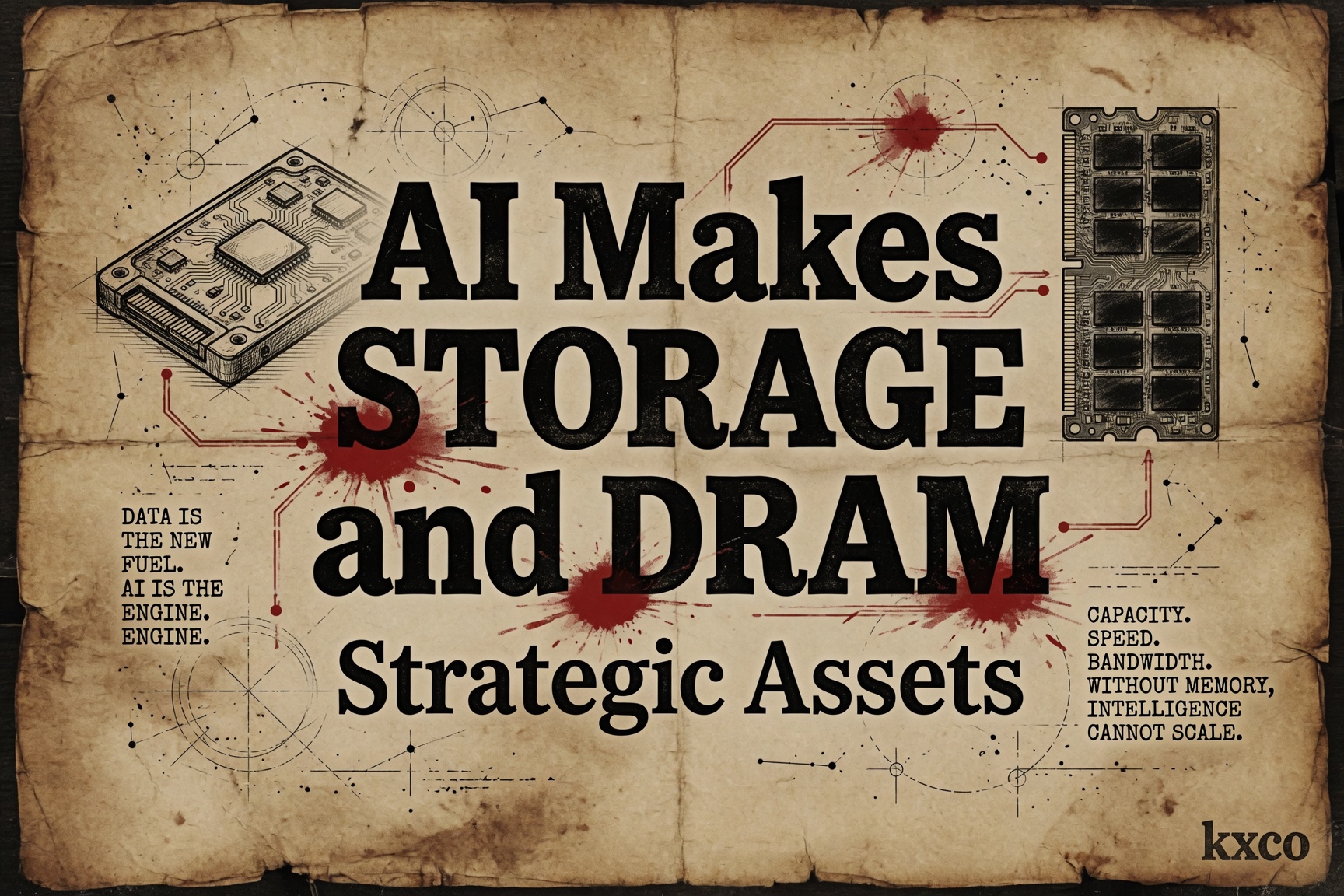
AI Makes Storage and DRAM Strategic Assets
Memory supply is growing about 20% a year while AI demand climbs 200%. Shayne Heffernan on the agentic workload behind the shortage, Micron's real fab timelines, the five listed names carrying the trade, and why quantum computing increases demand for classical memory rather than replacing it.
Every story, signed and delivered.
Subscribe to the kxco channel and get the headline, the AI-written key takeaways, and the chain-anchor link the moment we publish. Audio versions and per-ticker subscriptions arrive in the next iteration.