
The New Multipolar World
China and Russia continue to work for close strategic coordination at international and multilateral levels, advance the process for a multipolar world and democratization in international relations, and uphold the basic norms of international relations, Chinese Foreign Minister Wang Yi said Monday.
Talking on the phone with Russian Foreign Minister Sergei Lavrov, Wang, also a member of the Political Bureau of the Communist Party of China (CPC) Central Committee, said this is the international responsibility for the two countries and is also the integral component of the China-Russia comprehensive strategic partnership of coordination.
Wang underlined that the BRICS mechanism keeps pace with the trend of the times, demonstrating abundant vitality, while over 20 countries have expressed their willingness to join BRICS, making the process of its expansion smooth and imperative.
China is willing to work with Russia and other BRICS partners to support South Africa in hosting the upcoming BRICS Summit and promote the healthy and vigorous development of the BRICS mechanism, he added.
Wang noted that since Chinese President Xi Jinping's visit to Russia in March this year, the strategic coordination and pragmatic cooperation between the two countries have made headway. Bilateral trade volume has reached a new high, energy cooperation has been carried out steadily, and personnel exchanges have swiftly resumed.
It has been proven that China and Russia are trustworthy and reliable good friends and partners, he said, noting that at present, the priority for both sides is to continue to implement the important consensus reached by the two heads of state and promote the high-level development of the China-Russia comprehensive strategic partnership of coordination for a new era.
For his part, Lavrov noted that Russia is willing to work with China to implement the important achievements of President Xi's visit to Russia in March, further strengthen strategic coordination, and deepen pragmatic cooperation for more results in bilateral relations.
Russia is willing to further strengthen communication and coordination with China under the multilateral framework of the United Nations, BRICS and the Shanghai Cooperation Organization, oppose hegemony, resist unilateralism, promote the democratization of international relations, and safeguard international equity and justice, said Lavrov.
The two sides also exchanged views on international and regional issues of common concern, including the Ukraine crisis. Wang emphasized that on any international and multilateral occasion, China will uphold an independent and impartial position, make objective and rational statements, actively promote peace and talks, and strive to seek a political solution to the Ukraine crisis.
Lavrov said Russia highly agrees with the position paper put forward by China on the political settlement of the Ukraine crisis, and appreciates and welcomes China playing a constructive role in this regard.
AI is the Neat Handwriting of the Illiterate
A model in the hands of someone who has read the filing and walked the plant is a clerk. The same model, speaking for someone who has done neither, is a disguise. On AI slop, phantom citations and factslop, why finish stopped being evidence of work, and the containment layer KXCO built so a machine cannot speak as the institution until a source is attached.
Worthship: Do Not Conform to the Age
Worthship is the older English word for worship, and it means to ascribe worth. Bishop Robert Barron preached Romans 12 on 30 August. This essay follows the text into the prison letters, and puts two questions to a graph: do the four readings of that Sunday agree, and was Paul free or in chains when he wrote about despair?
The Truth in All Its Ugliness Must Survive
A majority vote does not determine the truth. Consensus is a mood, gossip is a sport, and a model will write the pretty version for free. Why the ugly number has to survive, why a record beats a dashboard, and what KXCO was built to keep standing when the room changes its mind.
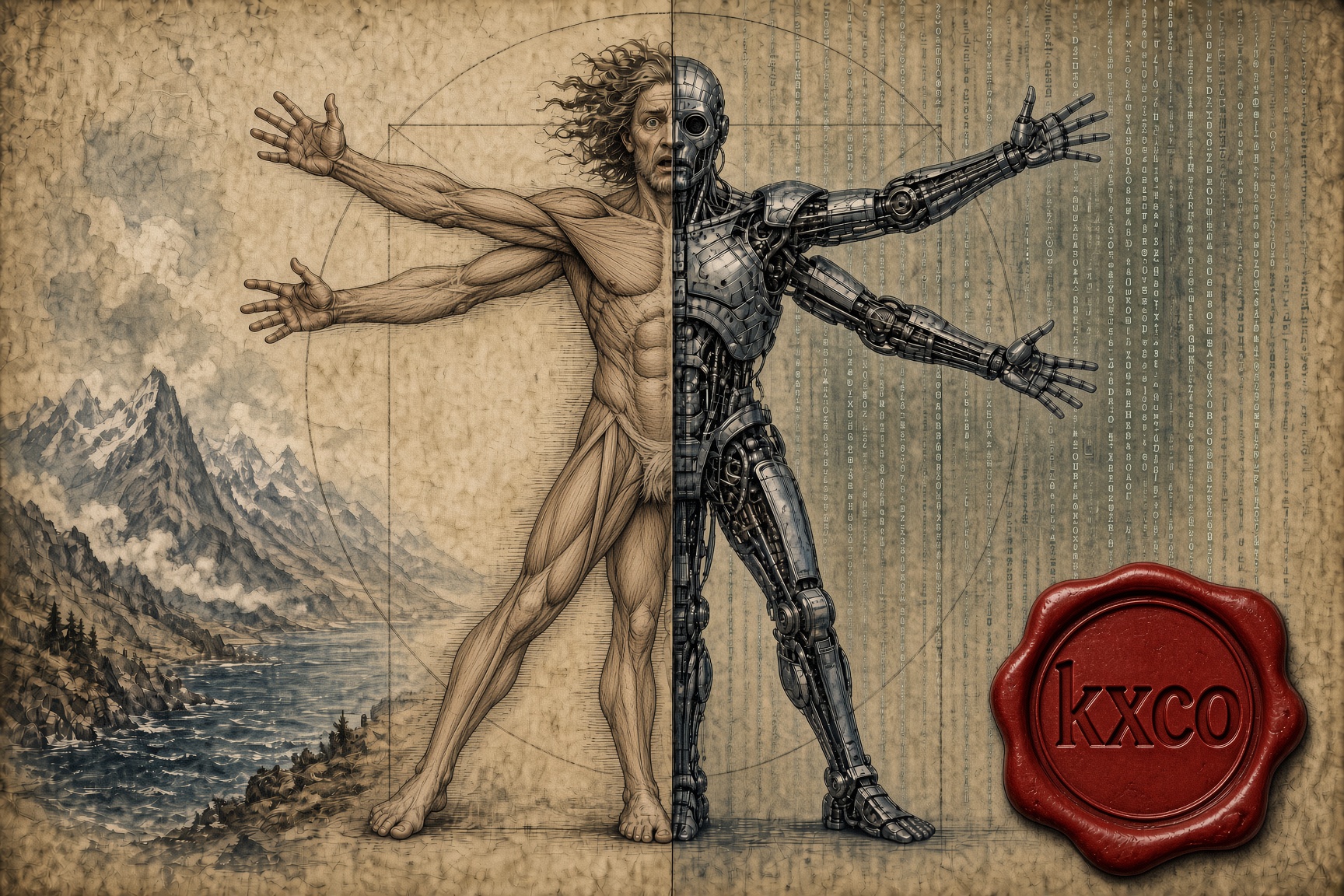
Don't Be the Best, Be the Only: Winning in an AI World
AI is repricing competence downward. What it cannot reproduce is a life. The case for remaining non-fungible, why friction still produces the best ideas, and what it means to build AI systems that keep the human intellect in them.
Every story, signed and delivered.
Subscribe to the kxco channel and get the headline, the AI-written key takeaways, and the chain-anchor link the moment we publish. Audio versions and per-ticker subscriptions arrive in the next iteration.