
The Most Important Catholic Relics: Their History and Where to Find Them
Catholicism, one of the world's oldest and most widely practiced religions, is rich in tradition and history. Central to the faith are relics, revered objects that have a deep connection to the divine and the saints. These relics are scattered across the globe, each with its own story and significance. In this article, we'll explore some of the most important Catholic relics, their histories, and where you can find them.
1. The Holy Grail:
The Holy Grail is the legendary chalice that, according to Christian tradition, Jesus used at the Last Supper. Its quest has been the subject of countless legends and stories. While its existence remains a mystery, various locations, including the Cathedral of Valencia in Spain, claim to house the Holy Grail.

2. The Shroud of Turin:
The Shroud of Turin is believed to be the burial cloth of Jesus, imprinted with his image. It's one of the most studied relics in history. You can view the Shroud at the Cathedral of Saint John the Baptist in Turin, Italy.
3. The True Cross:
The True Cross is said to be the actual cross on which Jesus was crucified. Fragments of it are distributed worldwide. You can find pieces of the True Cross in churches and cathedrals, including the Basilica di Santa Croce in Rome.
4. The Veil of Veronica:
According to tradition, Veronica wiped the face of Jesus on his way to the crucifixion, and his image was miraculously imprinted on her veil. Though its authenticity is debated, the relic can be found in St. Peter's Basilica in the Vatican.
5. The Crown of Thorns:
The Crown of Thorns, which Jesus wore during his crucifixion, is housed in the Notre-Dame Cathedral in Paris. It was notably saved from the fire that engulfed the cathedral in 2019.
6. The Relics of Saint Peter:
Saint Peter's Basilica in the Vatican is said to be built over the tomb of Saint Peter. Pilgrims visit to pay homage to this significant figure in Christianity. The relics of Saint Peter are contained within the basilica, and his tomb can be visited below the altar.
7. The Sudarium of Oviedo:
The Sudarium is a cloth that was believed to cover the face of Jesus after his crucifixion. It's currently displayed in the Cathedral of San Salvador in Oviedo, Spain.
8. The Chains of Saint Peter:
These chains are said to have bound Saint Peter during his imprisonment in Jerusalem and Rome. You can find them at the Basilica of San Pietro in Vincoli (Saint Peter in Chains) in Rome.
9. The Relics of Saint Francis of Assisi:
Saint Francis is one of the most beloved saints in the Catholic tradition. His tomb is located in the Basilica of Saint Francis in Assisi, Italy. Pilgrims come from all over the world to honor his memory.
10. The Holy House of Loreto: - This holy house is believed to be the Virgin Mary's home, transported by angels from Nazareth to Loreto, Italy. You can visit the Basilica della Santa Casa in Loreto to see it.
These Catholic relics serve as a powerful link between the faithful and their religious history. They inspire pilgrims and believers to embark on spiritual journeys to witness and venerate these sacred objects. While their authenticity may be a subject of debate, their historical and cultural significance remains undeniable. Whether you're a devout Catholic or a curious traveler, these relics offer a glimpse into the rich tapestry of Catholic tradition and history.
AI is the Neat Handwriting of the Illiterate
A model in the hands of someone who has read the filing and walked the plant is a clerk. The same model, speaking for someone who has done neither, is a disguise. On AI slop, phantom citations and factslop, why finish stopped being evidence of work, and the containment layer KXCO built so a machine cannot speak as the institution until a source is attached.
Worthship: Do Not Conform to the Age
Worthship is the older English word for worship, and it means to ascribe worth. Bishop Robert Barron preached Romans 12 on 30 August. This essay follows the text into the prison letters, and puts two questions to a graph: do the four readings of that Sunday agree, and was Paul free or in chains when he wrote about despair?
The Truth in All Its Ugliness Must Survive
A majority vote does not determine the truth. Consensus is a mood, gossip is a sport, and a model will write the pretty version for free. Why the ugly number has to survive, why a record beats a dashboard, and what KXCO was built to keep standing when the room changes its mind.
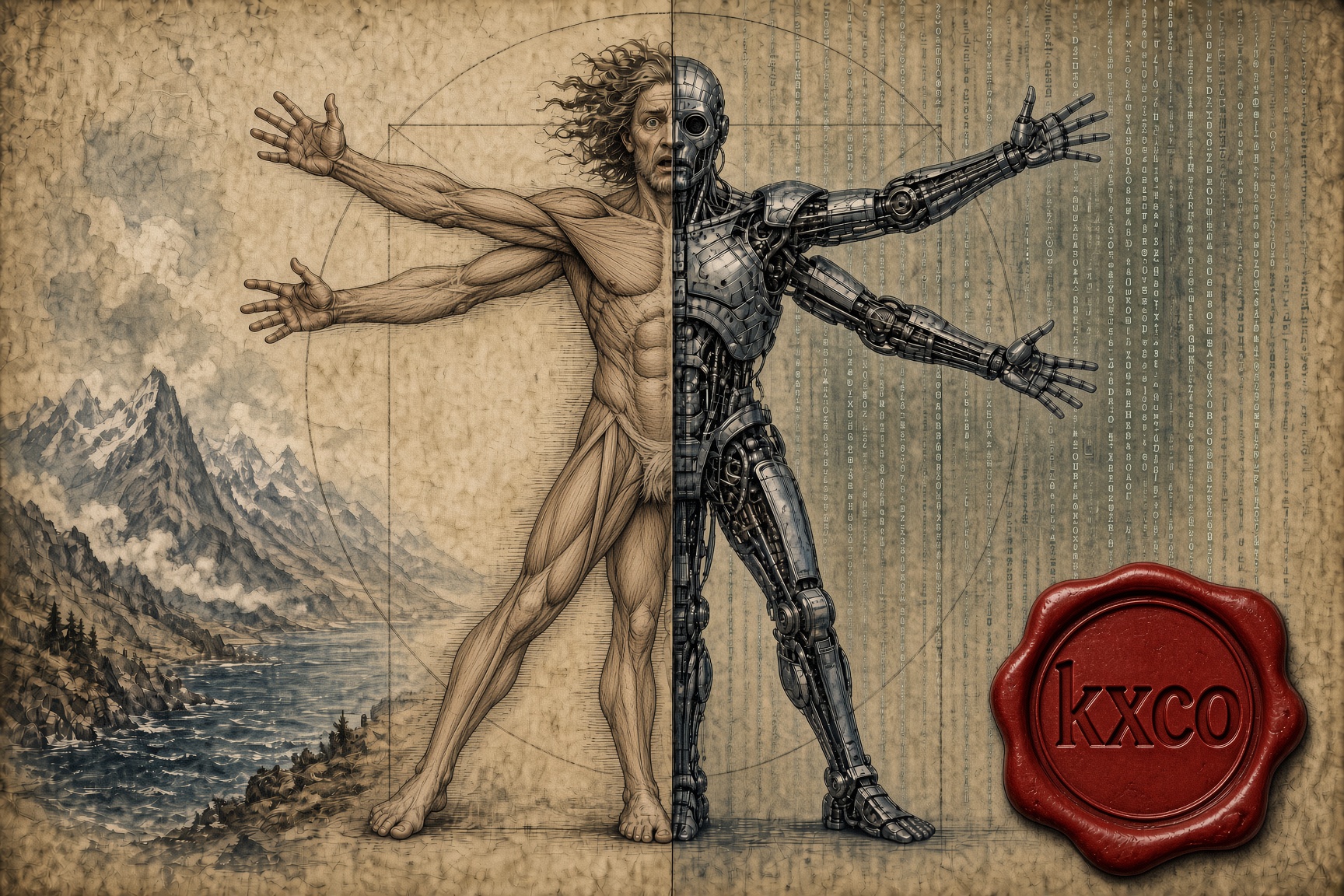
Don't Be the Best, Be the Only: Winning in an AI World
AI is repricing competence downward. What it cannot reproduce is a life. The case for remaining non-fungible, why friction still produces the best ideas, and what it means to build AI systems that keep the human intellect in them.
Every story, signed and delivered.
Subscribe to the kxco channel and get the headline, the AI-written key takeaways, and the chain-anchor link the moment we publish. Audio versions and per-ticker subscriptions arrive in the next iteration.