
The Hottest Biotechs of 2026
Exciting new drugs, current FDA status, and the companies using artificial intelligence to redesign medicine
Part of theStocks Center
By late summer 2026 the biotechnology complex no longer looks like the washed-out, rate-sensitive afterthought that defined 2022 through early 2024. Capital has returned, but it is picky. What the market is paying for is not another slide deck about platform optionality. It is paying for molecules that have already crossed a Food and Drug Administration finish line, or that are weeks away from one, and for a smaller set of computational companies that have finally put AI-designed drugs into human beings rather than only into press releases.
The official record is the cleanest place to start. In calendar 2025, the FDA's Center for Drug Evaluation and Research approved 46 novel drugs, 34 new molecular entities and 12 new therapeutic biologics, with 20 of those products identified by the agency as first-in-class and 23 carrying orphan-drug designation. Combined with the Center for Biologics Evaluation and Research, the United States cleared 58 novel products that year. By 1 September 2026, CDER's running novel-drug list for the current year had already reached 36 entries, a pace that, if sustained through December, would sit near the modern historical average and well above the long-run mean of 38 novel drugs a year since 2007.
Those raw counts understate the qualitative shift. The last fourteen months have produced the first approved treatment purpose-built for non-cystic fibrosis bronchiectasis, the first hepcidin-mimetic drug for polycythemia vera, the first oral medicine indicated for dermatomyositis, a first-in-class multi-RAS inhibitor that doubled median survival in previously treated metastatic pancreatic cancer, an oral small-molecule GLP-1 agonist approved in fifty days under a new national-priority voucher pilot, and Ultragenyx's first commercial gene therapy. In parallel, a cohort of AI-native firms has moved from computational demonstration to clinical-stage assets, even as the field is still waiting for its first Phase 3 win from a fully AI-designed molecule.
This report maps the companies that matter right now, the drugs that are either newly approved or sitting on an active FDA clock, and the artificial-intelligence platforms that have earned the right to be discussed in the same sentence as clinical medicine. It is written for readers who trade and allocate capital, not for patients seeking treatment decisions. Every status claim is tied to a public FDA action, a company disclosure or a contemporaneous trade-press account as of early September 2026.
1. The market map: who is actually hot
Market capitalization still concentrates in a handful of diversified giants. Genetic Engineering and Biotechnology News' 2026 A-List of the twenty-five largest public biotechs put the group's combined value at roughly $1.80 trillion as of December 2025, a year-on-year decline driven almost entirely by Novo Nordisk's retreat from its prior $497 billion peak. Strip Novo out and the remaining twenty-four names rose about 13 percent. Thermo Fisher Scientific took the top slot. Insmed, lifted by the August 2025 approval of Brinsupri for non-cystic fibrosis bronchiectasis and by later Phase 2b data on inhaled treprostinil palmitil, was one of two companies on the list with a triple-digit jump in value. Hansoh Pharma was the other, on a pivot from generics toward innovative drugs and large potential collaborations with Merck and Roche.
That large-cap snapshot is necessary context, but it is not where most of the trading heat lives in September 2026. Independent catalyst screens that re-verified primary sources on 26 August put Ultragenyx, Agios, Pharvaris and Disc Medicine at the top of a quality-adjusted ten-name list that also included Telix, GRAIL, Mirum, Biofrontera, SELLAS and Inovio. The common thread is not size. It is a dated FDA action or a Phase 3 readout inside a ninety-day window.
Oncology-focused screens tell a related story. As of 19 August 2026, Amgen remained the largest pure-play biotechnology company on Nasdaq, with a market value near $239 billion. Revolution Medicines, still far smaller, had already become one of the most closely watched names in RAS-driven solid tumors after zoldonrasib received Breakthrough Therapy designation for KRAS G12D-mutant non-small cell lung cancer and after the FDA accepted the new-drug application for the multi-RAS inhibitor that would be approved, days later, as Rasonque.
Morgan Stanley's mid-year 2026 recommended list leaned toward companies with both approved products and pipeline optionality: argenx, BeOne Medicines, IQVIA, BioNTech, Insmed, Ascendis and Ionis. The implied upside the bank attached to Insmed, nearly 100 percent from the June print, was the clearest single-name statement that pulmonary specialty biotech had re-entered the institutional conversation. Argenx's May 2026 label expansions for Vyvgart and Vyvgart Hytrulo to all adult generalized myasthenia gravis patients, not only those with specified antibody markers, is the commercial analog: a franchise that is still widening after approval rather than fading into biosimilar twilight.
New public companies are part of the heat as well. BioSpace noted that five of its NextGen honorees accounted for a third of US biotech IPOs completed in 2026. Kardigan raised $460 million to advance late-stage cardiovascular programs led by the myosin activator danicamtiv in genetic dilated cardiomyopathy. Seaport Therapeutics raised $260 million behind GlyphAllo, an oral allopregnanolone prodrug in Phase 2b for major depressive disorder. Those offerings would have been difficult to imagine in the 2023 funding winter.
Fast Company's 2026 innovation list is useful for a different reason: it flags private and hybrid names that traditional market-cap screens miss. eGenesis has moved gene-edited pig kidneys from compassionate-use headlines into an FDA-cleared expanded trial after one recipient lived 271 days without dialysis and a second remained off dialysis after a June 2025 transplant. Insilico Medicine published Phase 2a data in Nature Medicine showing that its AI-designed idiopathic pulmonary fibrosis candidate rentosertib stabilized lung function. Epicrispr Biotechnologies won FDA clearance in April 2025 for the first US investigational new-drug authorization of an epigenetic editing therapy, EPI-321, in facioscapulohumeral muscular dystrophy.
The honest ranking is three concentric rings. The outer ring is the cash-flow compounders: Amgen, Vertex, Regeneron, Gilead, argenx, BeOne, and the obesity franchises at Eli Lilly and Novo Nordisk. The middle ring is the 2025 and 2026 approval and PDUFA cohort: Insmed, Revolution Medicines, Ultragenyx, Protagonist and Takeda with rusfertide, Priovant and Roivant with brepocitinib, Replimune, Arvinas, Cytokinetics after aficamten. The inner ring is the AI and next-modality platforms that have not yet produced a blockbuster but have produced human data. All three rings are hot. Only the middle ring is hot for a reason that can be checked against an FDA letter this quarter.
2. The KXCO Biotech Ontology, and why this report has one
Most biotech notes are written from a spreadsheet. This one is written from a graph.
The KXCO Biotech Ontology is a private, non-public knowledge graph built to hold new discoveries and their regulatory status as structured, sourced claims rather than as prose. It is not published and there is no reader-facing endpoint. It exists so that the numbers in a piece like this one can be re-derived on demand instead of trusted.
As of 2 September 2026 it holds 180 entities and 231 claims. The entities break down as 48 companies, 48 indications, 37 approved drugs, 22 development-stage or regulatory-stage assets, 11 AI and computational platforms, 11 modalities, two FDA centres and one review programme. The claims break down as 59 indication links, 59 modality links, 52 development links, 39 regulatory actions, nine AI-origin design claims, eight live regulatory-clock claims, three competitive-rivalry claims and two capital claims.
Two design rules matter more than the counts.
Every claim carries its source. Each edge in the graph is stamped with the citation it came from, so any figure below can be walked back, hop by hop, to an FDA news release, a Drugs@FDA listing, a company disclosure or a named trade-press account. A number that cannot survive that walk does not go in.
And the graph records what a source states, nothing further. Where a company describes a clinical-stage asset without naming the phase, the ontology records the phase as not stated. That is why the third figure below has a column labelled that way. It is a disclosure gap made visible rather than an estimate dressed up as data.
The coverage is deliberate rather than complete. CDER's own running novel-drug list stood at 36 entries on 1 September, while the ontology holds 20 FDA approval actions for 2026, chosen because they moved a market, set a first-in-class precedent or sit on a dated clock. Where a count below is bounded by that coverage, it says so.
The three figures in this report were each generated by running Cypher against that graph. None of the numbers on them were typed in by hand. Every claim behind them carries a source stamp, and a check on 2 September found zero claims without one. What follows is what the graph says.
3. How to read an FDA status in 2026
Before the drug-by-drug tour, a vocabulary note is required, because FDA status is the phrase that separates a useful biotech note from a promotional one.
A novel drug on CDER's annual list is a product whose active ingredient had never before been approved or marketed in the United States. That is different from a supplemental approval, which extends an already licensed product to a new population or use. Accelerated approval lets the agency license a drug on a surrogate or intermediate endpoint reasonably likely to predict clinical benefit, with full approval hanging on a confirmatory trial. Priority review shortens the statutory clock. Breakthrough Therapy, Fast Track, Orphan Drug, Rare Pediatric Disease and Regenerative Medicine Advanced Therapy designations change the conversation the sponsor has with the agency. They do not, by themselves, approve anything.
Two 2026 wrinkles matter for traders.
The first is the Commissioner's National Priority Voucher pilot, launched in 2025 to compress review of applications that the agency judges to address national health priorities. By early April the FDA said it had awarded 18 vouchers and issued six decisions. Eli Lilly's oral GLP-1 agonist Foundayo became the first new molecular entity approved under the program, 50 days after filing and 294 days before its original 20 January 2027 PDUFA date, the fastest NME approval since 2002 according to the agency. Revolution Medicines' Rasonque was also reviewed under the voucher pilot and cleared about six and a half months ahead of its user-fee goal date.
The second is manufacturing. Ultragenyx's UX111 gene-therapy file received a complete response letter in July 2025 that the company attributed to chemistry, manufacturing and controls observations rather than to a failure of the clinical package. The resubmitted biologics license application was accepted in April 2026 with a 19 September 2026 action date. Clinical data intact, plant and process in the dock, has become a recurring pattern in cell and gene therapy, and it is why a PDUFA date is not the same thing as a probability of approval.
Readers should also distinguish CDER from CBER. Gene therapies, some cellular products and many vaccines sit with CBER, so CDER's novel-drug tables under-count the true innovation rate in genetic medicine. When this report says FDA approved, it means a marketed US license exists. When it says under review, it means a file has been accepted and a goal date is public. When it says clinical stage, it means human dosing has begun and no marketing application is pending.
4. The new-drug wave: what cleared, and what is on the clock
The tables below are not exhaustive. They isolate the products that have moved markets, created first-in-class precedent, or sit inside a near-dated FDA decision as of 2 September 2026.
4.1 Landmark 2025 novel approvals that still define 2026 franchises
Brand | Ingredient | Sponsor | FDA action | Approved use at first license |
|---|---|---|---|---|
Brinsupri | brensocatib | Insmed | 12 Aug 2025 | Non-cystic fibrosis bronchiectasis, first therapy approved for the disease |
Hernexeos | zongertinib | Boehringer | 8 Aug 2025 | HER2 tyrosine-kinase-domain mutant non-squamous NSCLC after prior therapy |
Ibtrozi | taletrectinib | Nuvation Bio | 11 Jun 2025 | Locally advanced or metastatic ROS1-positive NSCLC |
Hyrnuo | sevabertinib | Bayer | 19 Nov 2025 | HER2 TKD-mutant non-squamous NSCLC after systemic therapy |
Forzinity | elamipretide | Stealth BioTherapeutics | 19 Sep 2025 | Muscle strength in Barth syndrome, first US therapy |
Rhapsido | remibrutinib | Novartis | 30 Sep 2025 | Chronic spontaneous urticaria despite H1 antihistamines |
Inluriyo | imlunestrant | Eli Lilly | 25 Sep 2025 | ER+/HER2 negative, ESR1-mutant advanced breast cancer |
Palsonify | paltusotine | Crinetics | 25 Sep 2025 | Acromegaly after inadequate response to surgery |
Jascayd | nerandomilast | Boehringer | 7 Oct 2025 | Idiopathic pulmonary fibrosis |
Komzifti | ziftomenib | Kura Oncology | 13 Nov 2025 | Relapsed or refractory NPM1-mutant AML |
Redemplo | plozasiran | Arrowhead | 18 Nov 2025 | Triglyceride reduction in familial chylomicronemia syndrome |
Kygevvi | doxecitine and doxribtimine | US license holder | 3 Nov 2025 | First drug for thymidine kinase 2 deficiency |
Myqorzo | aficamten | Cytokinetics | 19 Dec 2025 | Symptomatic obstructive hypertrophic cardiomyopathy |
Yartemlea | narsoplimab-wuug | Omeros | 23 Dec 2025 | HSCT-associated thrombotic microangiopathy |
Exdensur | depemokimab-ulaa | GSK | 16 Dec 2025 | Add-on maintenance for severe eosinophilic asthma |
Two of those 2025 licenses reset entire disease categories. Brinsupri is the first medicine approved for non-cystic fibrosis bronchiectasis, a chronic suppurative lung disease that had been managed with airway clearance, antibiotics and hope. Mizuho's peak-sales estimate of $6.6 billion, cited in launch coverage, is aggressive, but even a substantial haircut leaves Insmed with rare-disease-style pricing power inside a prevalence that is not ultra-rare. By the second-quarter 2026 call the company had raised its own Brinsupri peak view above $7 billion and its TPIP peak view above $6 billion after open-label extension data in pulmonary arterial hypertension showed a 55-metre improvement in six-minute walk distance at twelve months.
Jascayd gave idiopathic pulmonary fibrosis a new oral option in October 2025. That matters beyond Boehringer's P&L. IPF is the same graveyard of antifibrotic ambition in which Insilico's AI-designed rentosertib is running, and in which any future computational fibrosis drug will have to beat or combine with an approved standard rather than with placebo alone.
Oncology's 2025 vintage was a mutation-by-mutation tightening of the noose around previously undruggable drivers. Zongertinib and sevabertinib opened the HER2 tyrosine-kinase-domain mutant NSCLC niche. Taletrectinib joined the ROS1 shelf. Ziftomenib became the second menin inhibitor in relapsed NPM1-mutant AML, after revumenib. Imlunestrant gave Lilly an oral selective estrogen-receptor degrader for ESR1-mutant breast cancer. None of these is a Keytruda. Collectively they are how modern oncology compounds: each approval is a biomarker-defined franchise with a companion diagnostic and a follow-on combination strategy.
4.2 The 2026 approvals that reset the tape
Brand | Ingredient | Sponsor | FDA action | Approved use at first license |
|---|---|---|---|---|
Zycubo | copper histidinate | US license holder | 12 Jan 2026 | First treatment for children with Menkes disease |
Yuviwel | navepegritide | Ascendis | 4 Mar 2026 | Pediatric achondroplasia |
Avlayah | tividenofusp alfa-eknm | Denali | 25 Mar 2026 | Neurologic manifestations of Hunter syndrome |
Foundayo | orforglipron | Eli Lilly | 1 Apr 2026 | Chronic weight management, oral GLP-1, no food or water restrictions |
Trutakna | atacicept-vymj | Vera Therapeutics | 7 Jul 2026 | Proteinuria in adults with primary IgA nephropathy |
Revtorpyk | gedatolisib | Celcuity | 14 Jul 2026 | HR+/HER2 negative advanced breast cancer without PIK3CA mutation |
Lipfendra | enlicitide decanoate | Merck | 15 Jul 2026 | LDL cholesterol reduction |
Jideytro | zidesamtinib | Nuvalent | 22 Jul 2026 | ROS1-positive NSCLC after a prior ROS1 TKI |
Zenbexus | iberdomide | Bristol Myers Squibb | 13 Aug 2026 | Multiple myeloma after at least one prior line |
Tauklarify | florquinitau F 18 | Diagnostic sponsor | 13 Aug 2026 | PET imaging of tau neurofibrillary tangle pathology |
Pasatru | garetosmab-grts | Regeneron | 19 Aug 2026 | Second approved treatment for fibrodysplasia ossificans progressiva |
GENGLYCOS | pariglasgene brecaparvovec-opnr | Ultragenyx | 19 Aug 2026 | Accelerated approval, GSDIa, first gene therapy for the disease |
Imaavy | nipocalimab-aahu | Johnson and Johnson | 25 Aug 2026 | First drug for warm autoimmune hemolytic anemia. The molecule already held an earlier gMG licence |
Rasonque | daraxonrasib | Revolution Medicines | 26 Aug 2026 | First-in-class RAS inhibitor for treated metastatic pancreatic cancer |
Lisraya | brepocitinib | Priovant and Roivant | 27 Aug 2026 | First oral drug indicated to treat dermatomyositis in adults |
Mimrylo | rusfertide | Takeda, Protagonist-originated | 28 Aug 2026 | First hepcidin mimetic for erythrocytosis in polycythemia vera |
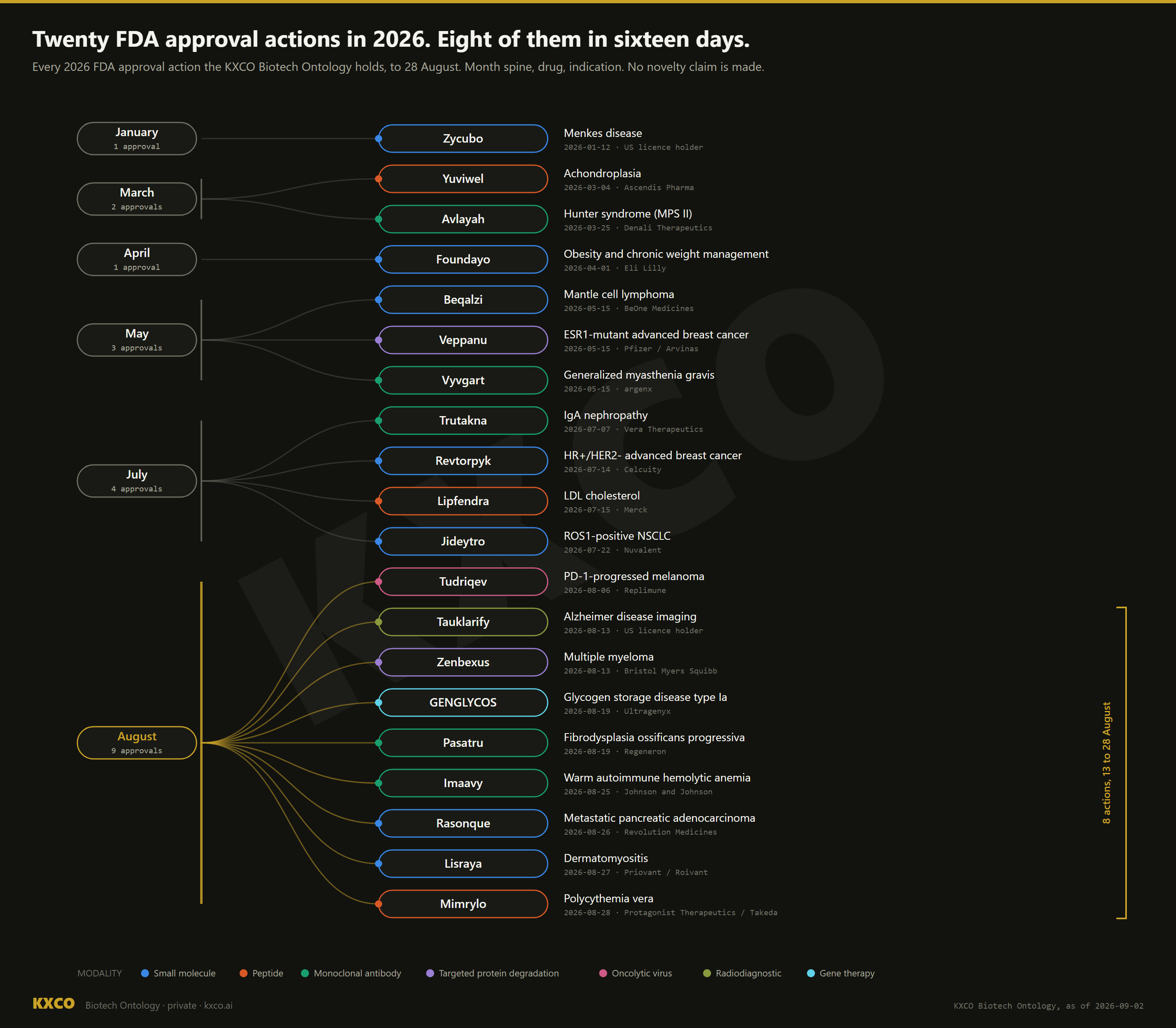
Figure 1. Every 2026 FDA approval action the KXCO Biotech Ontology holds, hung off a month spine. Eight of the twenty fell between 13 and 28 August. Seven modalities cleared across the year, six of them inside those sixteen days. The figure makes no novel-versus-supplemental claim, because that split cannot be drawn from the sources without a judgment call, and a judgment call is not a fact.
That August cluster is the single most useful thing the graph says about the year. Eight of the twenty 2026 approval actions in the ontology arrived inside a sixteen-day window, across six modalities. Desks that model catalyst risk as evenly distributed across a calendar were wrong by a wide margin.
Start with pancreatic cancer, because the clinical delta is the sort of number that does not usually appear in this disease. On 26 August 2026 the FDA approved Rasonque, Revolution Medicines' once-daily oral inhibitor of the RAS GTPase family, for adults with metastatic pancreatic adenocarcinoma who have already received at least one systemic regimen or who cannot take multiagent chemotherapy. In the randomized RASolute 302 trial of 500 patients, median overall survival was 13.2 months on daraxonrasib versus 6.7 months on standard chemotherapy, a hazard ratio of 0.40. Median progression-free survival was 7.2 versus 3.6 months. The objective response rate was 30 percent versus 11 percent. The agency acted about 6.5 months before the user-fee deadline, under Breakthrough Therapy, Orphan Drug, Priority Review and the national-priority voucher pilot. Revolution priced a 30-day supply at $39,800, with a commercial co-pay program that can take eligible insured patients to zero out of pocket.
That is not a cure. It is the first targeted therapy that treats the oncogene family present in the large majority of pancreatic adenocarcinomas rather than a rare fusion or a mismatch-repair sliver. Revolution's earlier G12D-selective inhibitor zoldonrasib already held Breakthrough Therapy designation in previously treated KRAS G12D NSCLC. The strategic question for 2027 is whether multi-RAS blockade moves earlier in pancreatic cancer and whether G12D-selective and multi-RAS agents can be sequenced or combined with PRMT5 inhibitors and checkpoint blockade. Tango Therapeutics has already signaled conversations with the FDA about pivotal work pairing its PRMT5 inhibitor vopimetostat with Revolution's RAS(ON) drugs.
Forty-eight hours later the agency licensed Mimrylo, a first-in-class hepcidin mimetic, for adults with polycythemia vera whose erythrocytosis has not been adequately controlled. In the pivotal study, 76.9 percent of patients on rusfertide required no phlebotomy between weeks 20 and 32, versus 32.9 percent on placebo. Takeda holds the US license and Protagonist Therapeutics originated the peptide. For a disease long managed with phlebotomy, hydroxyurea and interferons, a weekly subcutaneous hormone analog that restores the iron-regulatory brake is a genuine mechanism shift, not a reformulation.
Lisraya, approved 27 August 2026 for adult dermatomyositis, is the first oral drug carrying that specific indication. Priovant Therapeutics, a Roivant company, designed the dual TYK2 and JAK1 inhibitor as a once-daily tablet. In the Phase 3 program, the 30 mg dose produced a higher average Total Improvement Score at week 52 than placebo, with gains in physical function and skin activity and a higher rate of corticosteroid taper by week 48. For a rare idiopathic inflammatory myopathy that has lived for decades on steroids, methotrexate and intravenous immunoglobulin, an oral targeted option is the difference between a clinic built around infusion chairs and a clinic built around a prescription pad.
Foundayo deserves its own paragraph. It is a metabolic medicine, an industrial-policy exhibit and a retail phenomenon at once, and the three do not separate cleanly. Lilly's once-daily oral small-molecule GLP-1 receptor agonist was approved on 1 April 2026 for chronic weight management in adults with obesity or with overweight plus a weight-related comorbidity. It can be taken any time of day without food or water restrictions, a practical distinction from peptide pills that require fasting. In ATTAIN-1, adherent patients on the highest dose lost an average of 12.4 percent of body weight, about 27 pounds, over 72 weeks, versus 0.9 percent on placebo. Cash-pay pricing was introduced in a $149 to $349 monthly band depending on dose, with insured co-pays advertised as low as $25. Novo Nordisk's oral Wegovy pill, approved in December 2025, had already generated more than 600,000 US prescriptions by the time Foundayo launched. The obesity market is no longer an injectable duopoly. It is a formulation war.
Rare-disease genetic medicine kept pace. Ascendis won Yuviwel on 4 March for pediatric patients with the most common form of dwarfism. Denali's enzyme-transport approach reached the Hunter-syndrome label as Avlayah on 25 March. Stealth's Forzinity had already broken the Barth-syndrome barrier in September 2025 after a years-long sequence of delays and a prior rejection. Regeneron's Pasatru became the second approved drug for fibrodysplasia ossificans progressiva on 19 August. And on the same day, Ultragenyx received accelerated approval for GENGLYCOS, an AAV gene therapy for glycogen storage disease type Ia in patients eight and older, the company's fifth FDA approval and its first gene-therapy license. Wholesale acquisition cost was disclosed at $2.7 million per patient. The Phase 3 GlucoGene study showed a statistically significant reduction in daily cornstarch requirement, and 96-week follow-up published as the approval landed showed a 61 percent mean reduction in daily cornstarch across treated and crossover patients, with a third eliminating nighttime doses. Accelerated approval means Ultragenyx must still deliver confirmatory clinical benefit, and the company has committed to a decade-long monitoring program.
Supplemental oncology licenses filled the spaces between novel approvals. Bristol Myers Squibb's Breyanzi became the first CAR-T approved for relapsed or refractory marginal zone lymphoma on 4 December 2025, with an 84.4 percent overall response rate and a 55.8 percent complete-response rate. BeOne's sonrotoclax was approved in May 2026 as a next-generation BCL2 inhibitor for relapsed or refractory mantle cell lymphoma, on a 52.4 percent overall response rate. Arvinas and Pfizer received approval in May 2026 for Veppanu, a PROTAC estrogen-receptor degrader, in ESR1-mutant advanced breast cancer. Replimune, after two complete response letters and an advisory-committee fight, won accelerated approval on 6 August 2026 for Tudriqev, an oncolytic virus given with Opdivo in PD-1-progressed melanoma, with continued licensure depending on a Phase 3 readout expected in late 2027. Daiichi Sankyo and AstraZeneca moved Enhertu plus pertuzumab into first-line HER2-positive metastatic breast cancer on 15 December 2025 after DESTINY-Breast09 showed median progression-free survival of 40.7 months versus 26.9 months.
5. Files still on the FDA clock
A live PDUFA calendar is a trading instrument. It is also a graveyard of slipped dates. The items below were public, dated and material as of the last week of August 2026.
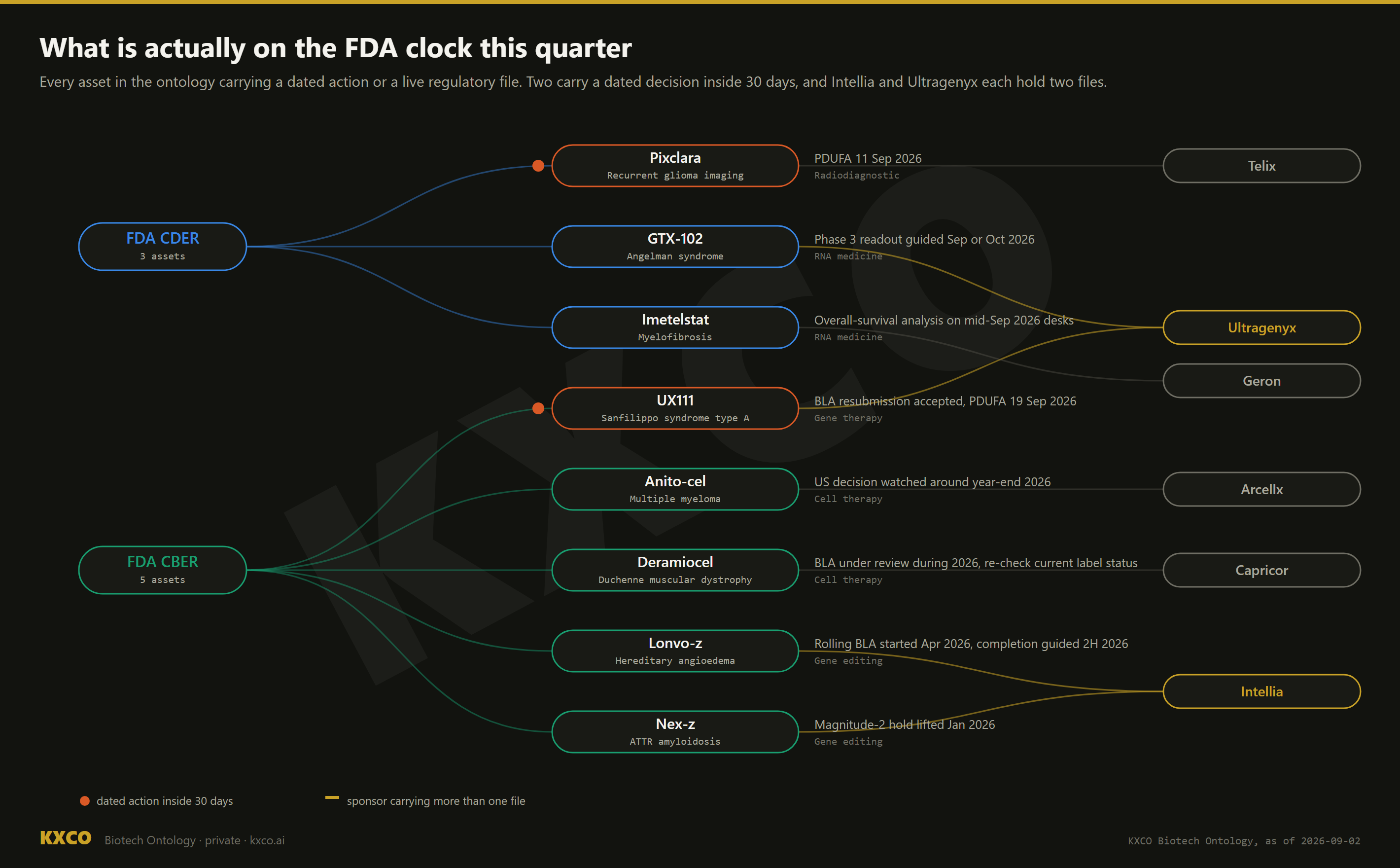
Figure 2. Every asset in the ontology carrying a dated action or a live regulatory file, split by review centre. Two carry a dated decision inside thirty days. Ultragenyx and Intellia each hold two files, and Ultragenyx is the only sponsor whose two files sit on opposite sides of the CDER and CBER line.
Asset | Sponsor | Indication | Status as of early Sept 2026 | Why it matters |
|---|---|---|---|---|
UX111 | Ultragenyx | Sanfilippo syndrome type A | BLA resubmission accepted, PDUFA 19 Sep 2026 | Potential first therapy for a uniformly fatal pediatric neurodegeneration |
GTX-102 | Ultragenyx | Angelman syndrome | Phase 3 readout guided Sep or Oct 2026 | ASO against UBE3A, large rare-neuro adjacency |
Pixclara | Telix | Recurrent or progressive glioma | PDUFA 11 Sep 2026 | Near-dated diagnostic catalyst in a thin-float name |
Lonvo-z | Intellia | Hereditary angioedema | Rolling BLA started Apr 2026, completion guided 2H 2026 | Would be the first in vivo CRISPR therapy approved |
Nex-z | Intellia | ATTR amyloidosis | Magnitude-2 hold lifted Jan 2026 | In vivo TTR knockout, overlap with marketed silencers |
Anito-cel | Gilead and Arcellx | Multiple myeloma CAR-T | US decision watched around year-end 2026 | Challenge to Carvykti, manufacturing slots are the bottleneck |
Deramiocel | Capricor | Duchenne cardiomyopathy | BLA under review during 2026, re-check current label status | Cell-therapy DMD bid adjacent to Sarepta |
Imetelstat | Geron | Myelofibrosis | Overall-survival analysis on mid-Sep desks | Survival read on an approved product |
PDUFA dates move. Confirm against the sponsor 8-K and the FDA calendar before trading a binary event.
UX111 is the cleanest near binary on the calendar. Sanfilippo type A is a childhood lysosomal storage disease caused by SGSH deficiency, and there is no approved disease-modifying therapy anywhere in the world. UX111 is a one-time intravenous self-complementary AAV9 vector intended to restore sulfamidase. Ultragenyx's original file drew a July 2025 complete response letter focused on manufacturing. The company resubmitted in January 2026, the agency accepted the file on 2 April and set 19 September as the action date. Long-term follow-up out to eight years, presented at WORLD Symposium 2026, is the clinical case, and in younger or earlier-stage patients the company reported Bayley-III cognitive raw-score treatment effects versus natural history of 23.2 points over 24 to 60 months. If the CMC package now satisfies the inspectors, UX111 would be the second Ultragenyx gene-therapy approval in a month. If it does not, the stock will re-learn a lesson the sector keeps teaching: vector is not product until the plant is product.
6. The names setting the pace
6.1 Revolution Medicines, making RAS a drug target in the open market
For two decades RAS was the oncogene everyone taught and almost no one drugged. Sotorasib and adagrasib cracked the G12C lock. Revolution's contribution is to treat RAS as a family rather than as a single mutant allele. Daraxonrasib's pancreatic-cancer label is the commercial proof of that thesis. The scientific proof sits in the RASolute 302 hazard ratio and in the earlier Phase 1/2 package published in the New England Journal of Medicine in May 2026. A $39,800 monthly wholesale price will invite payer scrutiny in a post-chemotherapy population with limited remaining life expectancy. It will also invite imitation. Every large oncology company now needs a RAS strategy, whether built, bought or partnered. That is how a mid-cap biotech becomes a strategic asset rather than merely a trading vehicle.
6.2 Ultragenyx, five approvals, one gene-therapy launch, another decision in seventeen days
Ultragenyx has spent a decade looking like a rare-disease roll-up that could not quite get gene therapy over the line. GENGLYCOS changes that. The product is indicated to reduce daily cornstarch intake as an adjunct to nutritional management in GSDIa patients eight and older. GSDIa is an ultra-rare inherited inability to release glucose from the liver, and patients live on around-the-clock cornstarch to avoid hypoglycemic catastrophe. A one-time AAV infusion that cuts cornstarch use by more than half, and that eliminates overnight dosing in a third of treated patients at 96 weeks, is a quality-of-life claim families understand immediately. Peak-sales estimates around $360 million are modest by oncology standards and entirely consistent with an ultra-rare metabolic census. The 19 September UX111 decision and the guided autumn GTX-102 Angelman readout are why the stock screened as the strongest setup in independent August catalyst rankings. Manufacturing remains the unpriced risk. It was the reason UX111 was rejected once, and it will be the reason every subsequent AAV file is read with a plant inspector's eyes.
6.3 Insmed, a pulmonary franchise, not a single-asset story
Brinsupri gave Insmed a first-in-disease launch in August 2025. The 2026 story is whether TPIP, an inhaled once-daily treprostinil palmitil powder, can turn that launch into a multi-indication pulmonary franchise. Phase 3 PALM-ILD and PALM-PAH studies are enrolling. Twelve-month open-label PAH data showed a 55-metre gain in six-minute walk. Placebo-adjusted 16-week PAH data included a 35 percent reduction in pulmonary vascular resistance and a 60 percent drop in NT-proBNP, measured at trough. Additional Phase 3 programs in progressive pulmonary fibrosis and idiopathic pulmonary fibrosis are slated to start in late 2026 and the first half of 2027. Management has talked about more than $7 billion in Brinsupri peak sales and more than $6 billion for TPIP. Those figures are aspirational. What is not aspirational is the strategic position: Insmed owns the first approved drug in bronchiectasis and a late-stage inhaled prostacyclin with a once-daily device in a field still dominated by burdensome dosers.
6.4 Eli Lilly and Novo Nordisk, the metabolic complex that funds everything else
No honest biotech survey omits the two companies that turned incretin biology into the largest drug-class launch in history. Lilly's 2026 contribution is formulation and access. Foundayo is a small-molecule GLP-1 that does not need a cold chain or a pen, which matters in primary-care offices, in cash-pay channels and in health systems that never built an injection infrastructure. Novo's oral Wegovy pill had a multi-month head start and hundreds of thousands of US prescriptions by April. Lilly is answering with price bands, LillyDirect fulfillment and a diabetes-and-comorbidity program that will try to make orforglipron a chronic metabolic backbone rather than a diet-clinic product. When Novo's capitalization cracked, it moved the entire top-25 biotech total. Metabolic demand still sets the risk-free rate of the biotech market. Everything else is a spread over that rate.
6.5 argenx, BeOne, Ionis, Cytokinetics, Crinetics, the approved-product compounders
The quietest way to get rich in biotechnology is to own a drug that keeps finding new rooms in the same house. Argenx's FcRn franchise did that again in May 2026 when Vyvgart and the hyaluronidase formulation expanded to all adults with generalized myasthenia gravis. BeOne's Brukinsa continues to take B-cell-malignancy share while sonrotoclax gives the company a BCL2 option after BTK failure in mantle cell lymphoma. Ionis remains the antisense incumbent with a late-stage metabolic and rare-disease stack that Morgan Stanley still assigned more than 70 percent implied upside in June. Cytokinetics entered the commercial hypertrophic-cardiomyopathy market with Myqorzo in December 2025, a myosin-inhibitor fight with Bristol's Camzyos that will be decided by safety, echo monitoring burden and payer contracts. Crinetics turned a once-daily oral somatostatin-receptor agonist into a September 2025 acromegaly approval and a template for the rest of its endocrine pipeline. These are not hot in the catalyst-calendar sense. They are hot in the sense that cash flow from a first label is funding a second and a third.
6.6 Vertex, CRISPR Therapeutics, Intellia, Beam, editing becomes a product line
CASGEVY, the Vertex and CRISPR Therapeutics ex vivo CRISPR therapy for sickle cell disease and transfusion-dependent beta thalassemia, is no longer a science-fair story. Second-quarter 2026 CASGEVY sales of $76 million were up 78 percent quarter on quarter, with approvals in 39 countries. That is still a rounding error next to Vertex's cystic-fibrosis franchise, but it is evidence that a one-time genetic edit can be administered, reimbursed and reordered. CRISPR Therapeutics' next act is in vivo. At the European Society of Cardiology congress in August 2026 the company presented Phase 1a durability data for CTX310, a lipid-nanoparticle CRISPR editor aimed at ANGPTL3, showing deep and durable editing with triglyceride and LDL reductions, with a Phase 1b update in severe hypertriglyceridemia expected in the second half of 2026.
Intellia is closer to an in vivo approval than anyone else. Lonvoguran ziclumeran completed a randomized, placebo-controlled Phase 3 trial in hereditary angioedema, where the mean monthly attack rate from weeks 5 to 28 was 0.26 versus 2.10 on placebo. The company started a rolling BLA in April 2026 and has guided to completing the file in the second half of the year, with a possible US launch in the first half of 2027. If that sequence holds, lonvo-z would be the first approved CRISPR therapy administered inside the body rather than in a manufacturing suite. Nexiguran ziclumeran, the TTR editor, is a more complicated story. A clinical hold hit the Magnitude cardiomyopathy and Magnitude-2 polyneuropathy Phase 3 trials in October 2025, and the FDA lifted the hold on Magnitude-2 in January 2026. ATTR-PN remains the nearer path. ATTR-CM must still outrun the commercial reality of already-approved TTR silencers and stabilizers.
Beam Therapeutics continues the base-editing route. BEAM-302, in alpha-1 antitrypsin deficiency, dosed the first patient in its global pivotal cohort in July 2026. Earlier 60 mg data showed mean steady-state total AAT of 16.1 micromolar, with every patient above the 11 micromolar threshold that historically tracks with clinical protection. Prime Medicine, one notch earlier, received simultaneous US IND and New Zealand CTA clearance for PM577a, its first in vivo prime-editing candidate. The editing stack is no longer a single-company race. It is a modality class with commercial, pivotal and first-in-human rungs occupied at the same time.
6.7 Xenotransplantation and the edge of the field
eGenesis is not a public-market trading vehicle in the usual sense, but it is one of the handful of private biotechs whose clinical moves change how the entire organ-failure market is discussed. Gene-edited porcine kidneys have kept human recipients off dialysis for record intervals, including 271 days in one widely reported case. The FDA cleared an investigational new drug for EGEN-2784 and an expanded study in wait-listed, dialysis-dependent patients aged 50 and older. Corporate materials heading into 2026 described a 33-patient Phase 1/2/3 design: three sentinel patients at Massachusetts General Hospital with 12-week spacing, then 30 patients across as many as ten sites, with six-month graft function as a central outcome. A gene-edited pig-liver extracorporeal system also holds an FDA-cleared clinical path as a potential bridge to transplant. This is not a 2026 revenue story. It is the first time xenotransplantation has a registration-shaped protocol instead of only a compassionate-use press release.
7. Artificial intelligence leaves the demo and enters the clinic
The AI-drug-discovery pitch of 2021 was that algorithms would empty the failure queue. The record of 2026 is narrower and more useful. Computation has compressed the cheapest part of development, which is target nomination, first chemical matter and early antibody design, and has left the expensive part, human efficacy, almost exactly where it was. Insilico has published a figure of roughly eighteen months and $2.6 million from target choice to a development candidate ready for first-in-human safety studies, against a traditional four-to-six-year early-cycle clock. Absci can now design a working antibody from a tiny computational library rather than from a wet screen of millions of clones. Those are real industrial facts. They are not the same thing as a Phase 3 win.
Capital has noticed the distinction and, for the moment, has funded both sides of it. Isomorphic Labs raised a $2.1 billion Series B in May 2026 led by Thrive Capital, with Alphabet, GV, MGX, Temasek, CapitalG and the UK Sovereign AI Fund participating, on top of 2024 partnership constructs with Eli Lilly and Novartis whose headline milestone value approaches $3 billion. Xaira Therapeutics launched in 2024 with more than $1 billion committed. Insilico listed in Hong Kong at the end of 2025, raising about $293 million on top of more than $500 million privately. Generate:Biomedicines went public in 2026. Recursion absorbed Exscientia in a $688 million all-stock deal that closed in November 2024. Lilly's March 2026 expansion with Insilico, $115 million upfront and up to $2.75 billion in milestones, is the largest single AI-era discovery collaboration disclosed to date, and it was followed in June by an SK Biopharmaceuticals neuroimmune pact worth up to $2.5 billion.
The scoreboard that matters is not the term sheet. It is which companies have patients on an AI-origin drug.
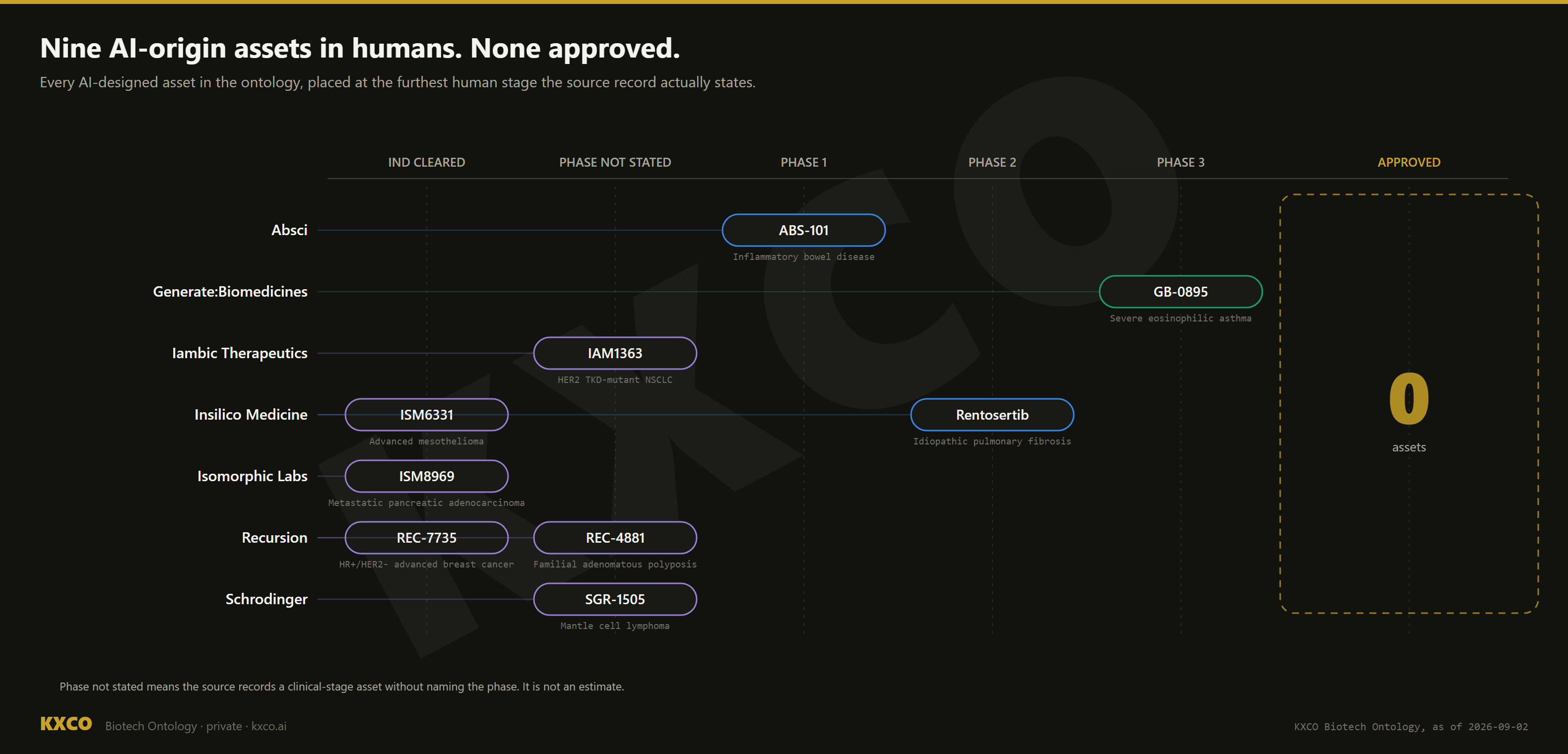
Figure 3. The nine AI-designed assets in the ontology, placed at the furthest human stage the source record actually states. One is in Phase 3. Three are recorded as clinical stage without a named phase, which is a disclosure gap rather than an estimate. The approved column is empty.
That empty column is the whole argument. Seven platforms, nine assets, real patients, and no marketed product. Anyone selling AI drug discovery as a solved problem is selling the left half of that picture.
7.1 Insilico Medicine, the proof point the field needed
Rentosertib, formerly INS018_055 or ISM001-055, is the first drug whose target and structure both came from a generative AI pipeline to complete a randomized mid-stage human study. It is a TNIK inhibitor for idiopathic pulmonary fibrosis. Phase 2a data, published in Nature Medicine in 2025, showed stabilization of lung function. That is a carefully chosen verb. Stabilization in IPF is a meaningful clinical signal, and it is not yet a registrational win against nintedanib, pirfenidone or nerandomilast. Insilico's broader Pharma.AI stack, PandaOmics for target discovery and Chemistry42 for generative chemistry, has since produced additional IND-stage assets. On 29 July 2026 the FDA granted Fast Track designation to ISM6331, a pan-TEAD inhibitor for advanced mesothelioma, the company's first Fast Track. The Lilly and SK Biopharmaceuticals collaborations are the business-model validation: large strategics will pay for repeated access to a discovery engine that has already survived contact with patients.
7.2 Recursion, scale, a merger, and an honest pipeline cull
Recursion's wager is that biology is an image-recognition problem. The Recursion OS runs millions of cell-painting experiments a week and trains models on the resulting perturbation maps. The Exscientia merger added automated precision chemistry and a European design culture to a Salt Lake City phenomics factory. The combined company is the most complete public expression of the AI drug discovery superpower slogan. It is also the most complete expression of the slogan's cost. In May 2025 Recursion discontinued three programs, including REC-994 after an earlier positive Phase 2 signal failed to hold, a reminder that an AI origin story does not immunize a molecule against biology. The surviving clinical stack is still busy. REC-4881 has shown a 43 to 53 percent reduction in polyp burden in familial adenomatous polyposis. REC-617 produced a confirmed partial response in platinum-resistant ovarian cancer. REC-4539 began a new solid-tumor and AML trial in April 2026. REC-7735, an AI-designed PI3K-alpha H1047R inhibitor, has IND clearance and is expected to enter Phase 1/2 in the second half of 2026. Recursion is not a single-asset biotech. It is a factory whose yield is still being measured.
7.3 Schrodinger, physics first, machine learning second, software revenue always
Schrodinger is the adult in the AI-biotech room because it already sells something. Its physics-based simulation platform is installed at more than 1,600 research organizations, and that subscription base funds a proprietary pipeline instead of the other way around. SGR-1505, a MALT1 inhibitor, has shown a 22 percent overall response rate in lymphoma in early clinical experience. The company's earlier computational fingerprints sit inside molecules that other sponsors took late, including the TYK2 inhibitor zasocitinib that Nimbus originated with Schrodinger tools and that Takeda has carried into Phase 3. For allocators who want AI-biotech exposure without a binary PDUFA, Schrodinger is the least theatrical way to own the stack.
7.4 Isomorphic Labs, the most expensive preclinical company on earth
Isomorphic is DeepMind's drug-discovery spinout, built on the AlphaFold lineage and on a proprietary design engine the company calls IsoDDE, which it has claimed more than doubles AlphaFold 3 accuracy on internal design tasks. President Max Jaderberg told WIRED Health in April 2026 that the firm was gearing up to go into the clinic with a pipeline in oncology and immunology. That is later than Demis Hassabis's earlier public guidance of clinical trials by the end of 2025. One contemporaneous industry survey in mid-2026 still described Isomorphic as having no disclosed dosed patient, and another listed an IND-cleared asset, ISM8969, in January 2026. Both things can be partly true in a company that discloses little, and the ontology records that ambiguity rather than resolving it. What is not in dispute is the capital and the partners. A $2.1 billion Series B and multi-year Lilly and Novartis collaborations make Isomorphic the most validated platform the field has by the only early test that counts, which is whether a top-ten pharma will pay again. The test that will count in 2027 is whether a patient responds.
7.5 Generate, Absci, Iambic, Relay, insitro, Xaira, Chai, the second wave
Generate:Biomedicines is the rare AI-protein company that has already reached Phase 3. GB-0895 is a computationally engineered, half-life-extended anti-TSLP monoclonal antibody designed for twice-yearly dosing in severe asthma. Generate reports a 98-day human half-life and femtomolar affinity, roughly a twenty-fold binding improvement over tezepelumab on the company's own comparison. Two global Phase 3 trials, SOLAIRIA-1 and SOLAIRIA-2, began around year-end 2025, and the first SOLAIRIA-1 patient was dosed on 26 January 2026. Full enrollment is guided to the first half of 2028. COPD is the next planned late-stage expansion. If GB-0895 works, it will not prove that AI discovered a new target, because TSLP was already clinically validated. It will prove that generative protein design can take a validated target and produce a genuinely differentiated product profile in dosing interval, potency and manufacturability, which is the more commercially relevant claim.
Absci is the public generative-antibody specialist. ABS-101, its first AI-designed biologic for inflammatory bowel disease, entered Phase 1. The company's pitch is speed and library compression, fewer than a hundred designed candidates instead of millions of physical clones. That is an antibody-factory argument, and it will be won or lost on whether ABS-101 looks like a real IBD drug or like a well-designed binder with a mediocre human pharmacodynamic curve.
Iambic Therapeutics has posted a 28 percent response rate with IAM1363 in heavily pretreated HER2-positive cancers, using a physics-informed neural-network stack. Relay Therapeutics remains the public protein-motion company, with clinical-stage PI3K-alpha work that overlaps competitively with Recursion's REC-7735. Insitro has stayed mostly private and partnership-driven, with Lilly, Bristol Myers Squibb and Gilead, leaning on machine learning plus functional genomics rather than on a single loud clinical asset. Xaira, launched with Baker-lab design DNA and more than a billion dollars, is still a pipeline-construction story. Chai Discovery, after a late-2025 Series B, is the fresh foundation-model name that sophisticated crossover funds mention in the same breath as structure prediction's next act. None of these companies is a 2026 revenue event. Several of them will be 2027 and 2028 binary events, which is why they belong in a hottest-biotechs survey even when they do not belong in a current-earnings model.
7.6 What AI has not done
Intellectual honesty is part of the assignment. BenevolentAI restructured after disappointing early clinical results. Recursion killed programs. Atomwise leaned harder into partnerships than into a proprietary late-stage stack. Isomorphic missed its first publicly floated clinical-trial year. No AI-native firm had reported Phase 3 data on a fully AI-designed small molecule as of mid-2026. Fifteen to twenty AI-origin candidates were expected to enter pivotal trials during the year, and those studies, not the next foundation-model paper, will decide whether the decade-long thesis was industrial transformation or an expensive way to generate mediocre chemical matter faster. Pharma's real bottleneck remains what it was in 1996: convincing a human body, in a heterogeneous population, under real-world adherence, that a molecule is better than the standard of care. Algorithms do not enroll patients, inspect plants or sit across from an FDA reviewer who wants a second manufacturing site.
The correct investor framing is therefore not that AI will replace chemists. It is that AI will change the cost and speed of generating the first credible candidate, and the companies that own both the generator and the clinical development muscle will capture the spread. Insilico, Recursion, Schrodinger and Generate are the present embodiments of that sentence. Isomorphic is the most expensive bet that the sentence is still incomplete.
8. Modalities that are quietly rewriting the pipeline mix
Hot companies are easy to list. Hot modalities are how those lists will look different in 2028.
Targeted protein degradation is no longer a curiosity. Veppanu's 2026 approval puts a PROTAC on a commercial breast-cancer label. Bristol's iberdomide, licensed in August 2026 as Zenbexus in a daratumumab-hyaluronidase triplet for previously treated myeloma, is a next-generation molecular glue that exists because Celgene's original immunomodulatory chemistry still had another gear. Mezigdomide is right behind it. Degradation and glues will not replace antibodies. They will take the intracellular half of the proteome that antibodies cannot touch.
Antibody-drug conjugates and T-cell engagers remain the business-development currency of oncology. Gilead's 2026 check-writing, the Arcellx takeout, a $3.15 billion upfront ADC purchase from Tubulis, and a $1.68 billion cash deal for Ouro's BCMAxCD3 engager, is what a large-cap does when its first-generation cell-therapy franchise ages. AbbVie's c-Met ADC temab-A is in Phase 3 colorectal cancer. The pattern is consistent: the hottest large biotechs are not discovering new binding domains so much as industrializing the payload, the linker and the combination sequence.
RNA medicines have split into two businesses. The first is the now-mature silencer franchise, Ionis, Alnylam and Arrowhead, which in 2025 put plozasiran on a familial chylomicronemia label as Redemplo. The second is circular and self-amplifying RNA, where Replicate and Strand have been flagged for durability and tumor targeting that linear mRNA never quite delivered after the vaccine boom. Neither sub-business needs another pandemic to justify its existence. One needs payer contracts. The other needs a first solid-tumor randomized win.
Epigenetic editing, prime editing and in vivo base editing are the 2027 to 2029 versions of the CRISPR story CASGEVY already told for ex vivo work. Epicrispr's EPI-321 IND, Prime's PM577a dual-jurisdiction clearance and Beam's BEAM-302 pivotal-cohort start are three different answers to the same question: can you rewrite a disease allele without cutting both strands of DNA in a patient's liver or muscle. The FDA has not approved any of those answers. It has, however, agreed to let them be asked in human protocols, which is how every current standard of care began.
9. A catalyst map for the rest of 2026
Catalyst calendars are perishable. The following items were the ones a desk covering the sector as of 2 September 2026 had to have on a whiteboard. They are not recommendations.
September is an Ultragenyx month. Telix's Pixclara glioma imaging PDUFA on 11 September is the first dated action. UX111 on 19 September is the one that can re-rate a mid-cap rare-disease name overnight. A GTX-102 Angelman Phase 3 readout is guided into September or October. Geron's imetelstat overall-survival analysis in myelofibrosis was also sitting on mid-September desks. Nuvalent's broader ROS1 and ALK franchise will be watched for residual filing news after the 22 July zidesamtinib approval. Roivant-adjacent immunology news flow will continue in the afterglow of the 27 August Lisraya license.
The second half more broadly still holds the ten late-stage readouts flagged at mid-year: Summit and Akeso's Harmoni-3 PD-1 and VEGF bispecific program in lung cancer, additional Alzheimer's and autoimmune studies, and infectious-disease and metabolic trials that would have been watch items in any other year and are now competing for attention with pancreatic-cancer and obesity headlines. Intellia's rolling BLA completion for lonvo-z is a fourth-quarter regulatory event even if the approval itself slips into 2027. Generate's Phase 3 asthma machine will not read out this year, but enrollment pace and any COPD expansion decision will leak into sentiment. Recursion's second-half IND-to-clinic step for REC-7735 is a small event with large symbolic weight.
Policy is a catalyst whether traders want it to be or not. Contemporary mid-year accounts described a White House-directed effort to put more traditional leadership back atop the FDA after a stretch of regulatory drama. The national-priority voucher pilot is the visible expression of that faster-review impulse. Faster reviews cut both ways. They pull forward good drugs, as they did with Foundayo and Rasonque. They also pull forward the moment when a thin file meets a reviewer who is no longer willing to negotiate away a second study. Binary event risk has not fallen in 2026. It has been compressed into fewer calendar days, which is exactly what Figure 1 shows.
10. Valuation, capital and the ways this goes wrong
A hottest-biotechs list that does not discuss failure modes is an advertisement. Several failure modes are already visible.
Price is the first. Rasonque at $39,800 a month and GENGLYCOS at $2.7 million a patient will test the post-IRA payer environment and the political temperature around rare-disease and oncology launches. Foundayo's cash-pay bands are an explicit attempt to get ahead of that fight in metabolic disease. Companies that launch into 2027 without a distribution and affordability plan will discover that an FDA letter is necessary and nowhere near sufficient.
Manufacturing is the second. UX111's 2025 complete response letter is the template. Cell and gene therapies, oncolytic viruses and xenotransplant products fail inspections for reasons that have nothing to do with Kaplan-Meier curves. Replimune needed two rejections and an advisory committee before Tudriqev's accelerated approval. Any owner of a CBER-track file should underwrite plant risk as a separate line item from clinical risk.
Confirmatory-trial risk is the third. Accelerated approvals on surrogate endpoints, cornstarch intake in GSDIa and response rate in PD-1-progressed melanoma, can be withdrawn if the post-marketing study does not convert. That is not a theoretical clause. It is the bargain the agency struck, and sponsors who treat it as boilerplate will eventually meet a commissioner who does not.
Competitive crowding is the fourth. Oral GLP-1s, RAS inhibitors, FcRn blockers, menin inhibitors, anti-TSLP antibodies, inhaled prostacyclins and in vivo editors now all have at least two serious contestants. First-in-class is a press-release phrase. First-in-class and still alone three years later is a business. Very few of the drugs in this report will enjoy the second fate.
AI-specific risk is the fifth. Platform companies can lose the plot in two opposite ways. They can over-prune the pipeline and look empty, as Recursion briefly did after the 2025 cull. Or they can keep every computationally pretty molecule alive and drown in Phase 1 burn. The public market has already shown it will fund the former for a quarter and punish the latter for a year. Isomorphic's enormous private raise buys time. It does not buy a shortcut through toxicology.
Macro remains the sixth. The 2022 and 2023 drawdown taught a generation of crossover funds that duration-sensitive unprofitable biotech is a bond proxy with bad convexity when real rates rise. That lesson is dormant, not dead. A hotter-than-expected inflation print still takes 400 basis points off a pre-revenue gene-editing name before it takes 40 off Lilly.
11. How a serious desk should use this list
There is no single hottest biotech. There are four different games, and they should not be funded out of the same bucket.
Game one is approved-product compounding. Lilly and Novo in metabolism, argenx in FcRn, Insmed in pulmonary, Amgen and BeOne in oncology, Vertex in cystic fibrosis plus the slow CASGEVY build, Cytokinetics and Bristol in hypertrophic cardiomyopathy. The work is commercial: refills, guidelines, payer contracts, sales-force execution.
Game two is dated FDA binaries. UX111, residual 2026 PDUFAs, any accelerated-approval conversion. Position size belongs to the event, not to the narrative. CMC history is part of the odds.
Game three is mid-stage science that just became Phase 3 science. Revolution's RAS franchise expanding beyond second-line pancreas, Intellia's in vivo HAE file, Generate's twice-yearly TSLP antibody, Insmed's TPIP pulmonary map, Beam's base editor in AATD. These names re-rate on data quality, not on logos.
Game four is platform optionality with a clinical pulse. Insilico, Recursion, Schrodinger, Absci, Iambic, Isomorphic by proxy if a vehicle ever exists, eGenesis if it ever lists or partners in a disclosed way. The discipline is to pay for evidence of human pharmacology and to treat foundation-model press releases as research notes, not as catalysts.
A portfolio that owns all four games without knowing which game a given position is playing will eventually donate its gains from Rasonque to its losses on a preclinical AI story that missed a self-imposed 2025 clinic date. The sector is hot enough, in September 2026, that sloppy taxonomy is the dominant way sophisticated people lose money.
12. Closing argument
The last twelve months of American drug regulation produced a first therapy for bronchiectasis, a first hepcidin mimetic for polycythemia vera, a first oral dermatomyositis drug, a first multi-RAS inhibitor that doubled survival in treated metastatic pancreatic cancer, an oral GLP-1 approved in fifty days, and a commercial gene therapy that lets children with GSDIa sleep through the night without a cornstarch alarm. That is a serious year. It is also an incomplete one. Sanfilippo type A still has no approved drug. In vivo CRISPR still has no approved drug. No fully AI-designed small molecule has won a Phase 3 trial. Pig kidneys are in a registration-shaped study, not in organ-procurement-organization inventory.
The hottest biotechs of 2026 are the firms that closed part of that gap and still have a dated, auditable plan to close the rest of it.
Markets like stories. Regulators like tables. Graphs like both, and they hold you to your sources. The three figures above came out of the KXCO Biotech Ontology, and all 231 claims behind them carry the citation they were built from, verified rather than assumed. That is the standard the rest of this report was written to. Everything else is a pipeline. Pipelines are optional. Approvals are not.
Shayne Heffernan writes on markets, biotechnology and global capital flows for Live Trading News and at shayneheffernan.com.
Stocks mentioned in this article: $RARE, $INSM, $RVMD, $LLY, $NVO, $NTLA, $CRSP, $BEAM, $RXRX, $ABSI, $ARGX, $ASND, $IONS, $ONC, $BNTX, $IQV, $TLX, $AGIO, $PHVS and $IRON.
Shayne Heffernan, Ph.D., is the founder of Live Trading News, the KnightsBridge Group, Knightsbridge Law and the KXCO.ai ecosystem spanning post-quantum cryptography, identity, attestation and enterprise ontology. More of his market and technology writing is at shayneheffernan.com.
This special report is for informational purposes only. Live Trading News and the author are not licensed to provide investment, legal, tax or medical advice. Nothing here is an offer to buy or sell securities or a recommendation of any therapy. FDA status, trial data, pricing and corporate structures change. Peak-sales figures cited from banks or companies are estimates, not facts. Readers should verify every dated regulatory claim against primary sources, including Drugs@FDA, official FDA news releases, EDGAR filings and peer-reviewed publications, before making a decision. Past scientific success is not a guarantee of future approval or commercial performance.
Sources
Web locations were live as of 1 and 2 September 2026. This is a journalist's source list, not an academic bibliography.
US Food and Drug Administration. Novel Drug Approvals for 2025.
US Food and Drug Administration. Novel Drug Approvals for 2025 table and Drug Trials Snapshots for Brinsupri, Jascayd, Forzinity, Rhapsido, Inluriyo, Palsonify, Komzifti, Redemplo, Kygevvi, Myqorzo, Yartemlea, Exdensur, Hyrnuo, Ibtrozi and Hernexeos.
US Food and Drug Administration. Novel Drug Approvals for 2026, running list through Mimrylo, 28 August 2026.
Fierce Pharma. 2025 approvals: biopharma delivered 55 new drugs and biologics. 5 January 2026.
US Food and Drug Administration. FDA approves first new molecular entity under the National Priority Voucher program, Foundayo. 1 April 2026.
US Food and Drug Administration. Rare Disease Drug Approvals index and related 2026 news releases: Mimrylo, Lisraya, Rasonque, Imaavy, Pasatru, Trutakna, Avlayah, Yuviwel and Zycubo.
IntuitionLabs. AI-discovered drugs in clinical trials 2026: full pipeline. Updated 9 August 2026.
ProMarket, Stigler Center. Pharma's AI boom has bet on the wrong bottleneck. 2 July 2026.
Philippidis, A. Top 25 biotech companies in 2026. Genetic Engineering and Biotechnology News, March 2026.
Merlintrader. Top ten biotech stocks right now, August 2026. Updated 26 August 2026.
Investing News Network. Oncology stocks: eight biggest Nasdaq companies in 2026. 21 August 2026.
Duggan, W. Seven best biotech stocks to buy for 2026. US News and World Report, 2 June 2026.
Gabriel, A. Five NextGen winners who went public this year. BioSpace, 5 August 2026.
Fast Company. The most innovative biotech companies of 2026. 24 March 2026.
US Food and Drug Administration. FDA approves lisocabtagene maraleucel for relapsed or refractory marginal zone lymphoma. 4 December 2025.
Associated Press. FDA grants speedy approval to Eli Lilly's weight-loss pill for obesity. 1 April 2026.
US Food and Drug Administration. FDA approves first in class targeted therapy for metastatic pancreatic cancer. 26 August 2026.
Ultragenyx Pharmaceutical. US FDA acceptance of BLA resubmission for UX111, 2 April 2026, with Drugs.com UX111 history.
BioPharma Dive. Ultragenyx, after setbacks, nabs first gene therapy approval. 20 August 2026.
US Food and Drug Administration. Notable Approvals index, 2025 and 2026.
Insmed second-quarter 2026 earnings call transcript. 13 August 2026.
American Association for Cancer Research. FDA approvals in oncology, October to December 2025. 6 January 2026.
US Food and Drug Administration. FDA approves first drug of its kind for polycythemia vera. 28 August 2026.
Ultragenyx Pharmaceutical. GENGLYCOS approval announcement, 19 August 2026, and 96-week GlucoGene publication release, 1 September 2026.
US Food and Drug Administration. FDA approves first oral drug indicated to treat dermatomyositis in adults. 27 August 2026.
US FDA NDA approval letter, NDA 220910, Rasonque tablets, Revolution Medicines, August 2026.
Reuters and CNN Health. Revolution's pancreatic cancer drug wins speedy FDA approval. 26 August 2026.
BioWorld. Coverage of RASolute 302 and Tango Therapeutics combination plans with RAS(ON) inhibitors. June 2026.
Eli Lilly. Foundayo approval press materials and Drugs.com approval history, April to June 2026.
Physicians Weekly. New oral GLP-1 option: FDA clears Lilly's orforglipron for weight management. April 2026.
Markets Insider and GlobeNewswire. Ultragenyx 96-week GENGLYCOS publication note. 1 September 2026.
Targeted Oncology. FDA approves next-gen BCL2 inhibitor sonrotoclax for R/R mantle cell lymphoma. May 2026.
Xtalks. Top 20 fastest growing pharma and biotech companies in the Americas for 2026. 15 May 2026.
BioPharma Dive. Replimune rebounds to win FDA approval of melanoma drug. 6 August 2026.
US Food and Drug Administration. FDA approves fam-trastuzumab deruxtecan-nxki with pertuzumab for HER2-positive breast cancer. 15 December 2025.
Sfera, D. Biotech catalyst calendar 2026.
New Market Pitch. Who will deliver the first in-body CRISPR cure? 23 July 2026.
Fierce Pharma and Synapse deal notes on the Gilead and Arcellx anito-cel takeout and adjacent ADC and T-cell-engager purchases, 2026 coverage.
Allsci and Ultragenyx WORLD Symposium 2026 data summary for UX111 Bayley-III treatment effects versus natural history.
MoneyDJ and Yahoo Finance theme note, 1 September 2026: CRISPR Therapeutics Q2 2026 CASGEVY sales, Intellia HAELO rates, Beam BEAM-302 pivotal start, Prime Medicine PM577a IND and CTA.
CRISPR Therapeutics. Presents Phase 1a data for CTX310 at ESC Congress 2026. GlobeNewswire, 28 August 2026.
BioWorld. Intellia's nex-z moves ahead, but only for ATTR-PN for now. 27 January 2026.
Inside Precision Medicine and eGenesis pipeline and corporate materials, 2025 and 2026.
pdpspectra. AI drug discovery platforms in 2026: the honest state of the pipeline. 28 May 2026.
New Market Pitch. AI drug discovery: what are the top startups now? 29 June 2026.
Vision Life Sciences. AI drug discovery companies: the 2026 power list. 27 June 2026.
MarketWise. Six AI drug discovery stocks to play the Isomorphic Labs trade. 25 June 2026.
Alatirok and IntuitionLabs pipeline surveys, mid-2026.
Zacks. Four AI-powered drug discovery stocks to watch. 17 August 2026.
Pharmacological Reviews. Leading artificial intelligence-driven drug discovery platforms: 2025 landscape and global outlook. 2025.
Mullin, E. AI-designed drugs by a DeepMind spinoff are headed to human trials. WIRED, 24 April 2026.
Generate:Biomedicines April 2026 corporate overview and February 2026 SEC registration narrative.
BioPharma Dive. Ten clinical trials to watch in the second half of 2026. Mid-year 2026.
US Food and Drug Administration. Compilation of CDER NME and new biologic approvals, 1985 to 2025.
Prime Therapeutics. Quarterly drug pipeline, October 2025.
Antibodies to Watch in 2026. mAbs, Taylor and Francis, late-2025 installment.
Company primary sources cross-checked for brand spelling: Revolution Medicines, Eli Lilly, Ultragenyx, Takeda and Protagonist, Priovant, Insmed.
KXCO Biotech Ontology, private graph, as of 2 September 2026. 180 entities and 231 claims, each claim stamped with the source entry above that it was built from. Figures 1, 2 and 3 were generated by Cypher queries against it.

Thoughts on Thinking: Physics, Biology and Thought
Thinking is not a faculty that sits on top of the body. It is the electrochemical activity of neurons, organised into rhythms whose frequencies are set by the time constants of channels, synapses and loops. Diet, light, noise, natural settings and 40 Hz drive can shift the balance, and an MIT study of essay writing found the weakest EEG connectivity in the group using a language model. The tools and the biology work on one resource: the capacity of a named person to form and defend a judgment.

What the Round Table Is Predicting in Biotech Markets
Seventeen FDA decisions fall due between 30 October 2026 and 29 June 2027, and KXCO's Round Table has called every one. Its model portfolio holds the thirteen Nasdaq companies behind them, led by BridgeBio, Cogent Biosciences and Praxis, and was signed with ML-DSA-87 and anchored on chain before the FDA acts. The first test is Inovio's INO-3107 on 30 October.

Week Ahead on Wall Street: CPI, Banks and Oil
September CPI lands on Wednesday after a Fed hike and a 10-year yield at its highest since 2002. JPMorgan, Goldman and Citi open bank earnings on Tuesday, ASML and TSMC report midweek, and Saudi pipeline attacks kept Brent at $104.72 on 9 October 2026, per CNBC. The KXCO AI Sector Ontology still shows contracted demand. This week ahead sets out the calendar, the three facts that would change the call, and why dips in the AI leaders remain buying opportunities.

Weekly Market Outlook: Fed Minutes, Anthropic and OpenAI IPOs, Gold, Bitcoin, FX
The Fed raised rates in September and payrolls rose 29,000, per the Labor Department. This week the FOMC minutes, three Treasury auctions and a 10-year near 5.3 percent test that gap. Anthropic's IPO clock runs toward a 14 October investor day while OpenAI's chief executive says not 2026. Gold sits 26 percent below its record, bitcoin near $85,500, the dollar up three weeks running. Two knowledge graphs from KXCO's records map the IPO backers and the FDA board.
Every story, signed and delivered.
Subscribe to the kxco channel and get the headline, the AI-written key takeaways, and the chain-anchor link the moment we publish. Audio versions and per-ticker subscriptions arrive in the next iteration.