
The Equality Act Attacks Women and Christianity
Family Research Council responded today to the White House giving support to H.R. 5, deceptively titled "The Equality Act," which was introduced yesterday in the U.S. House of Representatives and is scheduled for a vote next week.
Family Research Council President Tony Perkins made the following comments:
"To wrest special privileges for sexual orientation and gender identity, the so-called Equality Act would eliminate women's privacy and safety, forcing them to share public bathrooms, locker rooms, showers, and even battered women's shelters with biological males. The harms aren't hypothetical; local laws to this effect have already led to a kindergartener being assaulted in her school restroom, a rape survivor being forced to quit her job, and nine women being harassed in a shelter.
"The bill erodes parental rights and positions the government as lord over churches and other faith-based institutions, potentially dictating how their facilities are used, who they hire, and even punishing them for not falling in step with a view of human sexuality that directly contradicts orthodox biblical teaching. No person of faith or religious institution, whether school, church, synagogue, mosque, business, or non-profit, will escape the Orwellian reach of the Equality Act.
"When Speaker Pelosi says she isn't concerned about the 'collateral damage' of her agenda, she means it. The bill would bring a catastrophic loss of religious freedom in America, and, as a result, every American, those who believe and do not believe, will suffer the consequences," concluded Perkins.
Mary Beth Waddell, FRC's Director of Federal Affairs For Family and Religious Liberty, also commented:
"The Equality Act undermines hard-fought gains for women in America. The Equality Act imposes on women's privacy and unfairly penalizes female athletes by allowing biological men to compete in women's sports, flagrantly denying the scientific evidence of real biological differences.
"This bill also politicizes the medical profession and denies biological reality, harming those it claims to protect. It could also be the most pro-abortion legislation to pass the House in a decade, dramatically expanding abortion access and jeopardizing long-standing federal conscience laws. All Americans should strongly speak out against what is actually the 'Inequality Act,'" concluded Waddell.
To read more on the Equality Act, visit: www.frc.org/equalityact.
AI is the Neat Handwriting of the Illiterate
A model in the hands of someone who has read the filing and walked the plant is a clerk. The same model, speaking for someone who has done neither, is a disguise. On AI slop, phantom citations and factslop, why finish stopped being evidence of work, and the containment layer KXCO built so a machine cannot speak as the institution until a source is attached.
Worthship: Do Not Conform to the Age
Worthship is the older English word for worship, and it means to ascribe worth. Bishop Robert Barron preached Romans 12 on 30 August. This essay follows the text into the prison letters, and puts two questions to a graph: do the four readings of that Sunday agree, and was Paul free or in chains when he wrote about despair?
The Truth in All Its Ugliness Must Survive
A majority vote does not determine the truth. Consensus is a mood, gossip is a sport, and a model will write the pretty version for free. Why the ugly number has to survive, why a record beats a dashboard, and what KXCO was built to keep standing when the room changes its mind.
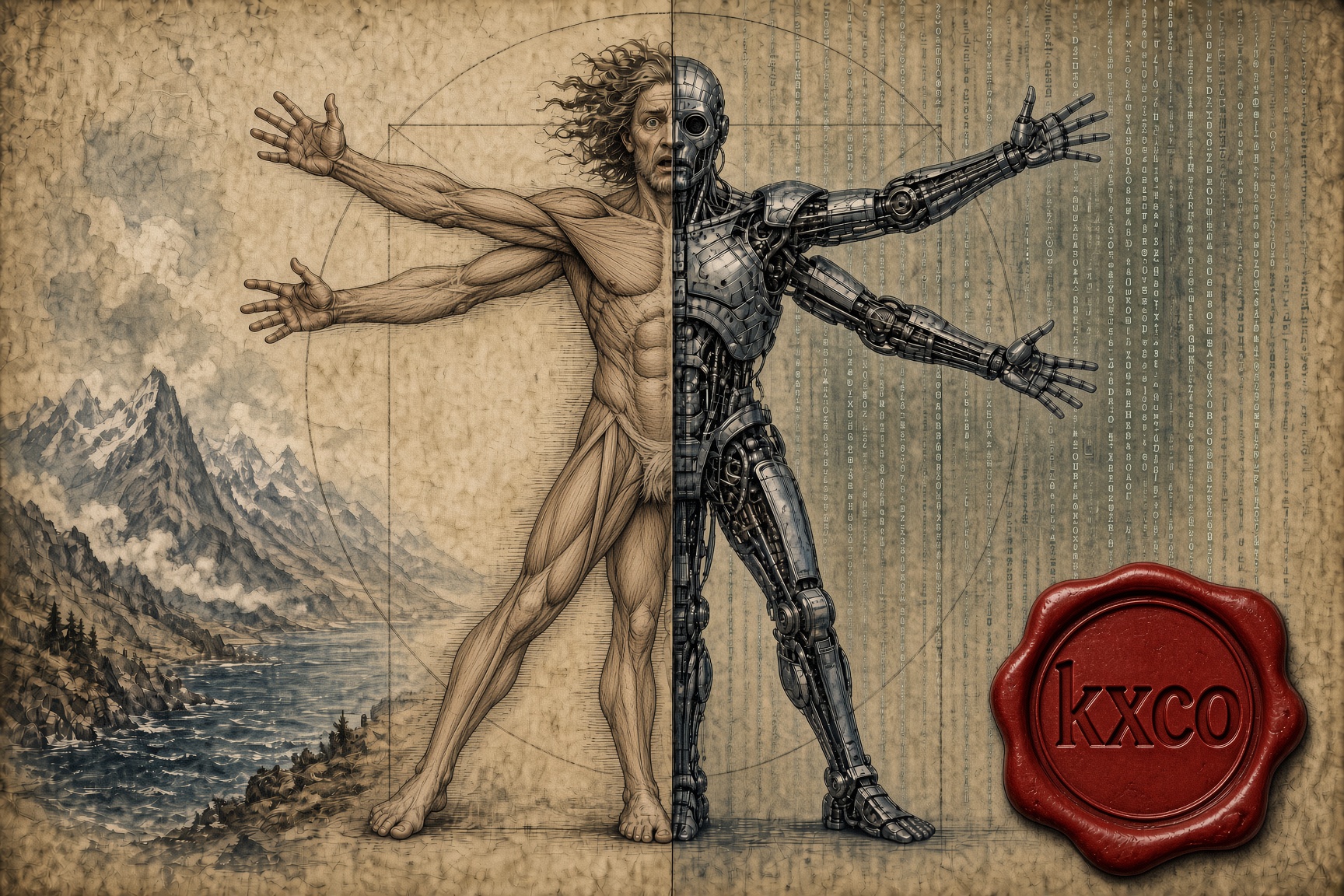
Don't Be the Best, Be the Only: Winning in an AI World
AI is repricing competence downward. What it cannot reproduce is a life. The case for remaining non-fungible, why friction still produces the best ideas, and what it means to build AI systems that keep the human intellect in them.
Every story, signed and delivered.
Subscribe to the kxco channel and get the headline, the AI-written key takeaways, and the chain-anchor link the moment we publish. Audio versions and per-ticker subscriptions arrive in the next iteration.