
The AI-Quantum Convergence Hits Critical Mass
and how to trade it
Part of theMacro Center
The AI-Quantum Convergence Hits Critical Mass
Where Value Concentrates in August 2026 — and Why KXCO Ontology Is Now the Real Edge
By Shayne Heffernan, Ph.D.
August 3, 2026
The week opened with a familiar but sharper tension. U.S. equity futures pointed higher after Amazon’s cloud results re-ignited the AI infrastructure narrative. Crude slipped below $85 as President Trump paused kinetic options on Iran and pursued talks. The Nasdaq Composite had closed Friday at 25,373.85, the S&P 500 at 7,489.72, and the Dow at 52,485.03. Gold hovered near $4,050. Bitcoin traded in the low $60,000s. On the surface it looked like a normal risk-on Monday. Underneath, three structural forces were colliding with greater force than at any point this year: the sustained capital intensity of AI compute, the accelerating practical roadmap for quantum systems, and the sudden recognition that neither can be navigated safely without a shared, verifiable model of reality.
That model is the ontology. Not a knowledge graph bolted on after the fact, but a live, post-quantum verified map of entities, capital flows, dependencies, and claims. You can inspect the working version for the AI sector here: https://kxco.ai/ontology-live/.
What follows is the market context as of August 3, 2026, the state of the AI and quantum trades, the specific value concentrations the ontology is currently identifying, and why names such as $BABA, $NVDA, $IONQ, $RGTI and the hyperscalers sit where they do.
Friday’s close reflected selective strength. Amazon’s results, particularly the acceleration in cloud and AI-related revenue, lifted the broader complex even as Apple’s more muted guidance reminded investors that not every mega-cap is in the same part of the cycle. Memory names remained under pressure after earlier July volatility. Oil’s decline on de-escalation talk provided a mild tailwind for risk assets and a headwind for energy.
Asian markets opened mixed, with South Korean chipmakers giving back recent gains. Indian benchmarks opened higher on the crude move and firm global cues. The immediate calendar remains heavy: ISM manufacturing data, further earnings including several industrial and pharmaceutical names, and the non-farm payrolls report later in the week. SpaceX’s first post-listing quarterly is also on the radar for those tracking private-to-public transitions in high-technology infrastructure.
None of these daily moves alter the deeper picture. The AI infrastructure build-out continues to demand extraordinary capital expenditure. Quantum roadmaps are no longer pure science projects. And the cryptographic transition required by the arrival of useful quantum systems is now a near-term compliance and competitive issue rather than a 2035 problem.
AI Infrastructure: The Capital Wall Remains High
The AI trade in 2026 is no longer about whether demand exists. It is about whether returns on the capital being deployed will justify the scale of spending. Alphabet has guided capital expenditure into the $195–205 billion range for the year. Microsoft, Amazon and Meta continue to post cloud growth rates that would have been extraordinary five years ago. Nvidia remains the single most critical choke point in the physical stack.
The ontology at https://kxco.ai/ontology-live/ quantifies this concentration with unusual clarity. As of the July 2026 data refresh, Nvidia appears as the most-connected entity across the mapped AI sector graph. Dozens of major labs, cloud providers and sovereign programmes route through a single vendor for frontier accelerators. The recent AMD–Anthropic arrangement (up to 2 GW of MI450 capacity plus equity participation) is recorded as a partial mitigant — the first credible second source at the frontier-lab tier — but it is forward-dated and does not yet remove the systemic dependency.
This is the kind of structural observation that pure price action does not surface. $NVDA can continue to deliver exceptional results while the concentration risk itself grows. Investors who only watch the quarterly print miss the fragility that sits one layer below.
The same map tracks capital flows exceeding $1.1 trillion across the AI supply chain and identifies multiple single points of failure beyond the GPU layer: EUV lithography concentration, high-bandwidth memory production, advanced packaging capacity, and the electricity and cooling constraints that are now visible in every major data-centre cluster.
Quantum Computing: From Narrative to Roadmaps
Quantum computing has moved through several hype cycles. In 2026 the tone is different. IBM continues to target verified quantum advantage before year-end and has shifted its public narrative toward a multi-billion-dollar investment plan and a 2029 fault-tolerant machine (Starling). Google’s Willow architecture and Microsoft’s topological work keep the large-cap presence alive. Pure-play names — $IONQ, $RGTI, $QBTS and others — remain high-beta expressions of the theme, with revenue growth in some cases still explosive but valuations sensitive to any pause in the broader AI risk appetite.
The practical linkage to AI is now explicit. Error correction, hybrid classical-quantum workflows, and the eventual use of quantum systems for optimization and simulation problems that classical systems handle poorly all sit inside the same capital and talent pool. Jensen Huang’s observation that AI is essential to making quantum practical has become conventional wisdom among the hardware teams.
At the same time, the cryptographic clock is running. NIST’s post-quantum standards are published. Governments have begun setting transition deadlines. Financial institutions, critical infrastructure operators and anyone holding long-lived data are under pressure to achieve crypto-agility. This is not a 2035 story. It is a 2026–2030 procurement and architecture story.
The pure-play quantum stocks remain speculative vehicles. The cleaner expressions of the broader theme remain the companies that sit at the intersection of AI infrastructure, hybrid computing and the post-quantum migration itself — $NVDA, $IBM, $MSFT, $GOOGL and the specialized security and verification layer that must sit underneath any serious enterprise deployment.
The Missing Layer: Ontology as Infrastructure
Software can now act. Agents move money, sign documents, rebalance portfolios and trigger supply-chain decisions with limited or no human intervention. Traditional ledgers can prove that a transaction occurred. They cannot tell you what the transaction meant, who the real parties were, whether the action was authorized under the current permission set, or how the entity relates to the rest of the economic graph.
That gap is the ontology.
KXCO’s approach treats ontology not as a descriptive overlay but as a first-class, post-quantum verified layer. Entities (companies, agents, assets, claims, permissions) are structured objects. Relationships are typed. Claims are sourced. The entire model is anchored to Armature L1 so that the same verifiable reality can be referenced by human analysts, institutional systems and autonomous agents.
The live AI-sector instance at https://kxco.ai/ontology-live/ currently tracks more than 200 entities and over 500 sourced claims. It surfaces systemic patterns that are invisible when research is conducted company-by-company or filing-by-filing.
One of the highest-severity findings remains the Nvidia concentration already noted. Another is the unusual capital structure around Anthropic: simultaneous backing by Amazon, Google, Microsoft, Nvidia and now AMD — five direct competitors on a single cap table at a post-money valuation that had reached $965 billion by the May 2026 Series H. The ontology records this as both a source of resilience (diversified compute access) and a source of governance complexity.
Chinese participation in the AI stack is mapped with equal care. $BABA appears not merely as an e-commerce and cloud company but as a central node in domestic model development (Qwen), cloud AI services, chip efforts via T-Head, and the broader attempt to reduce external dependency. Recent reports of Alibaba providing substantial Nvidia chip access to Moonshot and testing Qwen across Tesla vehicles in China are the kind of multi-entity claims the ontology is designed to hold and keep current.
The value of this approach is practical. An investor or risk manager can move from a high-level systemic risk (single-vendor GPU dependency) to the specific entities and capital flows that create it, then to the public evidence underlying each claim, without reconstructing the entire research stack from scratch every quarter.
$BABA and the Chinese AI Stack
Alibaba has spent 2026 oscillating between AI optimism and China-specific risk. Cloud growth has accelerated, with AI-related products contributing a rising share of external cloud revenue. The company continues to invest in proprietary silicon and foundation models. At the same time it operates under the familiar VIE structure and faces the full suite of geopolitical, regulatory and capital-market constraints that attach to major Chinese technology names.
The ontology does not resolve the valuation debate. It does make the positioning clearer. $BABA sits at the intersection of domestic cloud AI demand, model development, and the attempt to build a parallel stack less dependent on the U.S. export-controlled frontier. When the broader AI narrative is strong and China risk appetite improves, the stock can move sharply, as it did in recent sessions. When either leg weakens, the same concentration of exposure works in reverse.
For multi-asset and cross-border portfolios, the ability to see $BABA’s relationships to the rest of the AI graph — rather than treating it as a pure China proxy or a pure e-commerce name — is a material analytical advantage.
Pure-Play Quantum versus Hybrid Winners
$IONQ, $RGTI and $QBTS have delivered periods of extraordinary percentage moves and equally sharp drawdowns. Revenue growth at the leaders has been real. Commercial traction is visible in cloud access and early enterprise contracts. Yet the path to sustained profitability and to fault-tolerant systems that can displace classical workloads at scale remains multi-year.
The cleaner expression of the quantum theme for most institutional capital continues to be the companies that already generate substantial cash flow from AI infrastructure while funding quantum research and preparing their own cryptographic transition. $NVDA sits at the hybrid classical-quantum software and control layer. $IBM has made quantum a board-level capital allocation priority. The hyperscalers offer quantum access through their clouds while simultaneously being the largest buyers of the classical accelerators that quantum systems will need to work alongside.
Post-quantum cryptography itself is a nearer-term procurement cycle. Institutions that treat it as a 2030 problem will discover that vendors, regulators and counterparties have already begun demanding evidence of crypto-agility.
Trading Implications and Risk Map
The immediate market backdrop supports selective risk. Softening oil prices and firm mega-cap cloud results provide cover. The deeper risks remain structural:
Concentration risk in the AI physical stack ($NVDA and the supporting semiconductor and power ecosystem).
Valuation and funding risk in pure-play quantum names if the broader AI risk appetite cools.
Geopolitical and regulatory risk around Chinese technology exposure, including $BABA.
Cryptographic transition risk for any institution holding long-lived sensitive data or operating critical systems.
The ontology does not eliminate these risks. It makes them visible as a coherent graph rather than a collection of isolated headlines. That visibility is the practical edge.
Our Strategy
At KXCO we do not treat ontology as an analytical luxury or a research product. It is core infrastructure. The same post-quantum verified model of reality that powers the live AI-sector map at https://kxco.ai/ontology-live/ is the foundation on which we build identity, permissions, attestations, settlement and agent coordination.
Our strategy is straightforward. First, make the structure of economic reality visible and verifiable so that both human decision-makers and autonomous agents operate from the same ground truth. Second, anchor every claim, identity and permission to Armature L1 so the model cannot be rewritten without detection. Third, expose that model through clean interfaces so institutions, funds, trading platforms and AI systems can consume it without rebuilding the research stack themselves.
In practical terms this means we prioritise three concurrent workstreams:
Ontology expansion and depth. We continuously extend the live graphs — starting with AI, then broadening into capital markets, digital assets and cross-border flows — so that concentration risks, capital structures and interdependencies remain current.
Integration into execution and custody rails. The ontology is designed to sit alongside trading, settlement and custody systems. When a position, a counterparty or an agent action is evaluated, the same verified entity graph is available.
Post-quantum readiness as default. Every signature, attestation and record we produce is already on the NIST path. We treat crypto-agility as a present requirement, not a future project.
This is why the AI-Quantum convergence matters to us beyond the trading implications for $NVDA, $BABA, $IONQ or the hyperscalers. The same forces that are concentrating risk and opportunity in the physical and capital stacks are also forcing a rewrite of how trust, identity and meaning are established in digital systems. KXCO exists to supply that rewrite.
Investors, institutions and platform partners who continue to navigate 2026 markets with disconnected documents and lagging mental models will find themselves permanently behind the agents and systems that do not. Our strategy is to ensure that the human side — and the institutional side — can operate with equal clarity, on the same verified foundation.
The live ontology is open for inspection. The infrastructure is operational. The work continues.
Shayne Heffernan, Ph.D.
Founder, KXCO
Live Trading News
August 3, 2026

Musk and Colossus: Inside the 1.29 Gigawatt Machine in Memphis
Elon Musk is sleeping in an Airstream beside a warehouse in Whitehaven with MACROHARD painted on the roof. The machine next to it is a two-state compute campus carrying about 1.29 gigawatts of IT load, roughly 670,000 accelerators and 48.7 billion dollars of modeled capital, per Epoch AI cards of 16 September 2026. A field brief on the buildings, the silicon, the turbines, the batteries, the tenants who now hold the hours, and what the compute is actually worth.
Quantum Is Accelerating
Quantum is accelerating. Not toward a machine that breaks RSA next quarter, which is still five orders of magnitude away on the first honest cross-platform yardstick the field has ever had, but toward foundries, clouds, logical qubits and government deadlines that are already fixed. Two clocks are running. Only one of them is slow, and it is not the one that decides what a bank, a court or a ministry has to do this year.

Ignore the Noise: AI Is Not Slowing Down
Commentators pointed at a flat Nasdaq, a few missed prints, the cost of a megawatt and a safety letter, and called it a slowdown. It is not. Between 12 August and 16 September 2026 nine labs shipped frontier or near-frontier models, and the contest moved from one leaderboard to two stacks. What actually slowed is accountability. Enterprises still cannot put any of it into a court file. That gap, not the capability curve, stops deployment inside banks, hospitals, courts and ministries.
Quantum Cybersecurity: The KXCO Chain Is Already Running
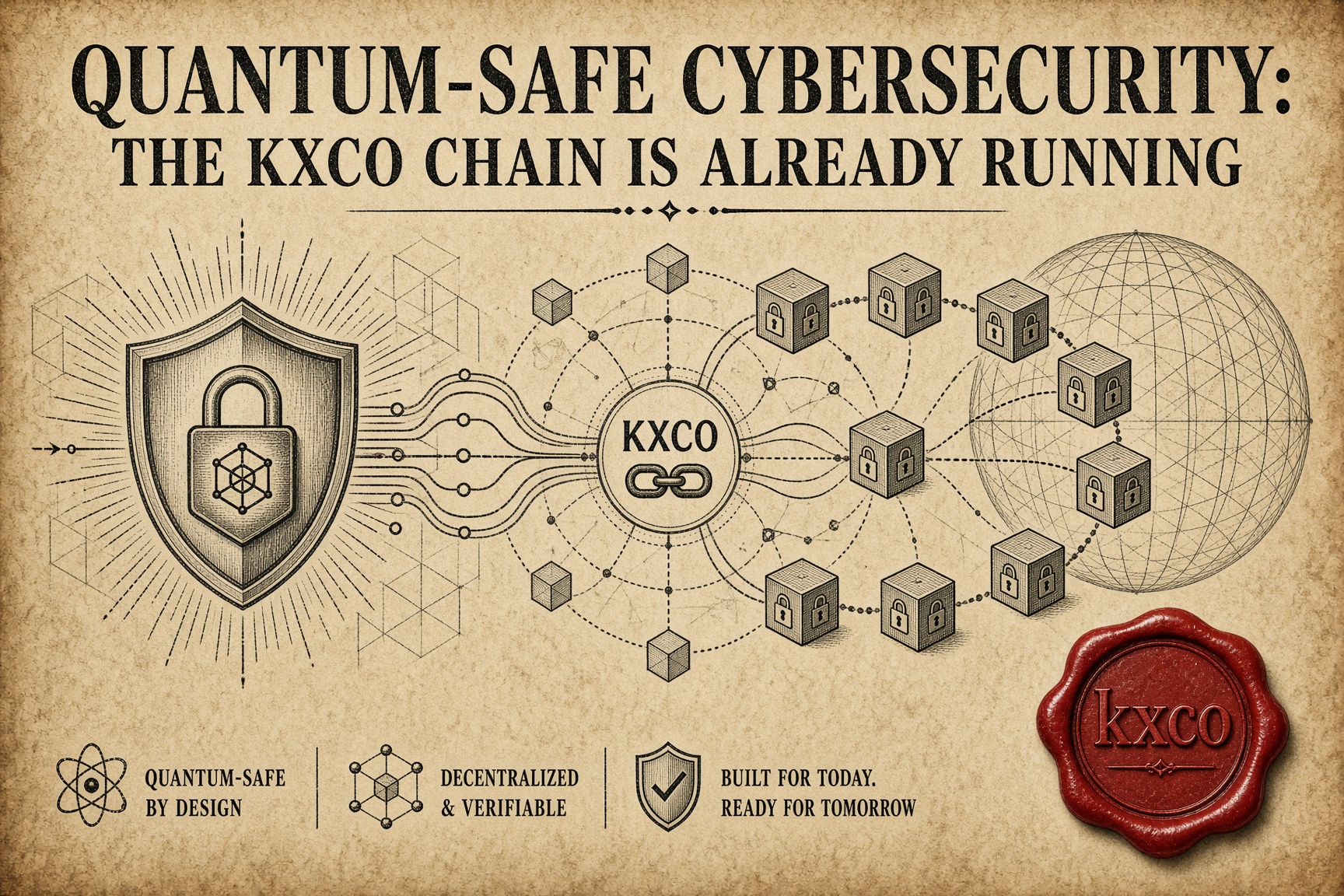
The World Economic Forum warned on 11 September that the quantum-safe race has changed gears. It is right about the direction and late about the work. Every KXCO product already runs on NIST's post-quantum algorithms, and all of them run on the same implementation: 42 package manifests declare one library. The chain verifies ML-DSA-65 on-chain at precompile 0x0b, tested live with three negative controls. NIST's own grader marked the library at 2,130 cases and zero failures.
Every story, signed and delivered.
Subscribe to the kxco channel and get the headline, the AI-written key takeaways, and the chain-anchor link the moment we publish. Audio versions and per-ticker subscriptions arrive in the next iteration.