
Some Facts about Interest Rates, Inflation, Wall Street and Economic Growth $SPY $QQQ
Wall Street numbers do reflect more of the global economy than simply the US economy. This is because the US stock market is the largest and most liquid stock market in the world. As a result, it is a major barometer of global economic activity.
For example, the S&P 500 index is a stock market index that tracks the performance of 500 large companies listed on stock exchanges in the United States. The S&P 500 is often used as a proxy for the US economy as a whole. However, the index also includes companies that do business around the world. As a result, the performance of the S&P 500 can be affected by economic conditions in other countries.
Another example is the Dow Jones Industrial Average (DJIA). The DJIA is a stock market index that tracks the performance of 30 large companies listed on stock exchanges in the United States. The DJIA is also often used as a proxy for the US economy as a whole. However, the index includes companies that are major exporters, such as Boeing and Caterpillar. As a result, the performance of the DJIA can be affected by economic conditions in other countries.
In addition to the stock market, other Wall Street numbers, such as interest rates and currency exchange rates, can also be affected by global economic conditions. For example, if interest rates in the US rise, it can make it more expensive for businesses to borrow money, which can slow economic growth in the US and around the world. Similarly, if the US dollar weakens against other currencies, it can make it more expensive for US businesses to import goods and services, which can also slow economic growth.
Overall, Wall Street numbers are a good indicator of the global economy. However, it is important to remember that they are not a perfect measure of economic activity. There are a number of factors that can affect Wall Street numbers, and not all of these factors are related to the US economy.
The Fed
The Federal Reserve often lowers interest rates in an effort to stimulate economic growth. This can be effective in the short term, but it can also lead to inflation in the long term. The Federal Reserve often raises interest rates in an effort to control inflation. This can be effective in the short term, but it can also lead to a recession in the long term. The relationship between interest rates and economic growth is not always clear-cut. There have been periods when interest rates have been high and economic growth has been strong, and there have been periods when interest rates have been low and economic growth has been weak.
Inflation
The average inflation rate in the United States over the past 100 years is 3.30%.
The highest inflation rate was 23.70% in June 1920, during the aftermath of World War I.
The lowest inflation rate was -15.80% in June 1921, during the Great Depression.
Interest Rates
The average federal funds rate in the United States over the past 100 years is 4.5%.
The highest federal funds rate was 20% in 1981, during the Volcker disinflation.
The lowest federal funds rate was 0% in 2008, during the Great Recession.
Economic Growth
The average economic growth rate in the United States over the past 100 years is 3.2%.
The highest economic growth rate was 10.8% in 1973, during the Vietnam War.
The lowest economic growth rate was -3.9% in 2009, during the Great Recession.
As you can see, there is no clear correlation between inflation and economic growth. There have been periods of high inflation and high economic growth, as well as periods of low inflation and low economic growth.
There are a number of factors that can affect inflation and economic growth, including:
Monetary policy: The Federal Reserve controls the money supply, which can affect inflation.
Fiscal policy: The government's spending and tax policies can also affect inflation.
Supply shocks: Natural disasters or other events that disrupt the supply of goods and services can cause inflation.
Demand shocks: Events that increase demand for goods and services, such as a war or a recession, can also cause inflation.
Productivity growth: Economic growth can be driven by productivity growth, which is the increase in output per worker.
The relationship between inflation and economic growth is complex and depends on a variety of factors. There is no single answer to the question of how to achieve both low inflation and high economic growth.
The US has seen declining productivity over the last 20 years. According to the US Bureau of Labor Statistics, labor productivity growth has averaged just 1.2% per year since 2000, compared to 2.2% per year in the 1990s.
There are a number of factors that have contributed to the decline in productivity growth, including:
The aging workforce: The US workforce is aging, and older workers tend to be less productive than younger workers.
The decline of manufacturing: The manufacturing sector has been declining in the US, and manufacturing is a highly productive sector.
The rise of the service sector: The service sector has been growing in the US, and the service sector is less productive than the manufacturing sector.
The slowdown in technological innovation: Technological innovation has slowed in recent years, and technological innovation is a major driver of productivity growth.
The decline in productivity growth has had a number of negative consequences for the US economy, including:
Slower economic growth: Slower productivity growth means that the economy is growing more slowly.
Lower wages: Lower productivity growth means that businesses have less money to pay workers, which can lead to lower wages.
Higher unemployment: Lower productivity growth can lead to higher unemployment, as businesses may need to lay off workers in order to remain profitable.
There are a number of things that can be done to address the decline in productivity growth, including:
Investing in education and training: Investing in education and training can help to increase the skills of the workforce, which can lead to higher productivity.
Promoting innovation: Promoting innovation can help to develop new technologies that can boost productivity.
Reforming the tax code: Reforming the tax code can make it easier for businesses to invest and grow, which can lead to higher productivity.
The decline in productivity growth is a complex issue, and there is no single solution. However, by addressing the factors that have contributed to the decline, it is possible to boost productivity growth and improve the US economy.

AI is the Neat Handwriting of the Illiterate
A model in the hands of someone who has read the filing and walked the plant is a clerk. The same model, speaking for someone who has done neither, is a disguise. On AI slop, phantom citations and factslop, why finish stopped being evidence of work, and the containment layer KXCO built so a machine cannot speak as the institution until a source is attached.

Worthship: Do Not Conform to the Age
Worthship is the older English word for worship, and it means to ascribe worth. Bishop Robert Barron preached Romans 12 on 30 August. This essay follows the text into the prison letters, and puts two questions to a graph: do the four readings of that Sunday agree, and was Paul free or in chains when he wrote about despair?
The Truth in All Its Ugliness Must Survive
A majority vote does not determine the truth. Consensus is a mood, gossip is a sport, and a model will write the pretty version for free. Why the ugly number has to survive, why a record beats a dashboard, and what KXCO was built to keep standing when the room changes its mind.
Don't Be the Best, Be the Only: Winning in an AI World
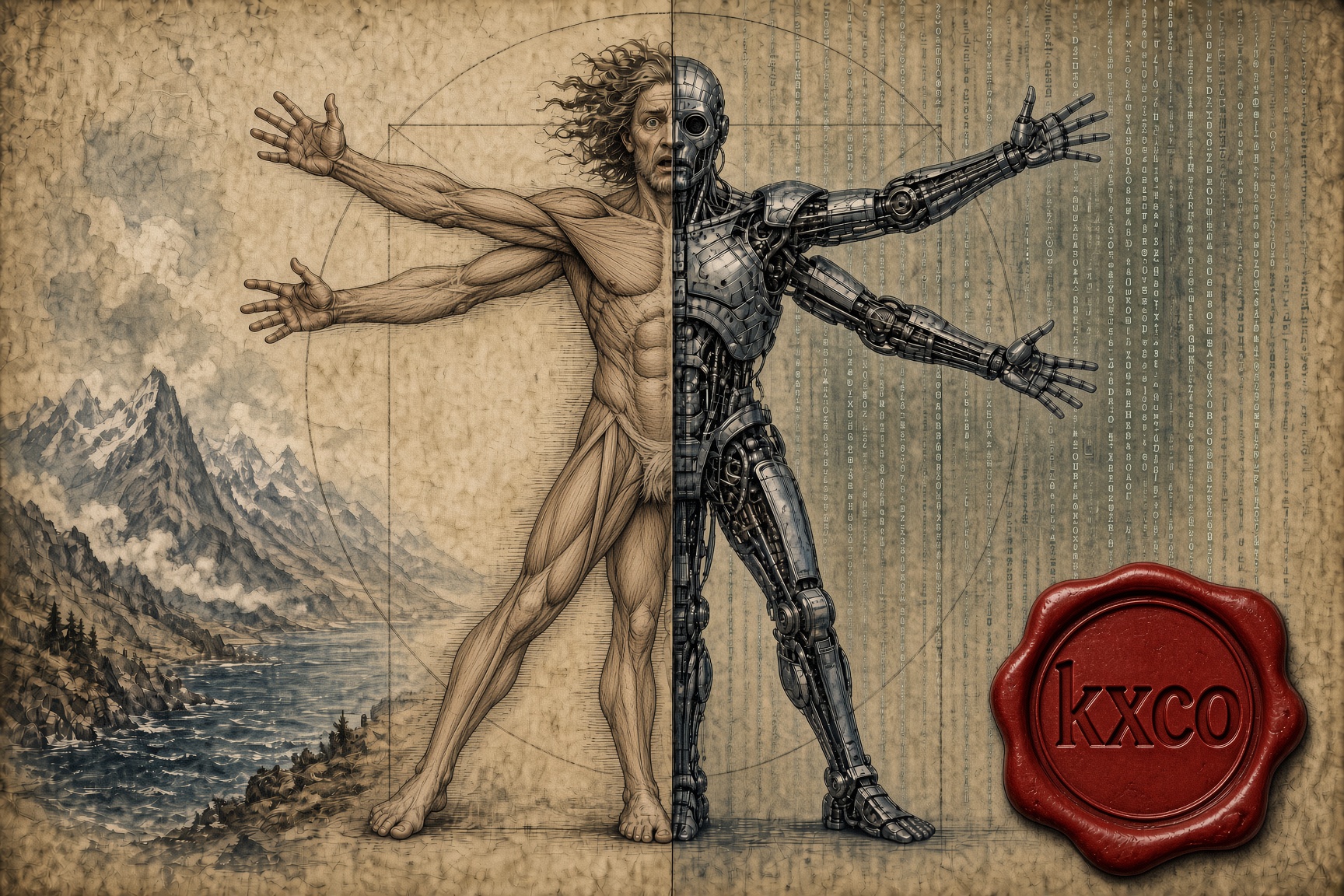
AI is repricing competence downward. What it cannot reproduce is a life. The case for remaining non-fungible, why friction still produces the best ideas, and what it means to build AI systems that keep the human intellect in them.
Every story, signed and delivered.
Subscribe to the kxco channel and get the headline, the AI-written key takeaways, and the chain-anchor link the moment we publish. Audio versions and per-ticker subscriptions arrive in the next iteration.