
KXCO Releases an AI SEO Extension for Chrome
Agent Lens grades any site on how legible it is to AI agents. We tested fourteen well-run sites and none scored an A.
Part of theAI Stocks Center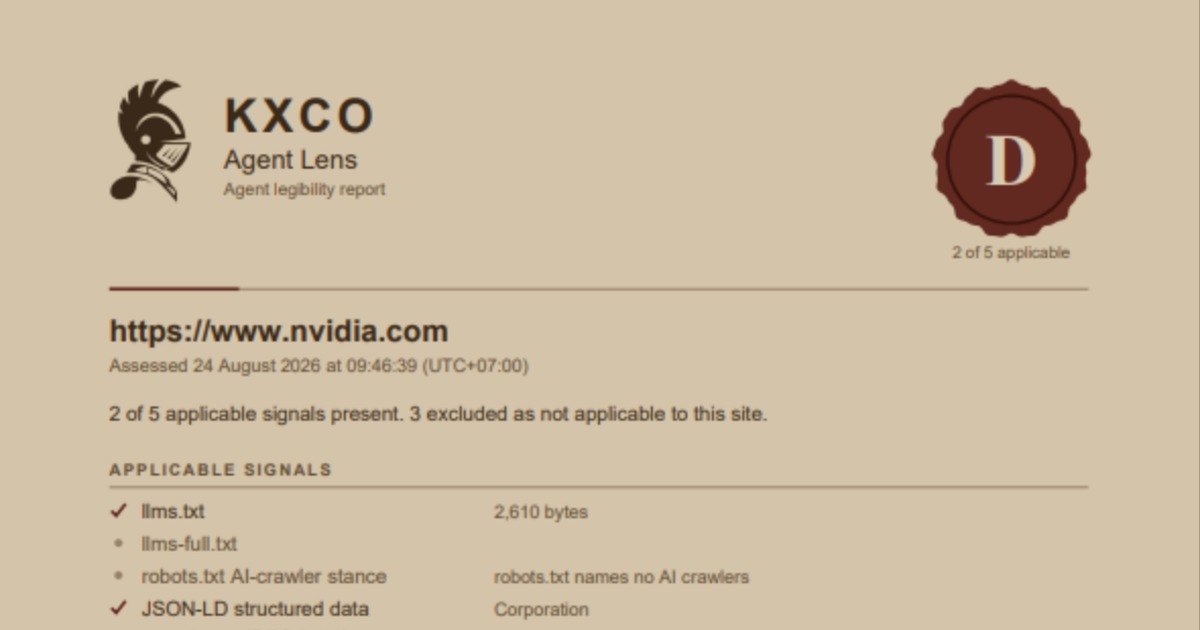
For thirty years a website had two audiences and both arrived through the same front door: a person, and a search crawler whose job was to send that person to you. One set of decisions served them both.
That arrangement is ending. Cloudflare's chief executive Matthew Prince said in March 2026 that he expects bot traffic online to exceed human traffic in 2027. His explanation of why is the part worth keeping. Performing a single task such as shopping, a person might visit five websites where an agent visits five thousand.
Those visits mostly do not send anyone back. On Cloudflare's own measurements, training accounted for close to 80% of AI bot crawling in July 2025, and in the first week of that August the ratio of pages crawled to visitors referred ran to nearly 50,000 to 1 for Anthropic, 887 to 1 for OpenAI and 118 to 1 for Perplexity.
Put those together and the machine reading of a company's website is already the visit that actually happens. The human arriving afterwards is the exception. Almost no business knows what those machine readers find when they get there.
KXCO has released a free Chrome extension that answers it in one click.
What Agent Lens does
Agent Lens is on the Chrome Web Store under Developer Tools. You install it, open any site, and click the icon. Within a few seconds it returns a letter grade and the evidence behind every mark. There is no account, no dashboard and nothing to configure.
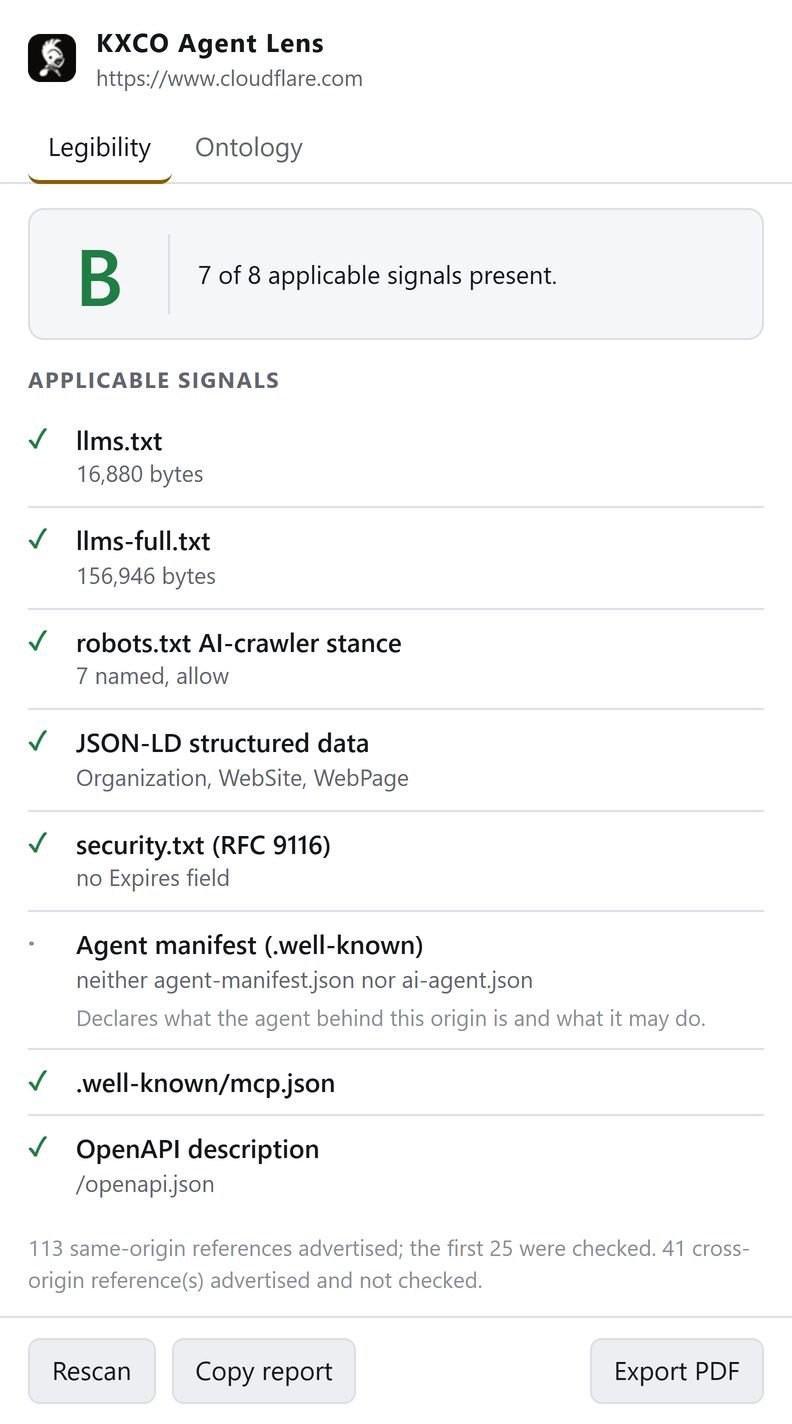
Behind the popup it requests thirteen machine-facing files from the site you are looking at, reads the structured data out of the live page, and checks whether robots.txt takes any position at all on twenty named AI crawlers, from GPTBot and ClaudeBot through to Bytespider and Applebot-Extended. Then it scores eight signals: the llms.txt convention and its long form, the crawler stance, JSON-LD structured data, a security contact under RFC 9116, an agent manifest, an MCP manifest, and an OpenAPI description.
Two design decisions make the grade worth reading.
The first is that a signal only counts where the site's own surface implies it should exist. A brochure site that advertises no API is not marked down for lacking an API description. Those checks drop out of the denominator and are listed separately with the reason given. Most scoring tools mark every site against every check, which lands everything in the same narrow band and tells the owner nothing.
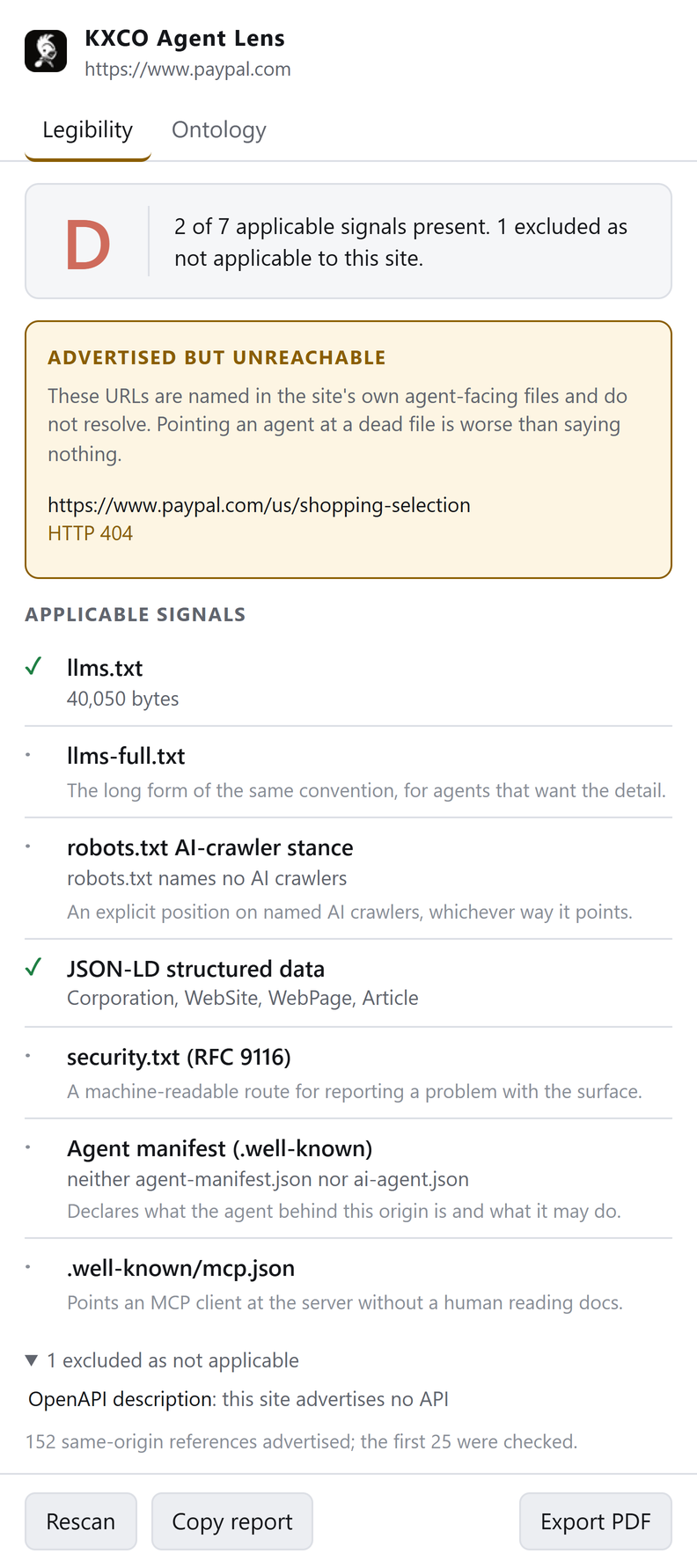
The second is that the extension checks the site's own promises. It collects every URL named inside those agent-facing files and confirms that the URLs resolve. A file you advertise to an agent and do not serve is worse than saying nothing, because silence sends the agent elsewhere while a dead link stops it. A broken promise caps the grade at C however complete the rest of the surface is.
It is also strict about what counts as present. Plenty of sites answer every request with HTTP 200 and their own homepage, because a catch-all route swallows the path. A naive checker records that as a pass. Agent Lens treats it as a miss and says so.
Fourteen sites, and not one A
These results were produced on 24 August 2026 by running the scorer shipped in version 0.1.0 against each site's live front page. Every result was checked a second time with a direct request.
Site | Grade | Signals | What decided it |
|---|---|---|---|
cloudflare.com | B | 7 of 8 | The only site tested carrying llms.txt, a 157KB long form, an MCP manifest, an OpenAPI description and a named crawler stance |
bbc.co.uk | B | 3 of 4 | No llms.txt, but names fifteen AI crawlers and disallows them all. A decision counts as legibility |
kxco.ai | C | 5 of 8 | KXCO's own site. Nineteen crawlers named and allowed, no agent manifest, no MCP manifest |
vercel.com | C | 4 of 8 | An OpenAPI description and a small llms.txt. Silent on AI crawlers |
supabase.com | C | 4 of 8 | Four crawlers named and allowed, and a long form that runs past the read cap |
shopify.com | C | 4 of 8 | Both llms.txt files present. No crawler stance, no MCP manifest |
stripe.com | D | 3 of 8 | A 65KB llms.txt, then nothing machine-facing for the API it is famous for |
github.com | D | 3 of 8 | Serves the same 28KB file as both the short and the long form. No structured data on the front page |
paypal.com | D | 2 of 7 | A 40KB llms.txt that advertises a URL returning 404 |
nvidia.com | D | 2 of 5 | A small llms.txt and one structured data type. No security contact |
huggingface.co | D | 2 of 5 | An OpenAPI description and a security contact valid to 2030, and no llms.txt at all |
anthropic.com | D | 1 of 4 | No llms.txt, no structured data, no stance on the crawlers it operates itself |
openai.com | D | 1 of 4 | The same shape, and no llms.txt to be found |
perplexity.ai | F | 0 of 4 | Nothing present, and a security contact that expired in November 2025 |
Cloudflare ($NET) is the only site in the set that looks designed for this audience. GitHub, now part of Microsoft ($MSFT), publishes the same file twice under two names. Shopify ($SHOP) and Nvidia ($NVDA) sit mid-table, and PayPal ($PYPL) is the cautionary tale.
The companies that read the most publish the least
The three names from those crawl-to-referral ratios, the ones doing the most reading of everyone else's sites and the least sending back, are also the three least legible sites in this test. Anthropic, OpenAI and Perplexity ask more of the machine-readable web than anyone and publish less of it than a regional broadcaster.
The payments companies are the other surprise, and the more commercially interesting one. Stripe and PayPal have more to gain than most from an agent describing their product correctly, and both sit near the bottom.
PayPal shows exactly why the second rule earns its place. Its file for AI agents is a serious 40KB document, and inside it the site points those agents at a page that returns 404. Somebody did the work and the surface drifted underneath it, which is the ordinary way this fails.
Keral Patel, the technologist who built the extension and heads the KXCO team in India, said the payments results were what surprised him during testing.
Stripe and PayPal scored badly when I was expecting them to grade nicely.
What a bad grade costs
An agent that cannot read a company's site does not politely skip it. It fills the gap from whatever else it can reach, which means competitors, forums, old press coverage and whatever sat in its training data. The company is then described to a buyer by sources it does not control and cannot correct.
That is the commercial case, and it is why this belongs under AI SEO rather than compliance. The files being checked are cheap to publish and most of them are an afternoon of work. The cost of not publishing them is a description of your business written by somebody else.
A second lens
The popup carries a second tab that answers a different question: not how readable this page is, but what is already known about the companies it names. It reads KXCO's published ontology of the AI sector, 387 entities as of 22 August 2026, finds the entities mentioned on the page, and shows the typed claims attached to them with a source link and a date on each. Where a page names nothing in the graph it says so, rather than inventing a connection.
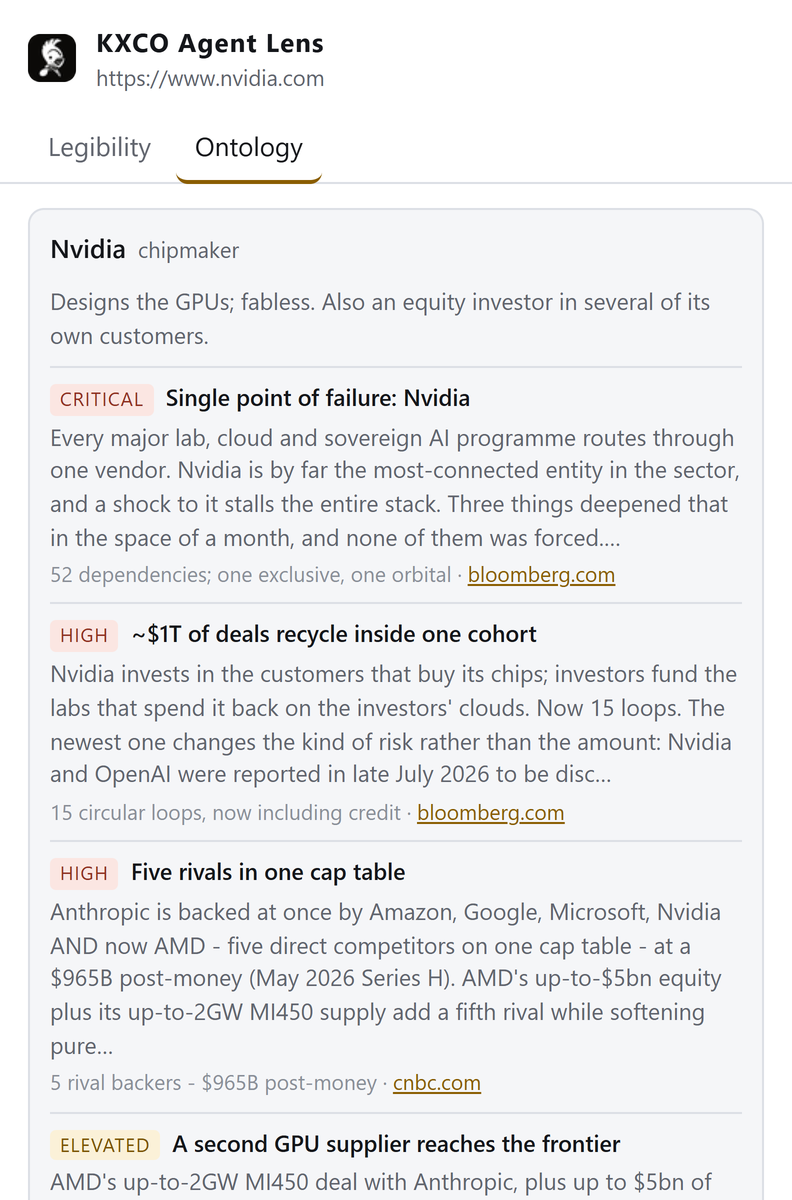
Both tabs export to a one-page PDF, written by the extension itself with no server involved.
What it does not do
This is version 0.1.0, published on 21 August 2026, and it is honest about its limits. It grades one page at a time, with no crawl and no site-wide roll-up. Advertised URLs on other domains are counted and not fetched. Several of the eight signals are conventions rather than standards, since llms.txt is a proposal that caught on while the security contact is a published RFC. The exported report carries a drawn wax seal rather than a cryptographic signature, which KXCO says was deliberate in order to keep the extension free of outbound calls.
A Firefox listing is expected this week. KXCO says the next version will draw on its own infrastructure rather than staying self-contained.
How to check your own site
The extension is on the Chrome Web Store as KXCO Agent Lens. Install it, open your own site, and click the icon. If you run a website that has never been designed for this second audience, the result will probably be a C.
Stocks mentioned in this article: $NET, $PYPL, $NVDA, $SHOP and $MSFT.
Shayne Heffernan, Ph.D., is the founder of Live Trading News, the KnightsBridge Group, Knightsbridge Law and the KXCO.ai ecosystem spanning post-quantum cryptography, identity, attestation and enterprise ontology.

AI Is Being Powered by Tech That Looks Almost Alien
Every frontier AI model runs on chips printed by one Dutch machine. ASML's extreme-ultraviolet scanner fires a laser at up to 50,000 droplets of molten tin a second, per ASML, and bounces the light off mirrors whose deviations are tens of picometres. Veritasium called it the closest thing we have to alien technology. This piece takes the film as the brief and checks it: the machine, High-NA, and the wafer-scale chips and liquid-cooled racks downstream of it.
There Is No AI Bubble
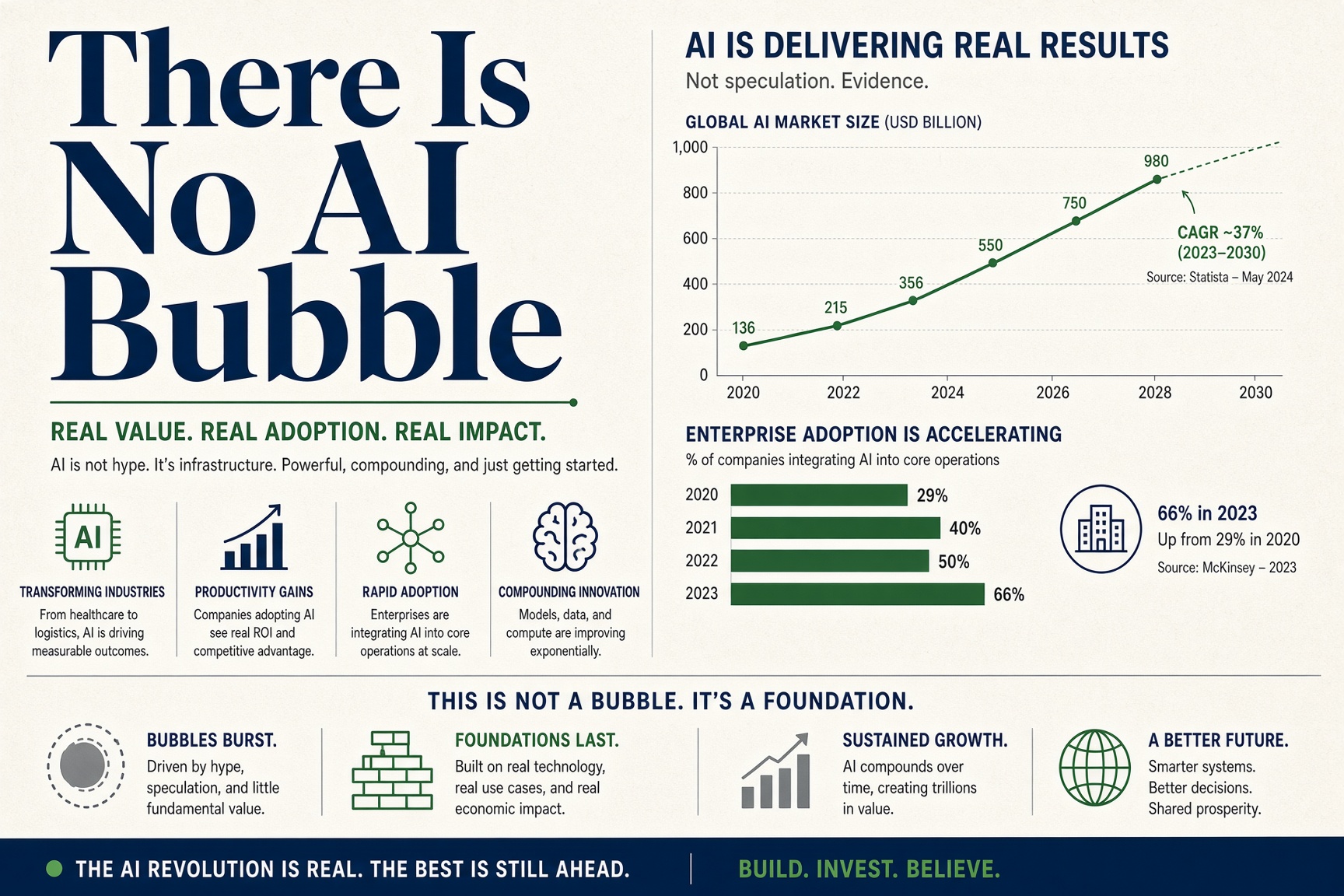
There is no AI bubble. A bubble is capacity nobody uses, demand nobody signs for and a glut when the building stops. KXCO's AI sector ontology, refreshed on 7 October 2026, finds the reverse: adoption rising on six independent measures, about $2.35tn of contracted backlog at the four largest sellers of compute per their own reports, and supply rationed at every layer. It keeps the bear case in the same record, 20 circular capital claims, and answers it.

Weekly Market Outlook: Fed Minutes, Anthropic and OpenAI IPOs, Gold, Bitcoin, FX
The Fed raised rates in September and payrolls rose 29,000, per the Labor Department. This week the FOMC minutes, three Treasury auctions and a 10-year near 5.3 percent test that gap. Anthropic's IPO clock runs toward a 14 October investor day while OpenAI's chief executive says not 2026. Gold sits 26 percent below its record, bitcoin near $85,500, the dollar up three weeks running. Two knowledge graphs from KXCO's records map the IPO backers and the FDA board.
Thoughts on Thinking in an AI World
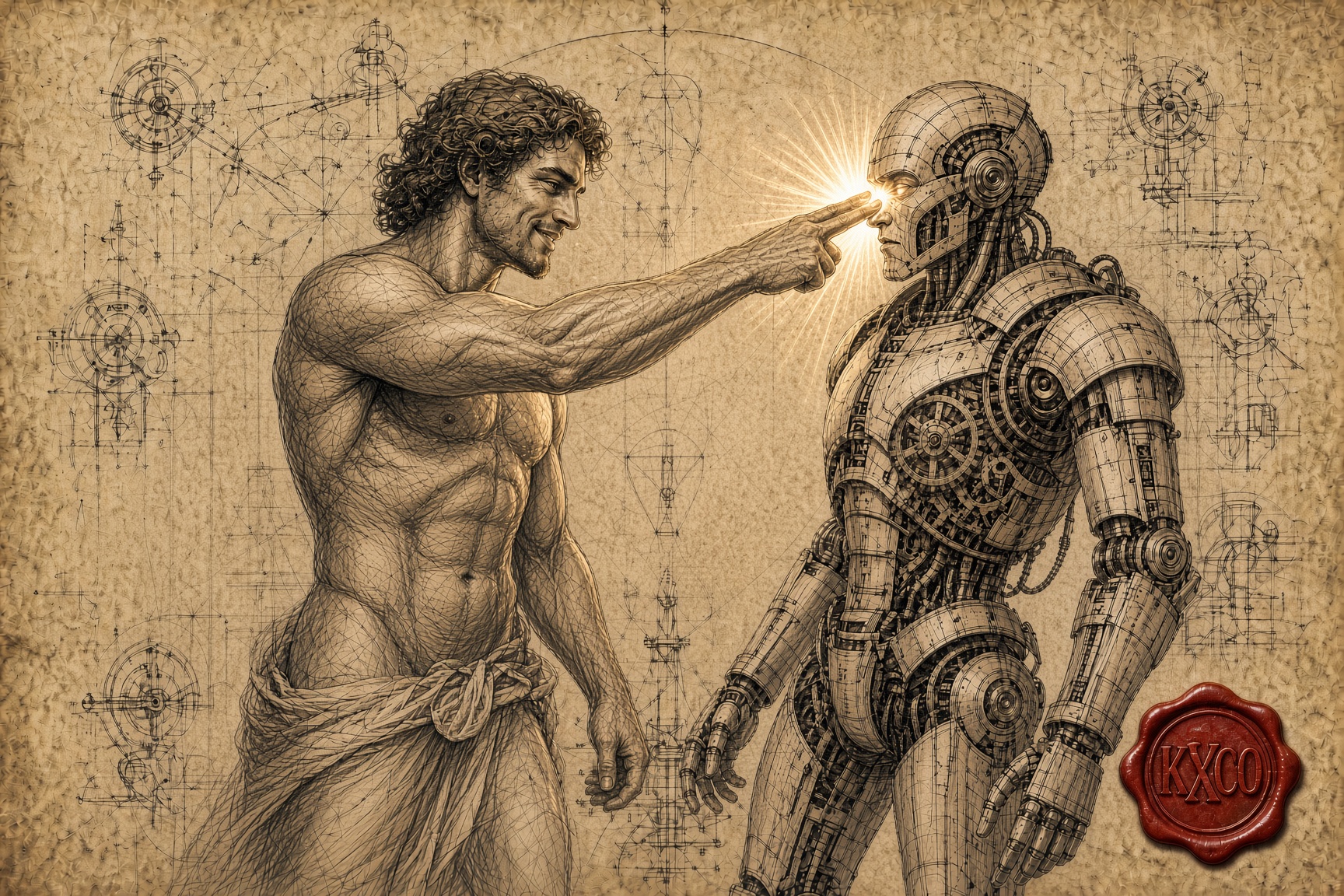
A model will write an answer about anything in seconds. What an AI world makes scarce is everything around the answer: what you believed last month and why you changed it, the link between fields nobody reads together, and a decision a named person can stand behind. Three knowledge-graph exhibits from the KXCO record show each one, from a reported Nvidia deal that became a signed 8-K to a war five links from a data centre.
Every story, signed and delivered.
Subscribe to the kxco channel and get the headline, the AI-written key takeaways, and the chain-anchor link the moment we publish. Audio versions and per-ticker subscriptions arrive in the next iteration.