
Intelligent World 2030
Huawei, along with industry partners, held the Intelligent World 2030 Forum. David Wang, Executive Director and President of ICT Products & Solutions of Huawei, released the Intelligent World 2030 report with a keynote speech on Exploring the Intelligent World 2030. This is the first time that Huawei has used quantitative and qualitative methods to systematically describe the intelligent world in the next decade and forecast industry trends, helping industries identify new opportunities and discover new value.

David Wang releases the Intelligent World 2030 report.
Over the past three years, Huawei has conducted in-depth exchanges with more than 1,000 academics, customers, and partners in the industry, organized more than 2,000 workshops, and drawn on data and methods from authoritative organizations, such as the United Nations, World Economic Forum, and World Health Organization. Huawei has derived insights from scientific journals such as Nature and IEEE, and drawn wisdom from relevant industry associations and consulting firms, as well as experts within and outside Huawei. Through these efforts, Huawei has developed the Intelligent World 2030 report, providing insights into ICT technology and application trends in the next decade.
The report proposes eight cross-disciplinary and cross-domain directions for exploration at the macro level. It explains how ICT technologies can solve critical problems and challenges of human development, and what new opportunities can be brought to organizations and individuals. At the industry level, the report explores the future technologies and development directions of communications networks, computing, digital power, and intelligent automotive solutions.
Wang said, "30 years ago, we decided to enrich life through communications. 10 years ago, we decided to connect every corner of the world, to build a better, connected world. Now, our vision and mission is to bring digital to every person, home, and organization for a fully connected, intelligent world. We firmly believe that a brilliant intelligent world is arriving at an accelerated pace."
Many heavyweight guests were invited to speak at the forum, including renowned futurist Steven Johnson, founding and rotating chairman of the World Electric Vehicle Association Chen Qingquan, Co-President of Roland Berg Global Management Committee Denis Depoux, and Vice President of the China Academy of Information and Communications Technology (CAICT) Wang Zhiqin. They shared their insights on the intelligent world and discussed how ICT can better drive socio-economic development.
As the prominent futurist and science author Steven Johnson said, we are entering an era of exponential growth. The coming decades will be characterized by a golden age of collaboration between human and machine intelligence, and algorithms will enhance human intelligence. As technology grows exponentially, all of society will benefit.
The Intelligent World 2030 Forum is the first time that Huawei has systematically shared cutting-edge research and insights into the next decade. This sharing of knowledge will bring great value to social development, especially for global digital transformation and digital economy.
Imagination will determine how far we will go in the future, action will determine how quickly we will reach the future, and the best way to predict the future is to create it. There are still plenty of challenges to overcome on the road to the intelligent world. As David Wang said at the end of his speech, "We believe, the greatest wisdom is found in shared ideas. Dreams are the key driver of social progress. Moving towards the next decade, let's work together to shape a better, intelligent world."
For more information, please visit: https://www.huawei.com/en/giv
AI is the Neat Handwriting of the Illiterate
A model in the hands of someone who has read the filing and walked the plant is a clerk. The same model, speaking for someone who has done neither, is a disguise. On AI slop, phantom citations and factslop, why finish stopped being evidence of work, and the containment layer KXCO built so a machine cannot speak as the institution until a source is attached.
Worthship: Do Not Conform to the Age
Worthship is the older English word for worship, and it means to ascribe worth. Bishop Robert Barron preached Romans 12 on 30 August. This essay follows the text into the prison letters, and puts two questions to a graph: do the four readings of that Sunday agree, and was Paul free or in chains when he wrote about despair?
The Truth in All Its Ugliness Must Survive
A majority vote does not determine the truth. Consensus is a mood, gossip is a sport, and a model will write the pretty version for free. Why the ugly number has to survive, why a record beats a dashboard, and what KXCO was built to keep standing when the room changes its mind.
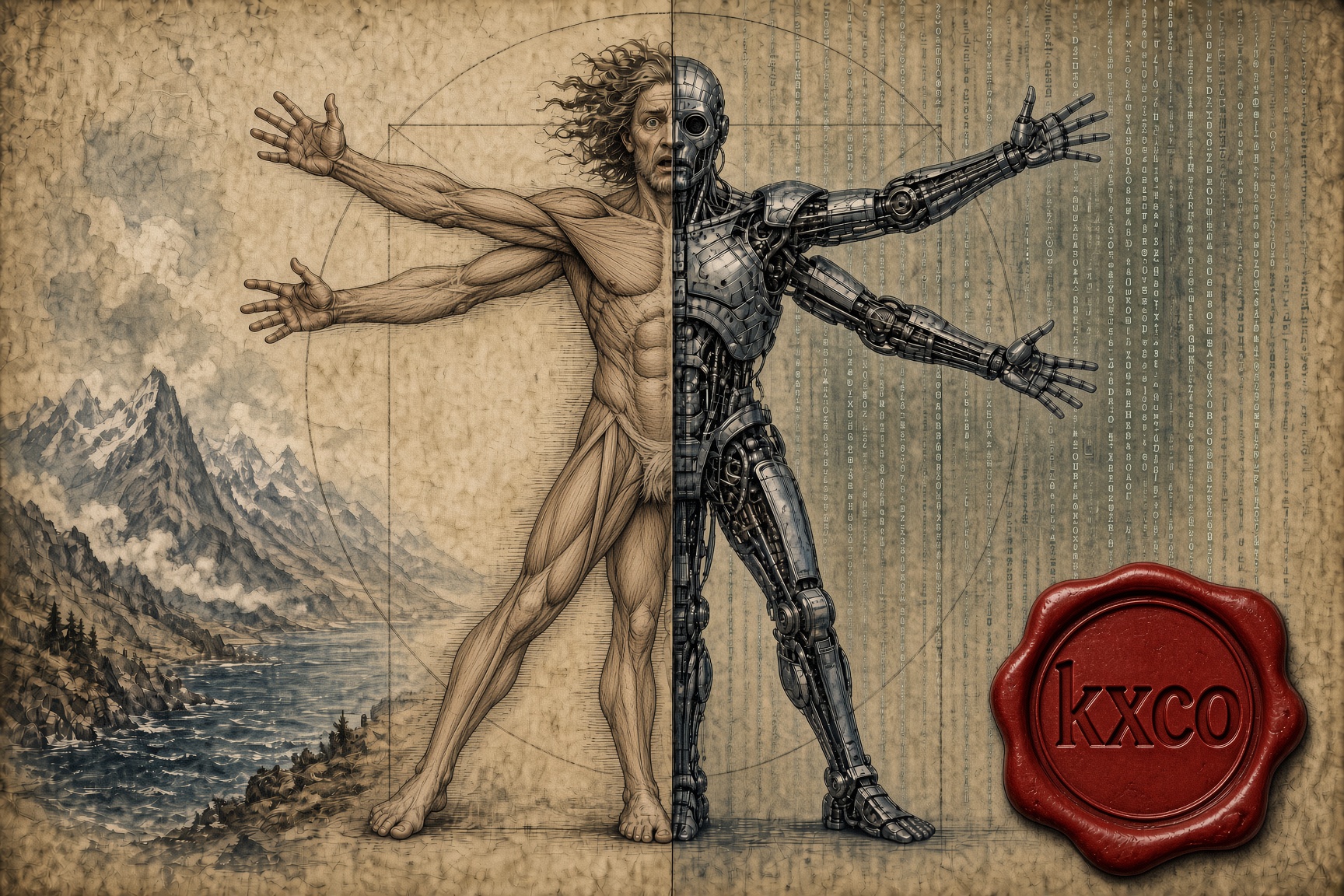
Don't Be the Best, Be the Only: Winning in an AI World
AI is repricing competence downward. What it cannot reproduce is a life. The case for remaining non-fungible, why friction still produces the best ideas, and what it means to build AI systems that keep the human intellect in them.
Every story, signed and delivered.
Subscribe to the kxco channel and get the headline, the AI-written key takeaways, and the chain-anchor link the moment we publish. Audio versions and per-ticker subscriptions arrive in the next iteration.