
Fed Makes the Case for Bitcoin
-- Fed officials expect the U.S. economy to grow by 6.5 percent this year, better than the previous projection of 4.2 percent in December.
-- Most Fed officials expected that interest rates would remain near zero at least through 2023, but seven out of the 18 participants looked for a hike in 2023.
The U.S. Federal Reserve on Wednesday kept its benchmark interest rate unchanged at the record-low level of near zero, as inflation debate heats up, driven by COVID-19 vaccination progress and the latest relief package.
The Fed and the Government have shown their complete disregard for the US Dollar they will continue to print money and flood market with cheap cash, Bitcoin has never looked better.
"Following a moderation in the pace of the recovery, indicators of economic activity and employment have turned up recently, although the sectors most adversely affected by the pandemic remain weak," the Fed said in a statement after concluding its two-day policy meeting.
Noting that inflation continues to run below 2 percent, the Federal Open Market Committee (FOMC), the Fed's policy-making body, reaffirmed that it will aim to achieve inflation moderately above 2 percent for some time so that inflation averages 2 percent over time and longer-term inflation expectations remain well anchored at 2 percent.
The Fed also said it will continue an asset purchase program, and buys at least 120 billion U.S. dollars of bonds a month, increasing its holdings of Treasury securities by at least 80 billion dollars and of agency mortgage-backed securities by at least 40 billion dollars.
"These measures, along with our strong guidance on interest rates and on our balance sheet, will ensure that monetary policy will continue to deliver powerful support to the economy until the recovery is complete," Fed Chairman Jerome Powell said at a virtual press conference Wednesday afternoon.
Since January, the numbers of new cases, hospitalizations, and deaths have fallen, and ongoing vaccinations "offer hope for a return to more normal conditions later this year," he said.
The Fed chair, however, noted that the economic recovery remains "uneven and far from complete," and the path ahead remains "uncertain."
In the labor market, for example, conditions "have turned up" recently, but employment is still 9.5 million below its pre-pandemic level, he noted, adding that unemployment rate remains elevated at 6.2 percent in February.
Looking ahead, the median projection of unemployment rate by FOMC participants is 4.5 percent at the end of this year and moves down to pre-pandemic level of 3.5 percent by the end of 2023, according to the Fed's latest economic projections also released on Wednesday.

Fed officials expect the U.S. economy to grow by 6.5 percent this year, better than the previous projection of 4.2 percent in December, the economic projections showed.
Most Fed officials expected that interest rates would remain near zero at least through 2023, but seven out of the 18 participants looked for a hike in 2023. In the December projections, only five out of 17 participants looked for a hike in 2023.
When asked about the debate on rate hikes among FOMC participants, Powell said everyone on the Committee agrees that there are three criteria for liftoff: maximum employment, 2-percent inflation not on a transitory basis, inflation on track to run moderately above 2 percent for some time.
"So it comes down to what's your projection for the economy? If you want -- people will have a range of assessments for how good the economy is going to be, and we don't -- I would say that we are in a relatively highly uncertain situation," said the Fed chair.
The newly passed 1.9-trillion-U.S.-dollar relief package, the first legislative victory for President Joe Biden, went into effect over the weekend, with some Americans already receiving 1,400-dollar direct payments.
The massive relief package, which is expected to help fight the pandemic and bolster the ravaged economy, could also lead to an overheated economy, inflationary pressures and rising interest rates, economists have warned.
"The state of the economy in two or three years is highly uncertain, and I wouldn't want to focus too much on the exact timing of a potential rate increase that far into the future," Powell said.
The Fed chair noted that fiscal support has helped avoid scarring and support economic recovery, but what it takes more to boost productive capacity or to raise living standards over time.
"What Congress has been doing has mainly been replacing lost income and beginning to support people as the economy returns to normal. But there should be a focus on a -- a longer-term focus, I think, would be healthy on the investment front," he said.
AI is the Neat Handwriting of the Illiterate
A model in the hands of someone who has read the filing and walked the plant is a clerk. The same model, speaking for someone who has done neither, is a disguise. On AI slop, phantom citations and factslop, why finish stopped being evidence of work, and the containment layer KXCO built so a machine cannot speak as the institution until a source is attached.
Worthship: Do Not Conform to the Age
Worthship is the older English word for worship, and it means to ascribe worth. Bishop Robert Barron preached Romans 12 on 30 August. This essay follows the text into the prison letters, and puts two questions to a graph: do the four readings of that Sunday agree, and was Paul free or in chains when he wrote about despair?
The Truth in All Its Ugliness Must Survive
A majority vote does not determine the truth. Consensus is a mood, gossip is a sport, and a model will write the pretty version for free. Why the ugly number has to survive, why a record beats a dashboard, and what KXCO was built to keep standing when the room changes its mind.
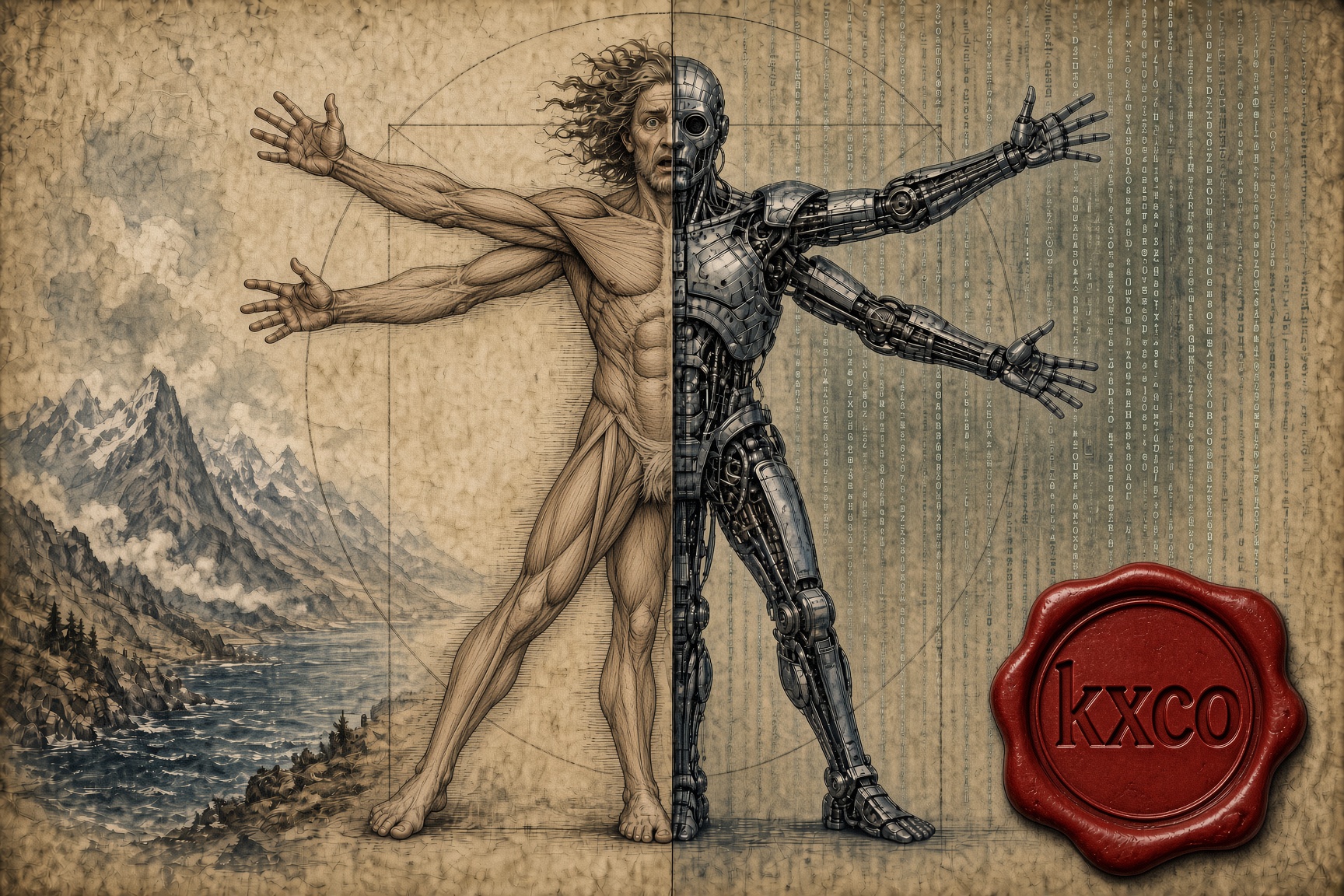
Don't Be the Best, Be the Only: Winning in an AI World
AI is repricing competence downward. What it cannot reproduce is a life. The case for remaining non-fungible, why friction still produces the best ideas, and what it means to build AI systems that keep the human intellect in them.
Every story, signed and delivered.
Subscribe to the kxco channel and get the headline, the AI-written key takeaways, and the chain-anchor link the moment we publish. Audio versions and per-ticker subscriptions arrive in the next iteration.