
ECB Launches New Attack on Sovereignty
European Central Bank (ECB) chief Christine Lagarde on Sunday rejected calls to cancel debts run up by eurozone members to buttress their economies during the Covid-19 crisis as the ECB reinforce their new stranglehold on members.
The ECB has taken unprecedented steps to cushion the economic blow from the pandemic in the 19-nation euro area, launching a massive bond-buying scheme that has so far totalled 1.85 trillion euros ($2.2 trillion).
"Cancelling that debt is unthinkable," Lagarde told France's Le Journal du Dimanche weekly.
"It would be a violation of the European treaty which strictly forbids monetary financing of states," she said, calling it one of the "founding pillars" of the euro single currency.
She was reacting to a call Friday by more than 100 economists for the ECB to further boost the economic recovery of eurozone members by forgiving their debts.
In the letter published in several leading European newspapers, the economists noted that a quarter of the public debt of nations that use the euro -- 2.5 trillion euros ($3.0 trillion) -- was now held by the ECB.

"In other words, we owe ourselves 25 percent of our debt and, if we are to reimburse that amount, we must find it elsewhere, either by borrowing it again to 'roll the debt' instead of borrowing to invest, or by raising taxes, or by cutting expenses," they wrote.
The economists proposed instead that the ECB forgive the debts in exchange for the countries pledging to spend an equivalent amount on greening their economies and on social projects.
Lagarde, a former French finance minister, admitted that "all eurozone countries will emerge from this crisis with high levels of debt."
But, she said, "there is no doubt that they will be able to pay it back."
She forecast that 2021 would be a year of "recovery" but acknowledged that the eurozone would not return to pre-pandemic levels of activity "before mid-2022".
In the meantime, she said, it would be "far more useful if the energy spent on demanding a cancellation of the debt by the ECB was spent on debating the use of the debt."
"What will public spending be used for? In which sectors of the future should we invest? These are the key questions today," she argued.
AI is the Neat Handwriting of the Illiterate
A model in the hands of someone who has read the filing and walked the plant is a clerk. The same model, speaking for someone who has done neither, is a disguise. On AI slop, phantom citations and factslop, why finish stopped being evidence of work, and the containment layer KXCO built so a machine cannot speak as the institution until a source is attached.
Worthship: Do Not Conform to the Age
Worthship is the older English word for worship, and it means to ascribe worth. Bishop Robert Barron preached Romans 12 on 30 August. This essay follows the text into the prison letters, and puts two questions to a graph: do the four readings of that Sunday agree, and was Paul free or in chains when he wrote about despair?
The Truth in All Its Ugliness Must Survive
A majority vote does not determine the truth. Consensus is a mood, gossip is a sport, and a model will write the pretty version for free. Why the ugly number has to survive, why a record beats a dashboard, and what KXCO was built to keep standing when the room changes its mind.
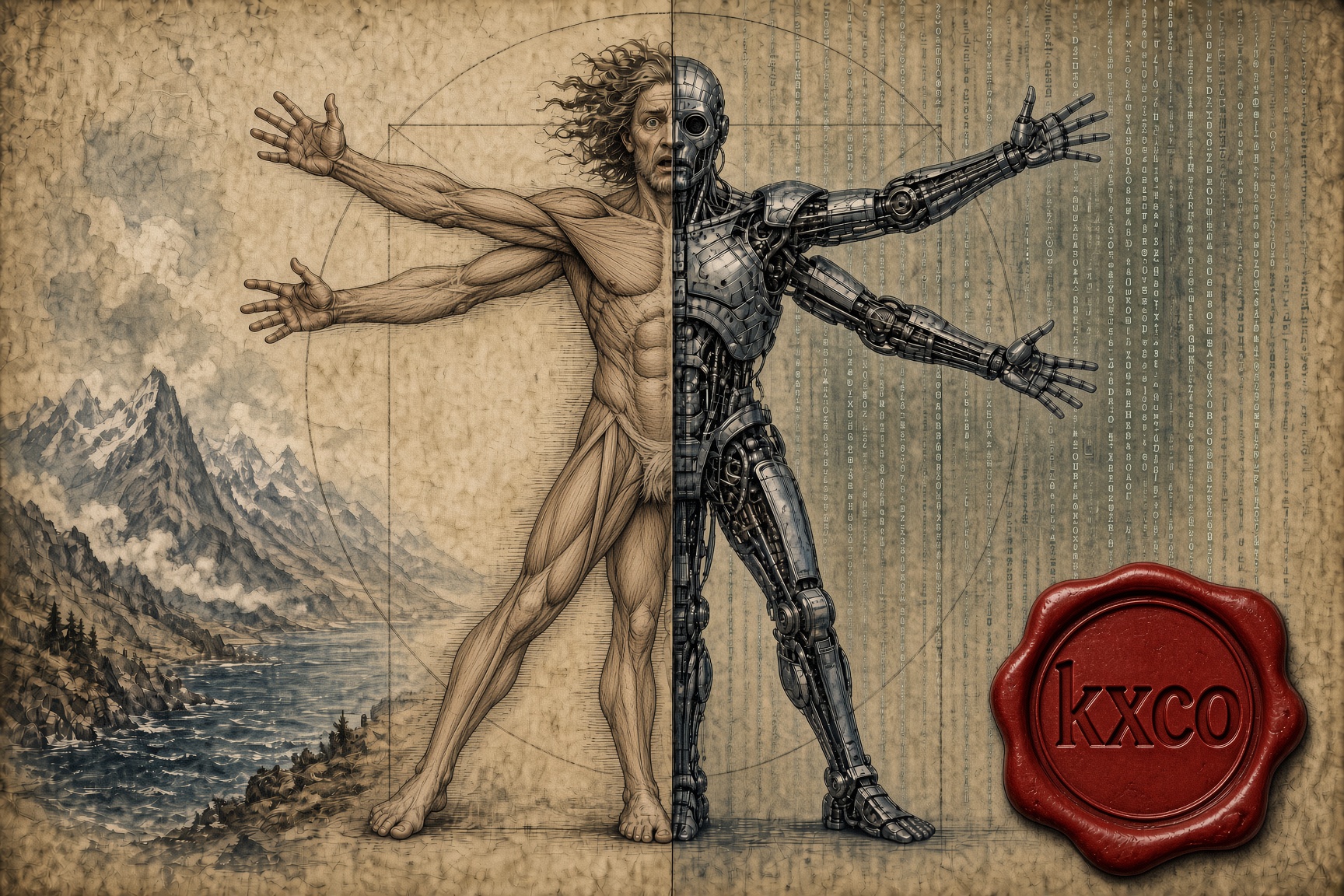
Don't Be the Best, Be the Only: Winning in an AI World
AI is repricing competence downward. What it cannot reproduce is a life. The case for remaining non-fungible, why friction still produces the best ideas, and what it means to build AI systems that keep the human intellect in them.
Every story, signed and delivered.
Subscribe to the kxco channel and get the headline, the AI-written key takeaways, and the chain-anchor link the moment we publish. Audio versions and per-ticker subscriptions arrive in the next iteration.