
Dmitry Medvedev Predictions 2023
Dmitry Medvedev Deputy Chair of the Security Council of the Russian Federation. The President of Russia, 2008-2012 has slammed the Biden led New World Order with a series of tweets.
On the New Year’s Eve, everybody’s into making predictions
Many come up with futuristic hypotheses, as if competing to single out the wildest, and even the most absurd ones.
Here’s our humble contribution.
What can happen in 2023:— Dmitry Medvedev (@MedvedevRussiaE)
December 26, 2022
1. Oil price will rise to $150 a barrel, and gas price will top $5.000 per 1.000 cubic meters
2. The UK will rejoin the EU
3. The EU will collapse after the UK’s return; Euro will drop out of use as the former EU currency
4. Poland and Hungary will occupy western regions of the formerly existing Ukraine
5. The Fourth Reich will be created, encompassing the territory of Germany and its satellites, i.e., Poland, the Baltic states, Czechia, Slovakia, the Kiev Republic, and other outcasts
6. War will break out between France and the Fourth Reich. Europe will be divided, Poland repartitioned in the process
7. Northern Ireland will separate from the UK and join the Republic of Ireland
8. Civil war will break out in the US, California. and Texas becoming independent states as a result. Texas and Mexico will form an allied state. Elon Musk’ll win the presidential election in a number of states which, after the new Civil War’s end, will have been given to the GOP
9. All the largest stock markets and financial activity will leave the US and Europe and move to Asia
10. The Bretton Woods system of monetary management will collapse, leading to the IMF and World Bank crash. Euro and Dollar will stop circulating as the global reserve currencies. Digital fiat currencies will be actively used instead
Dmitry Medvedev is a Russian politician who served as the Prime Minister of Russia from 2012 to 2020 and the third President of Russia from 2008 to 2012. He is currently the Chairman of the United Russia party and the Head of the Council of Ministers of the Union State. Medvedev was previously the First Deputy Prime Minister of Russia from 2005 to 2008, and is credited with modernizing the Russian economy by introducing economic reforms, including reducing the size of the state bureaucracy and increasing foreign investment.
Dmitry Medvedev is generally considered to have a centrist political leaning. He is affiliated with the United Russia party, which is considered to be moderately conservative.
Russia and European countries have a long and complex history of relations which date back to the Middle Ages. During the 16th and 17th centuries, Russian Tsars sought to extend their control and influence over much of the continent. This resulted in a series of wars, culminating in the Napoleonic invasion of 1812, which saw Russia repel the French army. In the 19th century, Russia and Europe tended to remain in competition with one another, as the Great Powers of the continent sought to gain control of other regions. The Crimean War saw a brief alliance between Russia and France to fight against the Ottoman Empire. Later, the two sides competed for influence in the Balkans, with Russia seeking to gain control of the region, while European states sought to preserve the autonomy of the various nations. In the 20th century, Russia and Europe were at odds over the issue of communism. During the Cold War, the two sides stood in opposition to one another, with the Soviet Union seeking to extend its influence over the continent. Following the dissolution of the Soviet Union in 1991, relations between Russia and Europe have gradually improved. The two sides have managed to cooperate on a number of issues, such as energy security and combating terrorism.
AI is the Neat Handwriting of the Illiterate
A model in the hands of someone who has read the filing and walked the plant is a clerk. The same model, speaking for someone who has done neither, is a disguise. On AI slop, phantom citations and factslop, why finish stopped being evidence of work, and the containment layer KXCO built so a machine cannot speak as the institution until a source is attached.
Worthship: Do Not Conform to the Age
Worthship is the older English word for worship, and it means to ascribe worth. Bishop Robert Barron preached Romans 12 on 30 August. This essay follows the text into the prison letters, and puts two questions to a graph: do the four readings of that Sunday agree, and was Paul free or in chains when he wrote about despair?
The Truth in All Its Ugliness Must Survive
A majority vote does not determine the truth. Consensus is a mood, gossip is a sport, and a model will write the pretty version for free. Why the ugly number has to survive, why a record beats a dashboard, and what KXCO was built to keep standing when the room changes its mind.
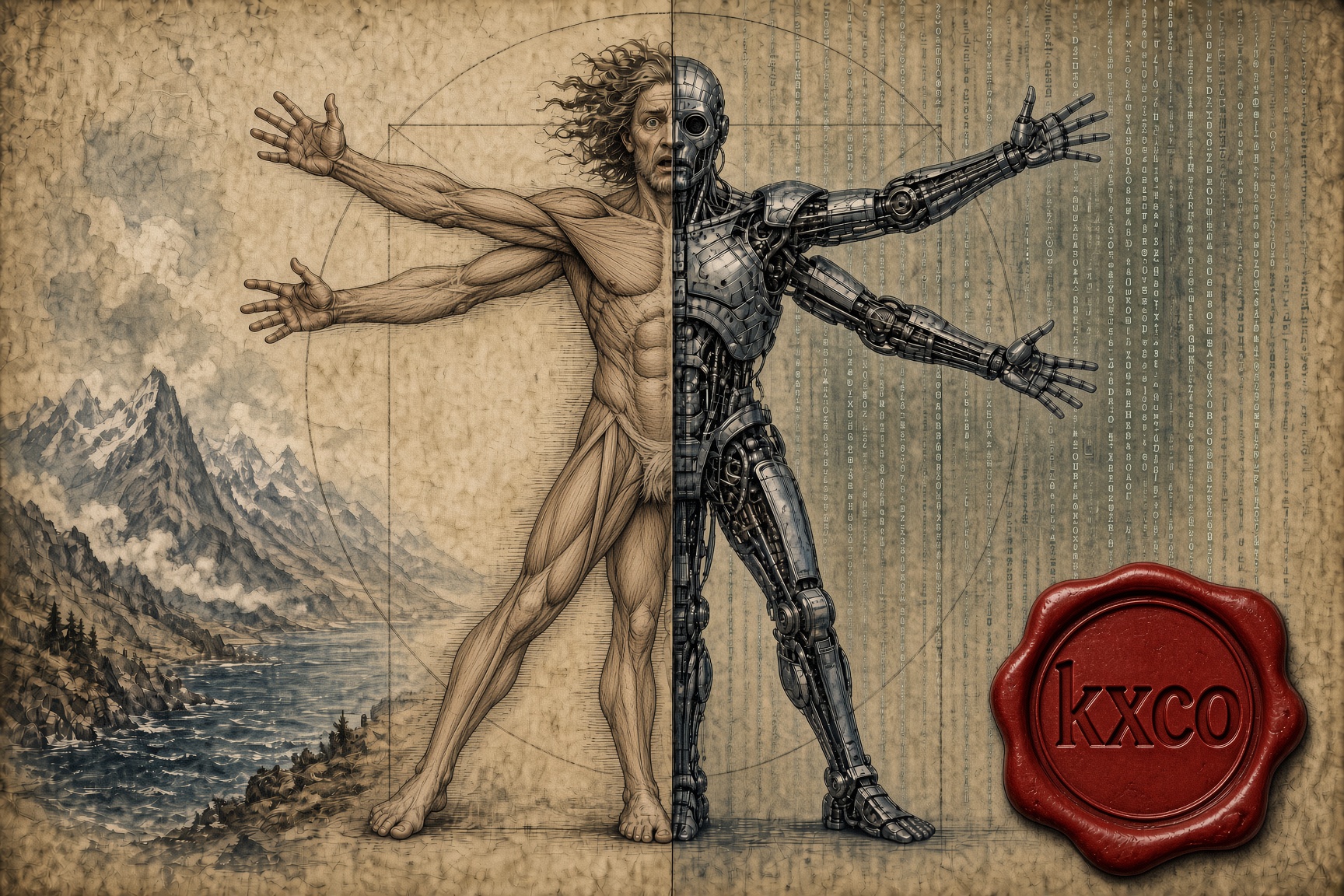
Don't Be the Best, Be the Only: Winning in an AI World
AI is repricing competence downward. What it cannot reproduce is a life. The case for remaining non-fungible, why friction still produces the best ideas, and what it means to build AI systems that keep the human intellect in them.
Every story, signed and delivered.
Subscribe to the kxco channel and get the headline, the AI-written key takeaways, and the chain-anchor link the moment we publish. Audio versions and per-ticker subscriptions arrive in the next iteration.