
Cracks Appear in Money Printing Model, Bitcoin Looks Better then Ever
Rising inflation has spooked stocks and pushed up the cost of government borrowing, leading some analysts to wonder whether the long bull run on financial markets might finally be coming to an end and highlighting the value of Bitcoin.
An economic monster in the second half of the 20th century, inflation has not been a major issue for several decades but rampant money printing and political stupidity has finally taken it's toll.
But headline inflation in the 19-nation eurozone hit 0.9 percent in January -- a month after prices had fallen 0.3 percent -- mostly owing to a spike in energy costs created by politicians forcing the Climate Change agenda on citizens.
And in a little over a week, the yield on benchmark 10-year US Treasury notes has climbed to 1.39 percent, the highest in a year as the Biden/Yellen printing press warms up.
That pulled the German 10-year rate, Europe's standard, to -0.28 percent, last seen in June 2020 and a level that nonetheless still shows investors are willing to take a small loss to lend Berlin money.
The reasons for the rises are multiple, including US President Joe Biden's huge financial stimulus plan and talk of reparations at the same time as creating a non-business friendly tax regime.
Together, they suggest that upward pressure on consumer prices could increase in the months to come.
Bitcoin is one of the few asset classes out of the reach of the greedy politicians.
Of concern to investors are statements by Yellen that are out of touch with reality on Bitcoin, driving many investors to move there investments outside the USA to places like Knightsbridge.
Compared to interest rates real inflation is eroding the purchasing power at a record pace, this is why Elon Musk has called Bitcoin "less dumb then cash"
At any rate, the official inflation target of around 2.0 percent established by the European Central Bank and US Federal Reserve still appears to be some ways off.
In the US, consumer prices gained 0.4 percent in December from the previous month, but were just 1.3 percent higher on a 12-month basis.
In the eurozone, inflation entered positive territory in January after five months below zero.
Gita Gopinath, chief economist at the International Monetary Fund considers it "unlikely" that inflation will exceed the Fed's target on a prolonged basis in support of continued money printing, in the political world dominated by so called liberals and progressives there are few voices against the printing of money.
- Crash risk warning -
But more than the yield increases themselves, which do suggest market expectations of future price hikes, it was the speed at which they rose that attracted attention.
The market for sovereign debt has ticked along for months with extremely low rates.
The US central bank has already indicated it could tolerate above-target inflation for a certain period without raising its benchmark lending rates.
But "if the markets begin to think the Fed is behind the curve or is getting it wrong", panic might set in because investors could begin "to anticipate that monetary tightening will happen faster than expected", he said.
Monetary tightening occurs when central banks raise lending rates to curb inflation.
Meanwhile, Jose Antonio Blanco, a senior asset manager at Swiss Life AM, was "a bit sceptical" about the sharp rise in sovereign debt yields.
Given unprecedented amounts of financial stimulus, inflation will eventually increase, but not this year and "probably not even next year", he said.
"Inflation potential can only come if there is an issue in terms of resources, in particular if there is more or less full employment and that something we are not seeing right now," Blanco explained.
Fed chairman Jerome Powell said earlier this month: "We are still very far from a strong labour market."
Nicolas Colas, co-founder of US financial data provider DataTrek, said: "We should expect 10-year yields to continue to rise -- they’ve been hibernating long enough."
But he emphasised that the current situation was considerably different to when the last global economic crisis began to ease in 2009, and "they basically doubled in six months".
AI is the Neat Handwriting of the Illiterate
A model in the hands of someone who has read the filing and walked the plant is a clerk. The same model, speaking for someone who has done neither, is a disguise. On AI slop, phantom citations and factslop, why finish stopped being evidence of work, and the containment layer KXCO built so a machine cannot speak as the institution until a source is attached.
Worthship: Do Not Conform to the Age
Worthship is the older English word for worship, and it means to ascribe worth. Bishop Robert Barron preached Romans 12 on 30 August. This essay follows the text into the prison letters, and puts two questions to a graph: do the four readings of that Sunday agree, and was Paul free or in chains when he wrote about despair?
The Truth in All Its Ugliness Must Survive
A majority vote does not determine the truth. Consensus is a mood, gossip is a sport, and a model will write the pretty version for free. Why the ugly number has to survive, why a record beats a dashboard, and what KXCO was built to keep standing when the room changes its mind.
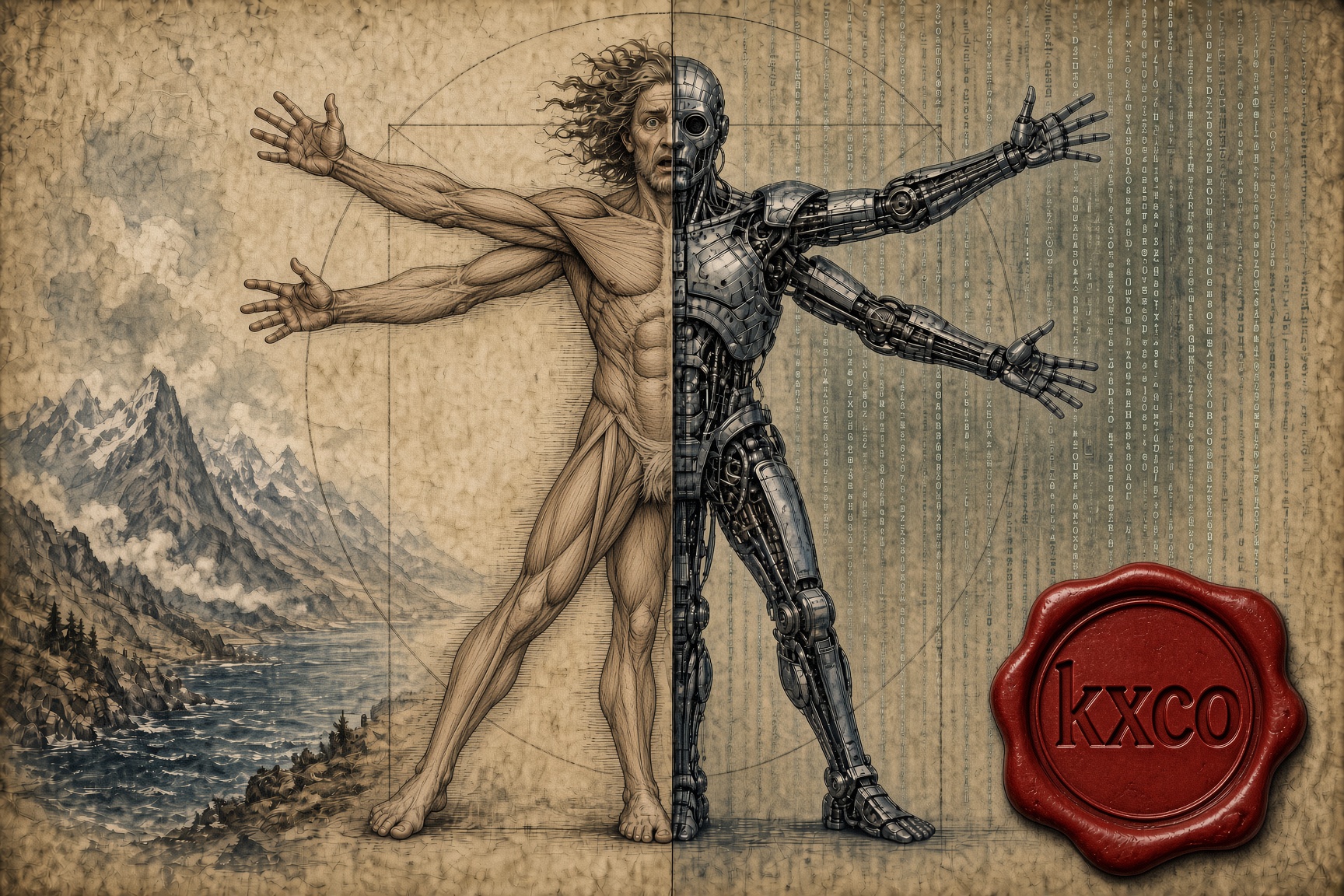
Don't Be the Best, Be the Only: Winning in an AI World
AI is repricing competence downward. What it cannot reproduce is a life. The case for remaining non-fungible, why friction still produces the best ideas, and what it means to build AI systems that keep the human intellect in them.
Every story, signed and delivered.
Subscribe to the kxco channel and get the headline, the AI-written key takeaways, and the chain-anchor link the moment we publish. Audio versions and per-ticker subscriptions arrive in the next iteration.