
Clean up at Tencent 0700.HK $TCEHY
In a significant move, Chinese tech giant Tencent acknowledged the dismissal of over 120 employees for breaching its anti-fraud regulations, citing instances of corruption and embezzlement. Renowned as the world's leading video game maker and the proprietor of the widely-used super-app WeChat, Tencent faced internal challenges leading to a substantial cleanup.
Stock Tickers: Investors tracking Tencent's performance can find its stock listed on various exchanges. For instance, Tencent Holdings Limited is listed on the Hong Kong Stock Exchange under the ticker 0700.HK, while its ADR (American Depositary Receipt) trades on the OTC (Over-the-Counter) market in the U.S. under tickers such as TCEHY or TCTZF.
Internal Strife and Regulatory Impact: Tencent's founder, Pony Ma, publicly addressed the company's internal challenges, describing the level of corruption as "shocking." Reports indicate that over 70 breaches of the company's code of conduct were reported, prompting decisive action. The dismissals affected employees across different divisions, including the PCG branch responsible for broadcasting content and the medical services arm, where Tencent's telemedicine applications dominate the Chinese market.
Legal Consequences: The repercussions extended beyond terminations, with nearly 20 cases reported to authorities. One implicated employee received a four-year prison sentence and a 100,000 yuan ($14,000) fine, underscoring Tencent's commitment to addressing internal misconduct through legal channels.
Regulatory Headwinds: Tencent's challenges are set against the backdrop of a broader regulatory crackdown on China's tech sector initiated in late 2020. This crackdown has resulted in significant market capitalization losses and profit declines for powerful internet companies, Tencent included. Additionally, regulatory restrictions in China, such as those limiting online gaming time for under-18s, have posed challenges to Tencent's profitability.
Global Expansion Strategy: Adapting to the evolving landscape, Tencent is exploring opportunities beyond China. The company has set its sights on Europe, where it aims to bolster its position by strategically investing in major gaming studios. This strategic shift aligns with Tencent's efforts to diversify its operations and mitigate the impact of regulatory uncertainties in its home market.
As Tencent navigates internal reforms and external regulatory pressures, investors and industry observers are closely monitoring its strategies and market performance. The company's foray into international markets, particularly in Europe, signals a proactive approach to sustain growth and resilience in the face of ongoing challenges within the Chinese tech landscape.
Tencent, the Chinese tech behemoth, has long been a cornerstone of the nation's digital ecosystem, wielding influence across various sectors. As a leading video game maker and the owner of the ubiquitous super-app WeChat, Tencent has played a pivotal role in shaping China's digital landscape. However, the company has recently faced a series of challenges, both internally and externally, as China's tech industry undergoes significant regulatory shifts.
Internal Strife and Corporate Cleanup:
In a surprising move, Tencent acknowledged dismissing over 120 employees for violating its anti-fraud regulations, with charges ranging from corruption to embezzlement. Founder Pony Ma's public admission of the "shocking" level of corruption within the company underscored Tencent's commitment to addressing internal issues. The dismissals affected various divisions, including the PCG branch responsible for content broadcasting and the medical services arm, where Tencent's telemedicine applications hold substantial market share.
Regulatory Headwinds and Market Impact:
The challenges faced by Tencent are not isolated but are part of a broader regulatory crackdown initiated by Chinese authorities in late 2020. This crackdown has reshaped the landscape for tech giants, leading to billions in market capitalization losses and plummeting profits. Tencent, with its diverse portfolio, has not been immune to these regulatory headwinds. Additional restrictions, such as limiting online gaming time for under-18s, have added further complexity to Tencent's operations in its home market.
Global Aspirations:
Adapting to the evolving regulatory environment, Tencent is exploring opportunities beyond the borders of China. The company's strategic focus on Europe involves strengthening its position by acquiring stakes in major gaming studios. This move aligns with Tencent's broader strategy to diversify its operations and reduce dependence on the domestic market.
WeChat's Continued Dominance:
WeChat, Tencent's flagship super-app, remains a linchpin in the company's success. Installed on nearly every phone in China, WeChat has evolved into an ecosystem offering services beyond messaging, including payments, social networking, and even mini-apps. Despite regulatory challenges, WeChat continues to be a vital tool for communication and commerce for millions of Chinese users.
Tencent's journey in China reflects the intricate dynamics of the nation's tech industry, where rapid growth and innovation coexist with regulatory scrutiny and internal challenges. As Tencent navigates this complex landscape, its commitment to corporate cleanup, global expansion, and the continued dominance of WeChat signal a company resilient and determined to shape the future of China's digital frontier. Investors, consumers, and industry observers alike will be watching Tencent's strategic moves and market performance with keen interest in the coming years.
AI is the Neat Handwriting of the Illiterate
A model in the hands of someone who has read the filing and walked the plant is a clerk. The same model, speaking for someone who has done neither, is a disguise. On AI slop, phantom citations and factslop, why finish stopped being evidence of work, and the containment layer KXCO built so a machine cannot speak as the institution until a source is attached.
Worthship: Do Not Conform to the Age
Worthship is the older English word for worship, and it means to ascribe worth. Bishop Robert Barron preached Romans 12 on 30 August. This essay follows the text into the prison letters, and puts two questions to a graph: do the four readings of that Sunday agree, and was Paul free or in chains when he wrote about despair?

The Truth in All Its Ugliness Must Survive
A majority vote does not determine the truth. Consensus is a mood, gossip is a sport, and a model will write the pretty version for free. Why the ugly number has to survive, why a record beats a dashboard, and what KXCO was built to keep standing when the room changes its mind.
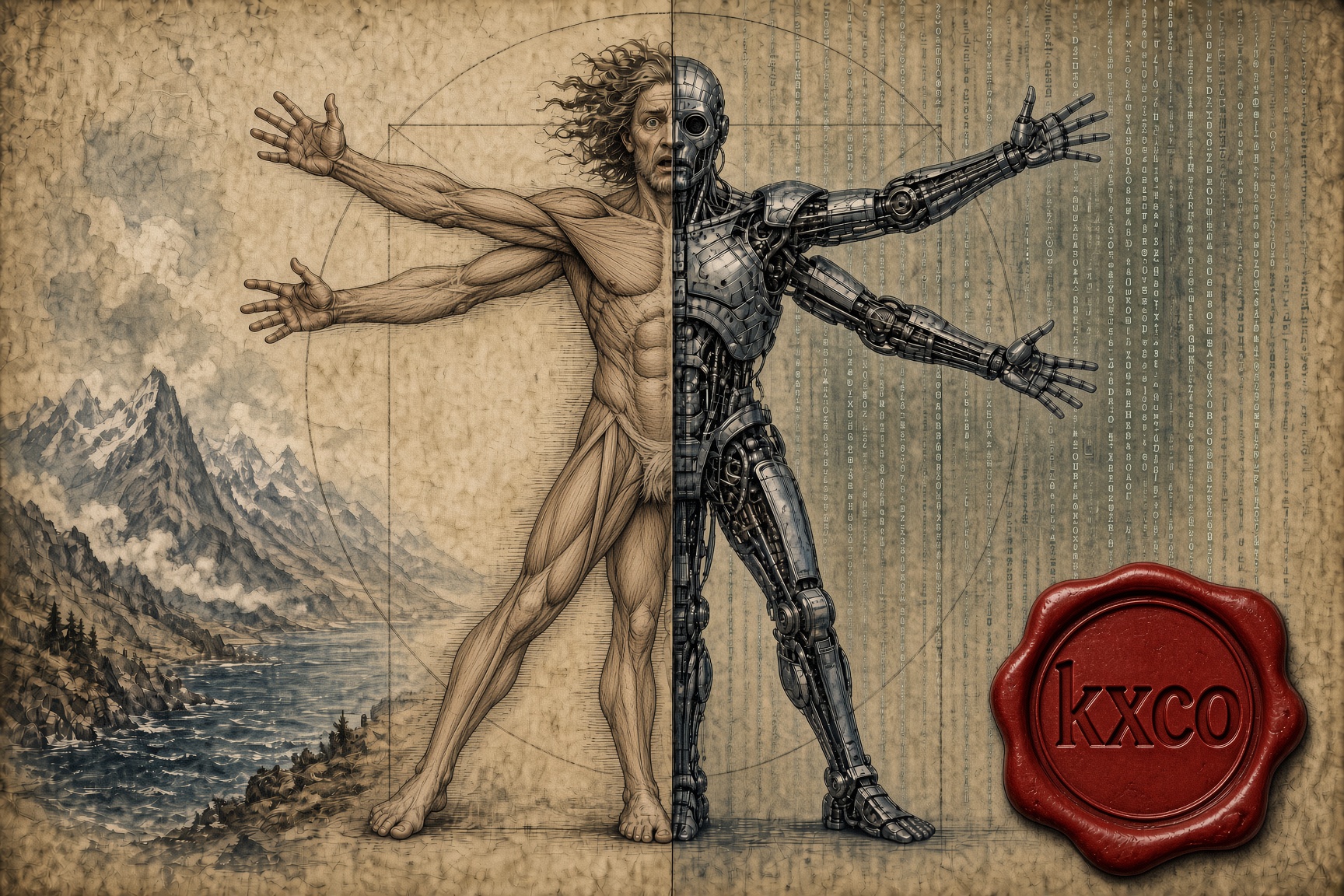
Don't Be the Best, Be the Only: Winning in an AI World
AI is repricing competence downward. What it cannot reproduce is a life. The case for remaining non-fungible, why friction still produces the best ideas, and what it means to build AI systems that keep the human intellect in them.
Every story, signed and delivered.
Subscribe to the kxco channel and get the headline, the AI-written key takeaways, and the chain-anchor link the moment we publish. Audio versions and per-ticker subscriptions arrive in the next iteration.