
China's Economy Shows Resilience
China's economic indicators for February show improvement, with the consumer price index (CPI) showing an increase while the producer price index (PPI) experiences a decline. Despite this, experts see positive signs in these numbers that underscore the resilience of China's economy amid ongoing challenges globally and politically.
China and Hong Kong stock markets since the Chinese New Year: BYD, Alibaba Group (BABA), NIO, JD.com (JD), Pinduoduo (PDD), and Baidu (BIDU).
China's Economy: Stock Market Performance
Bull Market in China’s Onshore Market
The CSI 300 Index, which tracks major stocks on China’s onshore exchanges, has surged more than 20% from its low on October 31, officially entering bull market territory.
Notable companies like Contemporary Amperex (an electric-car battery maker), BYD (a car manufacturer), and Lens Technology have seen substantial gains during this period.
Goldman’s Optimistic Outlook
Goldman Sachs has raised its China targets three times in the past two months, emphasizing a shift from “reopening” to a broader “growth recovery” theme.
The MSCI China Index and the CSI 300 are both beneficiaries of this evolving sentiment, with upgraded year-end targets.
China's top market watchdog on Friday pledged further efforts to address the pressing issues of regional protectionist practices and market segmentation in 2024, aiming to develop a unified domestic market.
Luo Wen, head of the State Administration for Market Regulation, made the remarks on the sidelines of the second session of the 14th National People's Congress, China's national legislature.
The administration will push for the introduction of regulations on the review of fair competition, facilitate cross-regional relocation and operation of enterprises, and rectify local protectionist practices that exploit hidden barriers, Luo said.
Regarding the administration's work on standardization, the official said that China will steadily expand related aspects of institutional opening up, and support foreign-invested enterprises to participate equally in the process of formulating standards in accordance with the law.
China will also engage actively in international standardization work, he said.
Hong Kong Stock Market Performance
Rapid Start and Concerns
The Hang Seng Index in Hong Kong had its best start to a year since January 1984, surging 14% in January 2023. However, concerns arose that this rapid rally might be unsustainable.
The Tech Index experienced a significant decline, signaling potential reversal.
Recent Developments
Hong Kong stocks tumbled by the most in seven weeks due to worries that the strong start was too much too soon.
Notable companies like Alibaba Group Holding and SMIC faced declines.
February Rebound
Ongoing Challenges
Both China and Hong Kong markets have faced challenges, with a combined loss of approximately $6.3 trillion in market value since 2021.
China’s economy continues to grapple with post-pandemic recovery and significant headwinds.
While both markets have experienced volatility, there are positive signs of recovery and growth. Investors should closely monitor developments and consider the evolving themes in China’s economic landscape.
The latest data from the National Bureau of Statistics (NBS) reveals that China's CPI, a key measure of inflation, edged up by 0.7 percent year-on-year in February. This marks a reversal from the 0.8-percent decline observed in January. On a monthly basis, the CPI rose by 1 percent in February, indicating a modest uptick in consumer prices.
The core CPI, which excludes volatile food and energy prices, increased by 1.2 percent year-on-year last month, according to the NBS data. This suggests that underlying inflationary pressures remain relatively subdued, providing some stability to consumer prices.
China's producer price index (PPI), which tracks the costs of goods at the factory gate, saw a decline of 2.7 percent year-on-year in February. This decrease reflects ongoing challenges in the manufacturing sector, including softening demand and rising production costs.
Despite the decline in the PPI, analysts note several positive implications from the latest economic data. Firstly, the slight increase in the CPI indicates that consumer demand remains resilient, supporting domestic consumption. This is particularly crucial for China as it seeks to rebalance its economy towards greater consumption-led growth.
The moderation in producer price deflation could alleviate some pressures on businesses, particularly in sectors heavily reliant on input costs. A more stable pricing environment could support profit margins and investment decisions, ultimately contributing to economic recovery.
Moreover, policymakers may interpret the CPI uptick as a sign of improving consumer confidence and economic stability. This could provide room for targeted policy adjustments aimed at sustaining growth momentum while addressing inflationary risks.
While the latest economic data reflects some challenges facing China's economy, such as softening manufacturing activity, the positive trends in consumer prices and the moderation in producer price deflation suggest underlying resilience. With ongoing efforts to promote domestic consumption and support businesses, China remains on track to navigate through current economic headwinds and achieve sustainable growth in the long term.
1. Optimizing Payment Methods for Foreigners
In a significant move, China’s State Council has pledged to further support policies aimed at optimizing payment methods. This commitment extends to providing wider support for currency exchange services. The goal is to address the hurdles faced by foreigners when conducting financial transactions in China. This development is seen as a positive step for both visitors and foreign investors, fostering an environment of greater ease and accessibility.
2. FTSE 100 Reacts Favorably
The FTSE 100 index closed today largely flat, losing just 1.28 points (0.02%). However, mining companies such as Anglo American and Antofagasta played a crucial role in supporting the index. These companies saw gains of 2.1% and 1.4%, respectively. The positive news from China contributed to investor confidence, particularly in the mining sector. Analysts are closely monitoring these developments as they signal potential growth opportunities.
3. China’s Economic Playbook Evolves
China’s economic playbook is undergoing a transformation. No longer relying solely on large stimulus measures, Beijing is adjusting to a more parsimonious future. While challenges remain, including debt concerns among property developers, the government’s measured approach is noteworthy. The International Monetary Fund forecasts GDP growth of 5.4% this year and 4.6% in 2024. As China navigates its economic landscape, resilience and adaptability are key themes.
Despite global uncertainties, China continues to demonstrate resilience and adaptability in its economic policies. Today’s positive developments signal a nation that is proactively addressing challenges while fostering an environment conducive to growth. Investors and observers alike are closely watching China’s economic trajectory, recognizing its significance on the global stage.
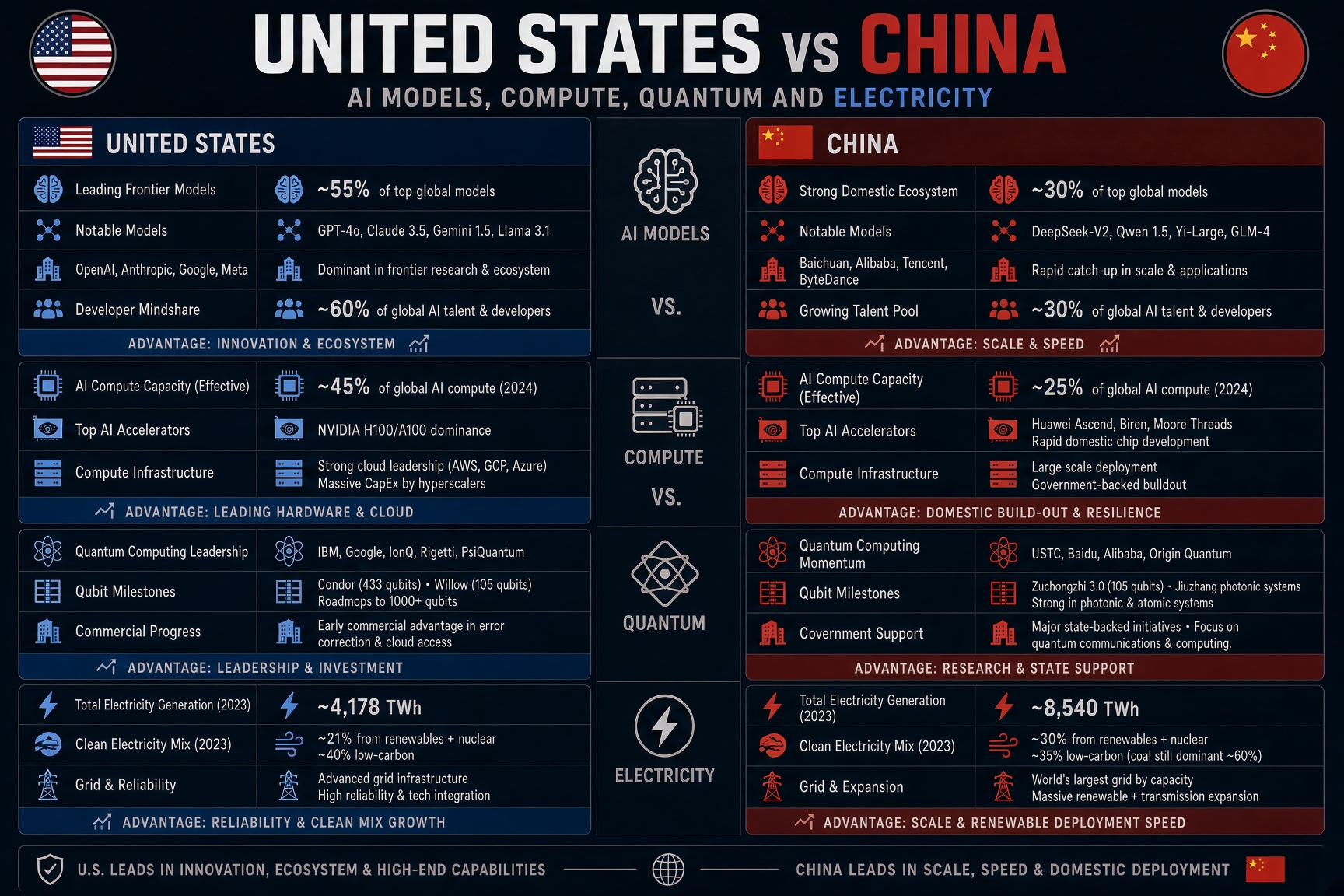
United States vs China: AI Models, Compute, Quantum and Electricity
The United States still leads in frontier model capability, total AI compute and quantum error correction, while China has narrowed the gaps in model performance, open-weight adoption and domestic chip volumes, and holds a structural advantage in power for data centres. Shayne Heffernan sets out the developments from July to October 2026 across models, compute, quantum and electricity, and how fast China is catching up.
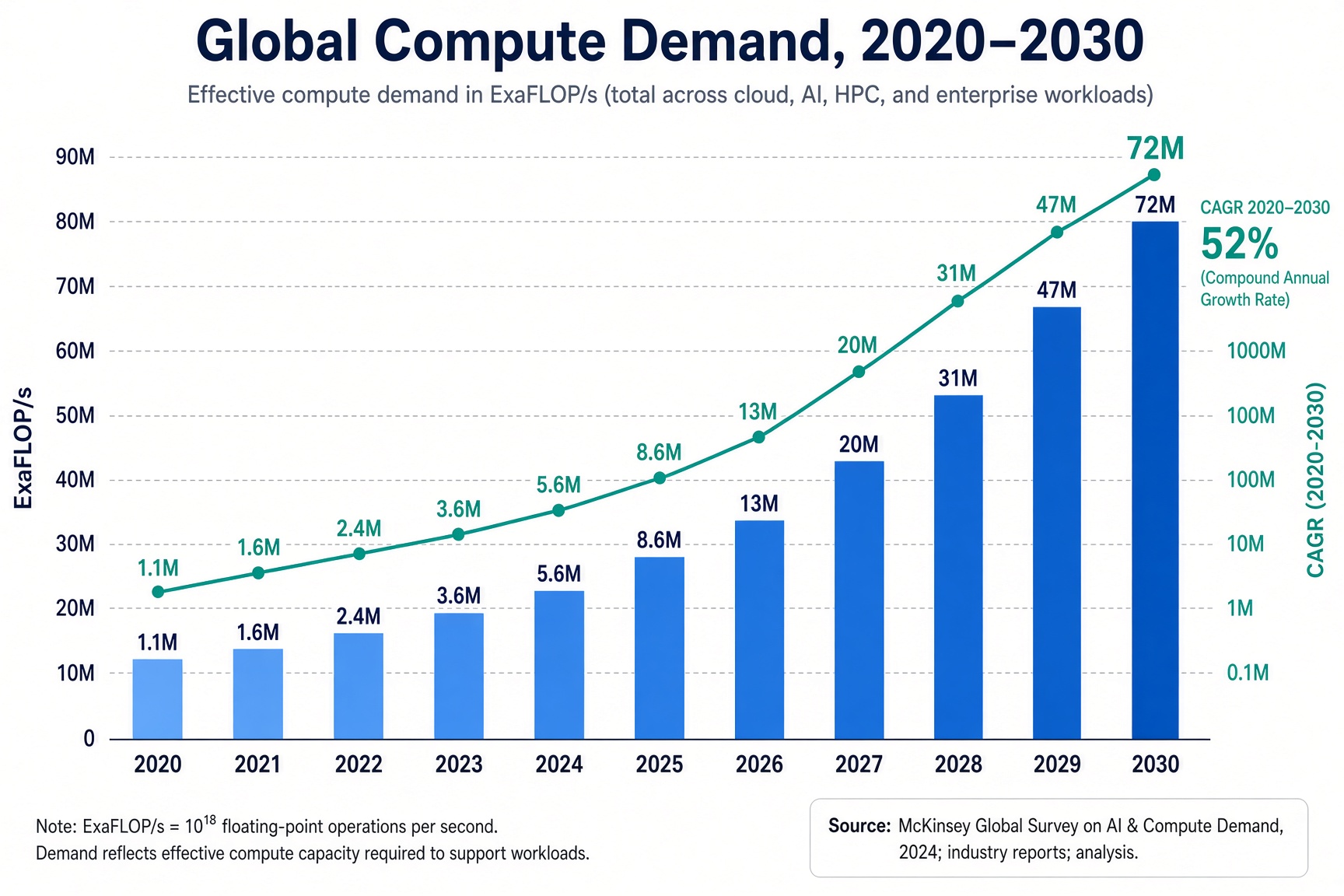
The 2030 Compute Landscape: GPUs, Power and the Architecture of Intelligence
The constraint on AI is no longer ideas or data but compute and the power to run it. Frontier training compute has grown about five times a year since 2020, and the leading AI supercomputer of June 2030 is on course for about 2 million chips and 9 gigawatts. Shayne Heffernan sets out the 2030 arithmetic, the power problem, who has already contracted the gigawatts, and how GPUs, custom ASICs, wafer-scale engines and quantum machines divide the work.

KXCO AI Ontology at 3 Months: What It Called and What Comes Next
On 19 July 2026 the Round Table's AI room published its first Analyst Outlook. To the 16 October 2026 close its 13 names rose 2.6% on an equal weight against 2.1% for QQQ, per StockAnalysis closes, and the six it opened with 35% or more of upside rose 8.6%. This piece lists the six names up more than 5%, the ten names I rate as opportunities now, the month's results in AI and quantum computing, and the official data showing that four in five firms have not yet started using AI.

SpaceX: The Road to 10 Gigawatts
SpaceX did not add an AI business. A company whose processes run on compute built its own computing plant, then built the power to run it. The 10-Q reports 1.4 gigawatts of nameplate compute at 30 June 2026, four leases worth about $41 billion a year and $100 billion of cash. The target is closer to 10 gigawatts than 5 by the end of 2027. This piece sets out the build sequence, the four layers of power in Memphis, and why Terafab is the act after 2027, not the road to it.
Every story, signed and delivered.
Subscribe to the kxco channel and get the headline, the AI-written key takeaways, and the chain-anchor link the moment we publish. Audio versions and per-ticker subscriptions arrive in the next iteration.