
China Plans for Economic Success
"China is the main global economic engine for recovery from the COVID-19 economic downturn. Therefore, the entire world will be affected by the targets set in China's new five-year plan and its success in achieving these," John Ross, a senior fellow at Chongyang Institute for Financial Studies, Renmin University of China.
China's new five-year plan, currently under review at the ongoing annual "two sessions," has come under the spotlight as analysts expect the development blueprint of the world's second-largest economy to inject more certainties and bring fresh opportunities to the pandemic-rattled world.
China on Friday unveiled the draft outline of the 14th Five-Year Plan (2021-2025) for national economic and social development and the long-range objectives through the year 2035, specifying policy priorities and major social and economic goals for the next five years and beyond.
In particular, the draft plan sends a reassuring message to the world by reaffirming China's commitment to a high-level opening-up. Keywords of the plan, such as "reduced import tariffs" and "shortened negative lists for foreign investment," have been deemed by analysts and diplomats as measures conducive to the global recovery from the pandemic-induced recession.
Last year, China emerged from the global headwinds to become the only major economy to register positive growths in GDP and foreign trade in goods, thanks to its effective anti-epidemic measures. The country's GDP increased by 2.3 percent year on year to cross the 100-trillion-yuan (about 15.35 trillion U.S. dollars) threshold, while its imports and exports of goods expanded 1.9 percent.

"China is the main global economic engine for recovery from the COVID-19 economic downturn. Therefore, the entire world will be affected by the targets set in China's new five-year plan and its success in achieving these," John Ross, a senior fellow at Chongyang Institute for Financial Studies, Renmin University of China, told Xinhua in a recent interview.
"Dual circulation," China's new development paradigm, features prominently in the draft five-year plan. It refers to a development pattern where domestic and overseas markets reinforce each other with the domestic market as the mainstay.
Since the new pattern was first proposed in May last year, China's top leadership has reiterated that the emphasis on boosting domestic consumption does not mean China will seek development behind closed doors. Instead, the country remains committed to pushing ahead with its opening-up drive and sharing development opportunities with the rest of the world.
In the draft outline of its new five-year plan, China has pledged to further lower tariffs and institutional transaction costs, and expand imports of quality consumer products, advanced technologies, key equipment and energy resources, allowing global firms to further tap into the immense purchasing power of the world's most populous market.
"The increasing income and more complex needs of the Chinese people will transform and enormously expand numerous global markets associated with high living standards, such as culture, education, entertainment, travel, healthcare and environmental protection," Ross said.
Ali Al Dhaheri, ambassador of the United Arab Emirates to China, who was present at the opening meeting of the fourth session of the 13th National People's Congress on Friday, said China's "dual circulation" development pattern will "unleash new possibilities" for international industries.
Advanced technology and carbon emission reduction could be key areas for China's future cooperation with its global partners, he noted.
Besides expanding imports and facilitating trade, China has vowed to further open up its economy in its new five-year plan through a series of measures. Some of these include shortening negative lists for foreign investment access, prudently advancing opening-up in its finance sector, and promoting the opening-up of sectors including telecommunications, the internet, education, culture and medical care to foreign investors in an orderly manner.
The country has also pledged to promote the development of its pilot free trade zones (FTZ) and construction of the Hainan Free Trade Port as well as to advance the high-quality development of the Belt and Road in the coming years.
The development of China's pilot FTZs and the Hainan Free Trade Port will help China further advance its institutional opening-up that covers rules, regulations, management and standards, said Wang Wentao, China's commerce minister, on the sidelines of the "two sessions."
"China will continue to open its doors wider, improve its business environment, and participate in international cooperation in broader areas and at a deeper level," Wang added.
AI is the Neat Handwriting of the Illiterate
A model in the hands of someone who has read the filing and walked the plant is a clerk. The same model, speaking for someone who has done neither, is a disguise. On AI slop, phantom citations and factslop, why finish stopped being evidence of work, and the containment layer KXCO built so a machine cannot speak as the institution until a source is attached.
Worthship: Do Not Conform to the Age
Worthship is the older English word for worship, and it means to ascribe worth. Bishop Robert Barron preached Romans 12 on 30 August. This essay follows the text into the prison letters, and puts two questions to a graph: do the four readings of that Sunday agree, and was Paul free or in chains when he wrote about despair?
The Truth in All Its Ugliness Must Survive
A majority vote does not determine the truth. Consensus is a mood, gossip is a sport, and a model will write the pretty version for free. Why the ugly number has to survive, why a record beats a dashboard, and what KXCO was built to keep standing when the room changes its mind.
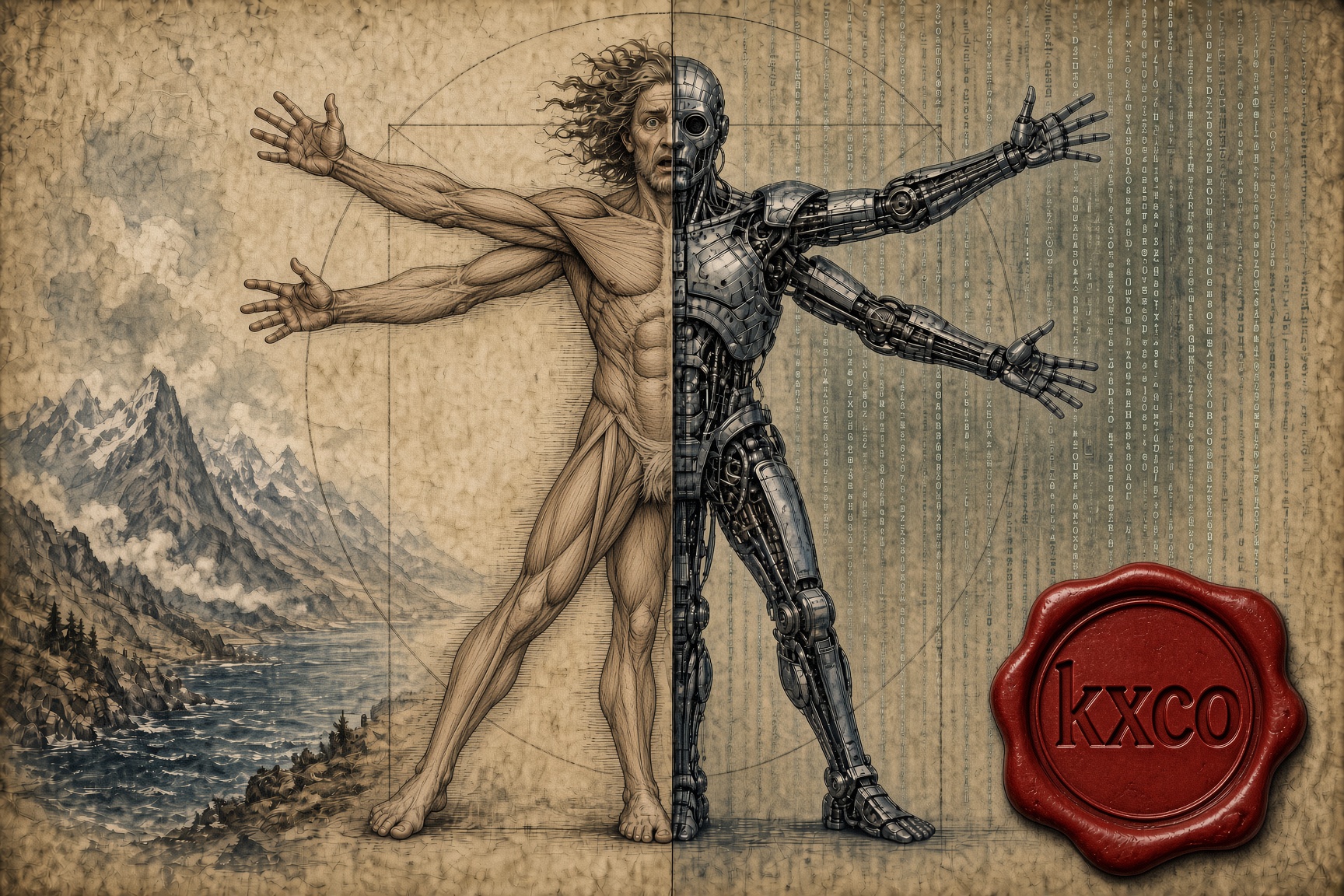
Don't Be the Best, Be the Only: Winning in an AI World
AI is repricing competence downward. What it cannot reproduce is a life. The case for remaining non-fungible, why friction still produces the best ideas, and what it means to build AI systems that keep the human intellect in them.
Every story, signed and delivered.
Subscribe to the kxco channel and get the headline, the AI-written key takeaways, and the chain-anchor link the moment we publish. Audio versions and per-ticker subscriptions arrive in the next iteration.