
China Moves Against Tencent
China's financial regulator has blocked a merger of the nation's two largest video game live-streaming sites planned by tech giant Tencent over antitrust concerns, it said Saturday.
Beijing has launched a major crackdown on the biggest players in its tech sector after years of runaway growth and lax regulation, partly due to fears over their growing influence and the security of troves of sensitive consumer data.
Analysts have estimated the planned merger of live streaming services Huya and Douyu could have brought the combined platforms' domestic market share to between 80 to 90 per cent.
"If Huya and Douyu merged, that would... further strengthen Tencent's dominant position in the video game live-streaming market," Beijing's State Administration for Market Regulation (SAMR) said in an online statement.
"This has the effect of eliminating or restricting competition, is not conducive to fair market competition ... and is not conducive to the healthy and sustainable development of the online gaming and video game livestreaming market."
The blocked merger comes shortly after regulators abruptly announced a cybersecurity review into ride-hailing app Didi Chuxing on the heels of a US IPO that raised $4.4 billion.
Plans for the deal were initially announced by Tencent last October, but SAMR said it would undertake an antitrust review into the merger in December.
The same month, it announced an antitrust investigation into e-commerce giant Alibaba, whose fintech arm Ant Financial's bumper IPO was shelved at the last minute by regulators in November.
The company was later slapped with a record 18.2 billion yuan ($2.78 billion) fine for anti-competitive practices.
Tencent currently has a majority stake in Huya and a 38 per cent stake in Douyu, and the merger was set to grant it majority control over the combined entity.
Both Huya and Douyu are listed in the US, with market caps of $3.57 billion and $1.77 billion respectively.
AI is the Neat Handwriting of the Illiterate
A model in the hands of someone who has read the filing and walked the plant is a clerk. The same model, speaking for someone who has done neither, is a disguise. On AI slop, phantom citations and factslop, why finish stopped being evidence of work, and the containment layer KXCO built so a machine cannot speak as the institution until a source is attached.
Worthship: Do Not Conform to the Age
Worthship is the older English word for worship, and it means to ascribe worth. Bishop Robert Barron preached Romans 12 on 30 August. This essay follows the text into the prison letters, and puts two questions to a graph: do the four readings of that Sunday agree, and was Paul free or in chains when he wrote about despair?
The Truth in All Its Ugliness Must Survive
A majority vote does not determine the truth. Consensus is a mood, gossip is a sport, and a model will write the pretty version for free. Why the ugly number has to survive, why a record beats a dashboard, and what KXCO was built to keep standing when the room changes its mind.
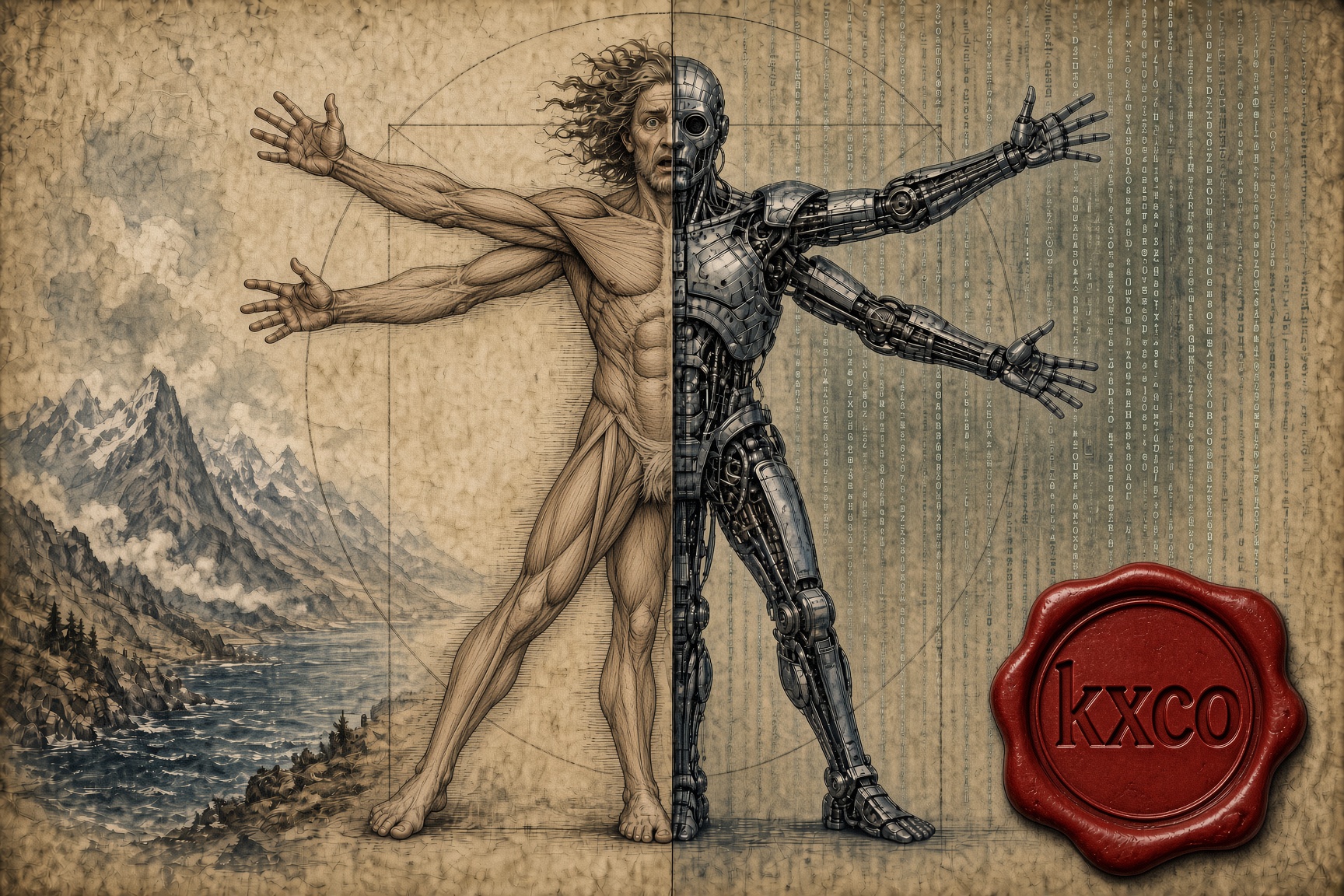
Don't Be the Best, Be the Only: Winning in an AI World
AI is repricing competence downward. What it cannot reproduce is a life. The case for remaining non-fungible, why friction still produces the best ideas, and what it means to build AI systems that keep the human intellect in them.
Every story, signed and delivered.
Subscribe to the kxco channel and get the headline, the AI-written key takeaways, and the chain-anchor link the moment we publish. Audio versions and per-ticker subscriptions arrive in the next iteration.