
China EU Trade reached $847.3B
Official statistics show that trade between China and the EU reached 847.3 billion U.S. dollars in 2022, a 2.4-percent increase over the previous year. China and the EU are each other's main trading partner, with rapid growth in the trade of lithium batteries, electric vehicles, photovoltaic modules, and other green products.
Trade between the European Union (EU) and China has grown in recent years despite talks of "decoupling" from or "de-risking" economic links with China, a sign that China's market still maintains an allure for European businesses due to its vast potential and size.
Eurostat data show the value of European imports from China nearly doubled between 2018 and 2022. During the first half of 2023, China remained the leading supplier of goods to the EU, said an analysis by the Organization for Economic Cooperation and Development (OECD). Throughout this period, imports of products such as phones, computers, and machinery all saw significant increases.
With both Europe and China sharing consensus on tackling climate change, Chinese electric vehicles have rapidly expanded their presence in the European market. Three of the top-selling electric car models in Europe in 2022 were of Chinese origin.
Official statistics show that trade between China and the EU reached 847.3 billion U.S. dollars in 2022, a 2.4-percent increase over the previous year. China and the EU are each other's main trading partner, with rapid growth in the trade of lithium batteries, electric vehicles, photovoltaic modules, and other green products.
All these figures prove that a growing list of European enterprises view China as a robust partner.
Ola Kaellenius, chairman of the Board of Management at Mercedes-Benz, said in a July interview with German weekly Automobilwoche that China, the world's largest automobile market, would be at the core of the company's marketing activities starting from 2025.

A concept car of Mercedes-Benz is displayed at the 20th Shanghai International Automobile Industry Exhibition in Shanghai, east China, April 18, 2023. (Xinhua/Xin Mengchen).
"Investing in China is investing in the future," said Jean-Paul Agon, president of L'Oreal France, in a written interview with Xinhua. He emphasized that with an open market, an improving business environment, and promising initiatives to stimulate domestic demand, China presents new opportunities for the world and vice versa.
He also noted that China is a strategic growth driver for L'Oreal, as "China is more than just a large market. It is the laboratory of the most innovative concepts and the testing ground for the latest marketing practices, where the future of beauty is born."
Several European business leaders warned of the "de-risking" narrative.
Belen Garijo, chief executive of Germany's leading science and technology group Merck, said that severing commercial ties with China would come with a substantial economic cost. She hoped tensions between China and some Western countries could be eased through dialogue.
"Globalization has brought well-being to the world, with more innovation and cooperation, but we risk losing it," Garijo warned.
Stefan Hartung, chairman of the board of management of Robert Bosch GmbH, also said in a July interview with The Financial Times that Europe cannot reduce risk by isolating itself. European countries should not speculate on the risks of doing business in China; instead, they should invest more in enhancing competitiveness, Hartung added.
European researchers have clarified the underlying logic behind the Europe-China partnership.
Maria Joao Rodrigues, president of the Foundation for European Progressive Studies, said that China and Europe are more strategic partners than "systemic rivals." They should collaborate in reestablishing global rules, particularly in areas such as combating climate change, digital transformation, and artificial intelligence. In recent years, China has advanced initiatives on global security and development, where Europe and China can enhance cooperation.
Similarly, The Financial Times cautioned in early August that it would be challenging for Europe to sever or reduce ties with such an important trading partner as China, which accounts for 14 percent of global exports.
Likewise, German weekly magazine Focus noted that the Western economy adheres to its own rules when U.S. President Joe Biden continues to announce restriction after restriction against China. Europe now understands the meaning of "decoupling," and the European economy is "decoupled" from American political directives rather than being "decoupled" from China, as the United States desires, the article concluded.
AI is the Neat Handwriting of the Illiterate
A model in the hands of someone who has read the filing and walked the plant is a clerk. The same model, speaking for someone who has done neither, is a disguise. On AI slop, phantom citations and factslop, why finish stopped being evidence of work, and the containment layer KXCO built so a machine cannot speak as the institution until a source is attached.
Worthship: Do Not Conform to the Age
Worthship is the older English word for worship, and it means to ascribe worth. Bishop Robert Barron preached Romans 12 on 30 August. This essay follows the text into the prison letters, and puts two questions to a graph: do the four readings of that Sunday agree, and was Paul free or in chains when he wrote about despair?
The Truth in All Its Ugliness Must Survive
A majority vote does not determine the truth. Consensus is a mood, gossip is a sport, and a model will write the pretty version for free. Why the ugly number has to survive, why a record beats a dashboard, and what KXCO was built to keep standing when the room changes its mind.
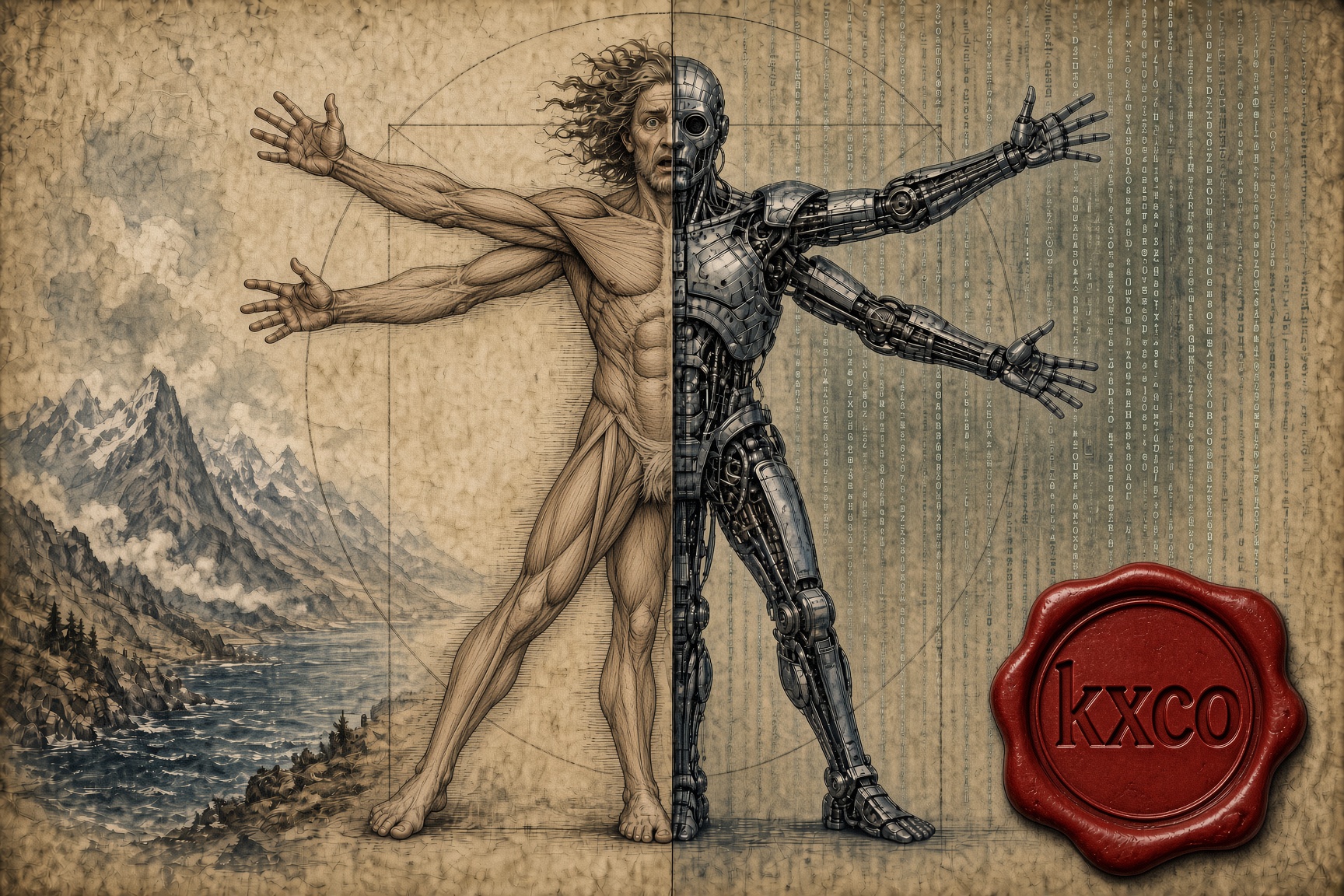
Don't Be the Best, Be the Only: Winning in an AI World
AI is repricing competence downward. What it cannot reproduce is a life. The case for remaining non-fungible, why friction still produces the best ideas, and what it means to build AI systems that keep the human intellect in them.
Every story, signed and delivered.
Subscribe to the kxco channel and get the headline, the AI-written key takeaways, and the chain-anchor link the moment we publish. Audio versions and per-ticker subscriptions arrive in the next iteration.