
Asian Stocks are Cheap
Asian stocks have room to grow in the long term, despite the recent sell-off. The region is home to some of the fastest-growing economies in the world, and is well-positioned to benefit from the global economic recovery.
Here are some of the reasons why Asian stocks have room to grow:
Strong economic growth: The economies of many Asian countries are growing at a rapid pace. For example, the Chinese economy is expected to grow by 8.1% in 2023, and the Indian economy is expected to grow by 7.2%. This strong economic growth is likely to support the growth of Asian stocks in the long term.
Monetary easing: Many Asian central banks are easing monetary policy, which is likely to support economic growth and stock prices. For example, the Bank of Japan has kept its policy rate at -0.1%, and the People's Bank of China has cut its policy rate by 0.25%.
Foreign investment: Foreign investors are increasingly investing in Asian stocks. This is due to the region's strong economic growth and its attractive valuations. In 2022, foreign investors bought a net \$290 billion worth of Asian stocks.
Attractive valuations: Asian stocks are trading at attractive valuations compared to other regions. The price-to-earnings (P/E) ratio of the MSCI Asia ex-Japan Index is 12.5, which is lower than the P/E ratio of the S&P 500 Index of 16.6.
The long-term outlook for Asian stocks is positive. The region is home to some of the world's most dynamic economies, and is well-positioned to benefit from the global economic recovery.
Here are some of the specific stocks that I think have room to grow in Asia:
Tencent Holdings Limited (0700.HK)
Tencent Holdings Limited is a Chinese multinational technology and entertainment conglomerate headquartered in Shenzhen, Guangdong. It was founded in 1998 by Ma Huateng and Zhang Zhidong. Tencent is one of the world's largest technology companies by market capitalization, and is the largest in China.
Tencent is a major player in the Chinese technology sector.
The company has a strong track record of growth.
Tencent is well-positioned to benefit from the long-term growth of the Chinese economy.
The stock is trading at a relatively attractive valuation.
Alibaba is a Chinese e-commerce giant. The company is also a major player in the cloud computing and digital payments markets. Alibaba is well-positioned to benefit from the growth of the Chinese economy and the rise of online shopping.
Alibaba Group Holding Limited (BABA)
Alibaba Group Holding Limited is a Chinese multinational technology company that specializes in e-commerce, retail, cloud computing, and artificial intelligence. It is one of the world's largest technology companies by market capitalization, and is the largest e-commerce company in China.
SCB X Public Company Limited (SCB.BK)
Siam Commercial Bank (SCB) is a Thai multinational banking and financial services company. It is the largest bank in Thailand by assets and market capitalization. SCB was founded in 1907 and is headquartered in Bangkok.
PTT Public Company Limited (PTT.BK)
PTT Public Company Limited (PTT) is a Thai state-owned petroleum and petrochemical company. It is the largest integrated energy company in Thailand and one of the largest in Southeast Asia. PTT was founded in 1970 and is headquartered in Bangkok.
These are just a few of the many stocks that I think have room to grow in Asia. The region is home to a number of dynamic and growing companies, and is well-positioned to benefit from the global economic recovery.
AI is the Neat Handwriting of the Illiterate
A model in the hands of someone who has read the filing and walked the plant is a clerk. The same model, speaking for someone who has done neither, is a disguise. On AI slop, phantom citations and factslop, why finish stopped being evidence of work, and the containment layer KXCO built so a machine cannot speak as the institution until a source is attached.
Worthship: Do Not Conform to the Age
Worthship is the older English word for worship, and it means to ascribe worth. Bishop Robert Barron preached Romans 12 on 30 August. This essay follows the text into the prison letters, and puts two questions to a graph: do the four readings of that Sunday agree, and was Paul free or in chains when he wrote about despair?
The Truth in All Its Ugliness Must Survive
A majority vote does not determine the truth. Consensus is a mood, gossip is a sport, and a model will write the pretty version for free. Why the ugly number has to survive, why a record beats a dashboard, and what KXCO was built to keep standing when the room changes its mind.
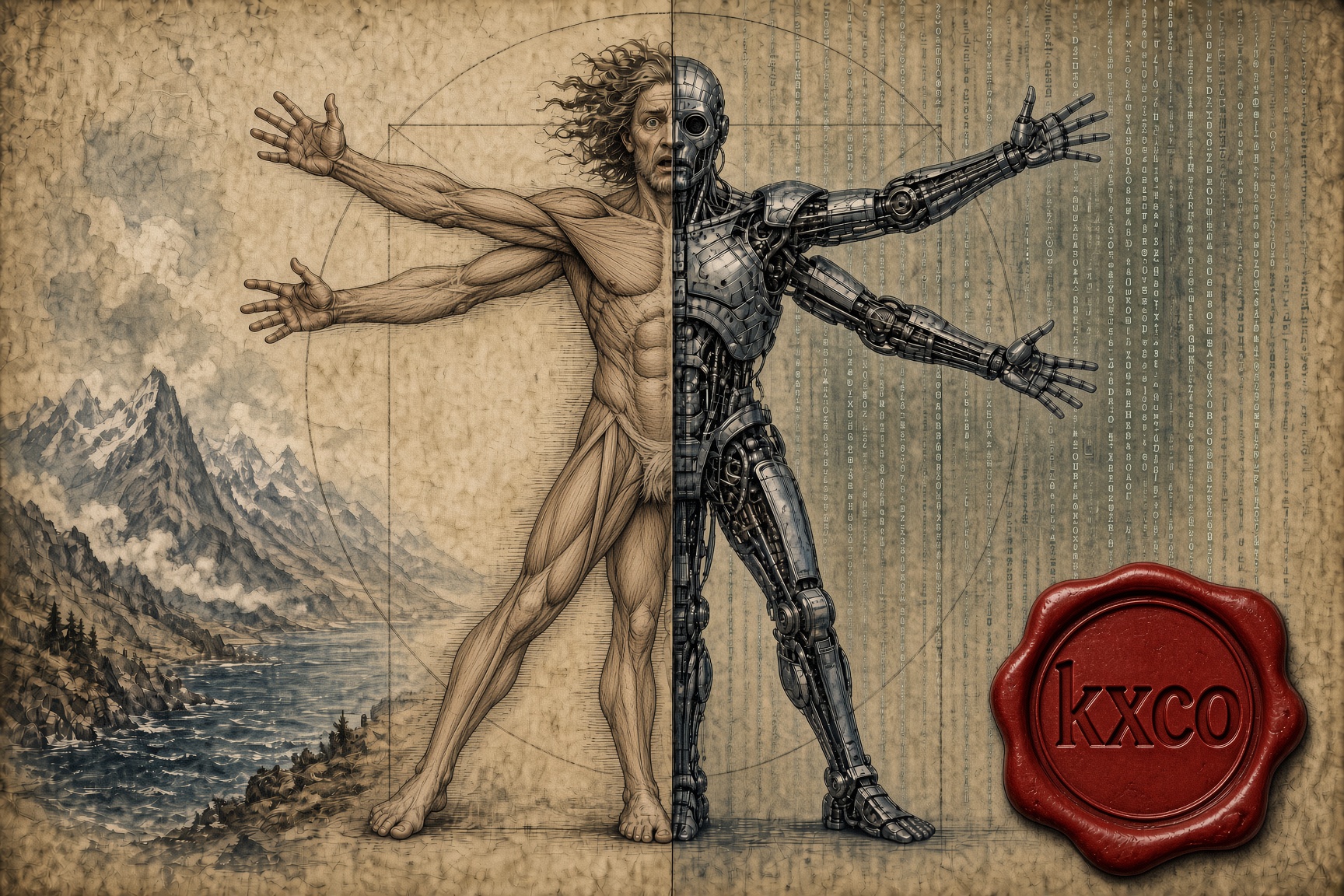
Don't Be the Best, Be the Only: Winning in an AI World
AI is repricing competence downward. What it cannot reproduce is a life. The case for remaining non-fungible, why friction still produces the best ideas, and what it means to build AI systems that keep the human intellect in them.
Every story, signed and delivered.
Subscribe to the kxco channel and get the headline, the AI-written key takeaways, and the chain-anchor link the moment we publish. Audio versions and per-ticker subscriptions arrive in the next iteration.