
Another Big Move for SpaceX and Starlink
NASA and SpaceX have signed a joint agreement to formalize both parties' strong interest in the sharing of information to maintain and improve space safety. This agreement enables a deeper level of coordination, cooperation, and data sharing, and defines the arrangement, responsibilities, and procedures for flight safety coordination. The focus of the agreement is on conjunction avoidance and launch collision avoidance between NASA spacecraft and the large constellation of SpaceX Starlink satellites, as well as related rideshare missions. A conjunction is defined as a close approach between two objects in space, usually at very high speed.
"Society depends on space-based capabilities for global communications, navigation, weather forecasting, and much more," said acting NASA Administrator Steve Jurczyk. "With commercial companies launching more and more satellites, it's critical we increase communications, exchange data, and establish best practices to ensure we all maintain a safe space environment."
The Starlink spacecraft are equipped with global navigation satellite service receivers to estimate orbital parameters, an ion propulsion system, and an autonomous maneuvering capability that provide data for prompt and proactive exchange of information. Both NASA and SpaceX benefit from this enhanced interaction by ensuring all parties involved are fully aware of the exact location of spacecraft and debris in orbit.
SpaceX has agreed its Starlink satellites will autonomously or manually maneuver to ensure the missions of NASA science satellites and other assets can operate uninterrupted from a collision avoidance perspective. Unless otherwise informed by SpaceX, NASA has agreed to not maneuver its assets in the event of a potential conjunction to ensure the parties do not inadvertently maneuver into one another.
NASA and the Department of Defense have decades of experience in proactively managing collision risks, as well as potential impacts. Effective mitigation relies on inter-operator coordination, accurate data, a sound technical basis for risk analysis, as well as proactive processes for appropriate actions to mitigate risks. By working together through this agreement, the approach to collision avoidance can be improved for all users.
In addition to this agreement, NASA is supporting growth in the U.S. commercial space sector through the release of the "Spacecraft Conjunction Assessment and Collision Avoidance Best Practices Handbook," which the agency issued in December 2020 to improve global awareness of space activity and to share NASA lessons learned regarding close approach coordination and mitigation. The handbook is available at:
https://go.nasa.gov/34f9ijM
AI is the Neat Handwriting of the Illiterate
A model in the hands of someone who has read the filing and walked the plant is a clerk. The same model, speaking for someone who has done neither, is a disguise. On AI slop, phantom citations and factslop, why finish stopped being evidence of work, and the containment layer KXCO built so a machine cannot speak as the institution until a source is attached.
Worthship: Do Not Conform to the Age
Worthship is the older English word for worship, and it means to ascribe worth. Bishop Robert Barron preached Romans 12 on 30 August. This essay follows the text into the prison letters, and puts two questions to a graph: do the four readings of that Sunday agree, and was Paul free or in chains when he wrote about despair?
The Truth in All Its Ugliness Must Survive
A majority vote does not determine the truth. Consensus is a mood, gossip is a sport, and a model will write the pretty version for free. Why the ugly number has to survive, why a record beats a dashboard, and what KXCO was built to keep standing when the room changes its mind.
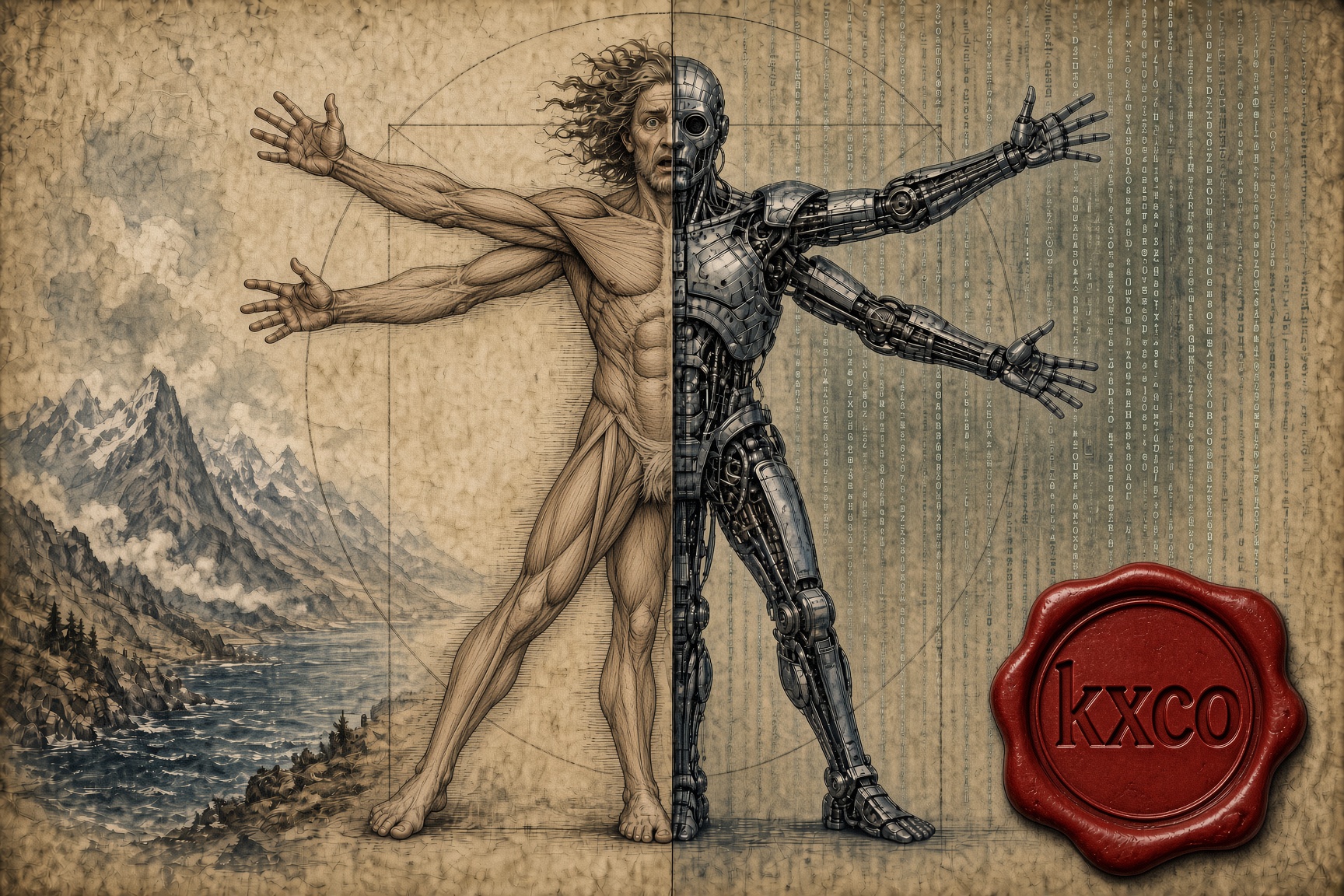
Don't Be the Best, Be the Only: Winning in an AI World
AI is repricing competence downward. What it cannot reproduce is a life. The case for remaining non-fungible, why friction still produces the best ideas, and what it means to build AI systems that keep the human intellect in them.
Every story, signed and delivered.
Subscribe to the kxco channel and get the headline, the AI-written key takeaways, and the chain-anchor link the moment we publish. Audio versions and per-ticker subscriptions arrive in the next iteration.