
America's Dangerous Addiction to Stimulus is Why you Need Bitcoin, Crypto and Gold
A flood of money for Covid-19 vaccines, stimulus checks and unemployment benefits is set to flow into the US economy this week, with Congress's expected approval of President Joe Biden's $1.9 trillion stimulus package.
There is an unlimited supply of freshly printed US Dollars that politicians will keep rolling out until the world awakens to the fact they are worthless, and it is at that point you must have Bitcoin, Crypto and Gold.
The bill -- approved by the Senate on Saturday and set for a vote in the House on Tuesday -- will pay for programs credited with helping the world's largest economy survive the mass layoffs and business disruptions sparked by the Covid-19 pandemic.
In a departure from previous relief measures, the package also claims to target poverty by expanding tax credits meant to help low-income families, which Politicians say could lead to child poverty being cut almost in half for a short period of time.
"It's a sea change for American social policy," Samuel Hammond, director of poverty and welfare policy at the Niskanen Center, said of the reforms included in the bill known as the American Rescue Plan.
Congress is only narrowly controlled by Biden's Democrats, and analysts believed the president's initial proposal would be whittled down significantly.
But the bill survived largely intact, and firms believe the US economy will expand even faster this year, with Oxford Economics forecasting a seven percent expansion in GDP. Which makes the need for such a massive stimulus seem questionable.
"That was the calculus on the part of the Democrats -- 'we're going to get one more bite at the apple, and we're going to make it big enough that we don't have to worry about not doing enough'," economist Joel Naroff said of the Democrats' incredibly expensive package, but it won't. Before the end of the year the US Govt will print money again.
- Continued aid -
The United States began spending big as its Covid-19 outbreak morphed into the world's largest, and unemployment skyrocketed after businesses shut down or curtailed operations.
The $2.2 trillion CARES Act passed nearly a year ago increased weekly unemployment payments, expanded eligibility, offered aid to small businesses and funded stimulus checks to consumers. An additional $900 billion in relief was passed in December.
After taking office in January, Biden proposed a third measure that would, among other things, keep the expanded unemployment aid going until September 6, despite arguments from Republicans that the bill is wasteful, and some economists' concerns that it could spark inflation.
It would also apportion money to speed up the US vaccination campaign against Covid-19, without which Naroff warned the crisis -- and the need for massive government spending -- will not end.
"Once you've got the pandemic down to the level where you probably wouldn't call it a pandemic anymore, you can start the process of moving from a government-run economy to a private sector-run economy," he said.
Wells Fargo Securities economist Michael Pugliese said businesses would step up rehiring in the coming months as virus cases ebb, but wasn't sure if the economy would return to the historically low unemployment seen before the pandemic, as Treasury Secretary Janet Yellen predicts.
"Even if we're not all the way back to full employment by 2022, we should be in a much, much better place than we are at the moment on jobs," he told AFP.
As he campaigned for Democratic control of the Senate, Biden promised stimulus checks of as much as $1,400 to adults, but the impact of that money is unclear.
"I would expect a jump there in consumption... starting in April and May as that money really starts to flow, but at an individual level, it will vary, I think, quite a bit what Americans are using it for," Pugliese said.
- 'Landmark legislation' -
Even as millions of people lost their jobs last year, the CARES Act's initial burst of spending helped push the US poverty rate down, but data from the University of Chicago and University of Notre Dame shows it has since rebounded to 11.3 percent in January 2021.
Biden's plan expands tax credits intended to aid the poor, most notably by raising the amount refundable to taxpayers under the Child Tax Credit to $3,600 for children under the age of six, and to $3,000 for children between the ages of six and 17.
Those provisions will cut the child poverty rate -- which Pew Research Center said was on a downward trajectory at 14 percent in 2019 -- by a little under half, Hammond said, while for the poorest children, the decline will be more than 50 percent.
"It's landmark legislation, but it's going to be enormous for low-income families across the country," he said.
AI is the Neat Handwriting of the Illiterate
A model in the hands of someone who has read the filing and walked the plant is a clerk. The same model, speaking for someone who has done neither, is a disguise. On AI slop, phantom citations and factslop, why finish stopped being evidence of work, and the containment layer KXCO built so a machine cannot speak as the institution until a source is attached.
Worthship: Do Not Conform to the Age
Worthship is the older English word for worship, and it means to ascribe worth. Bishop Robert Barron preached Romans 12 on 30 August. This essay follows the text into the prison letters, and puts two questions to a graph: do the four readings of that Sunday agree, and was Paul free or in chains when he wrote about despair?
The Truth in All Its Ugliness Must Survive
A majority vote does not determine the truth. Consensus is a mood, gossip is a sport, and a model will write the pretty version for free. Why the ugly number has to survive, why a record beats a dashboard, and what KXCO was built to keep standing when the room changes its mind.
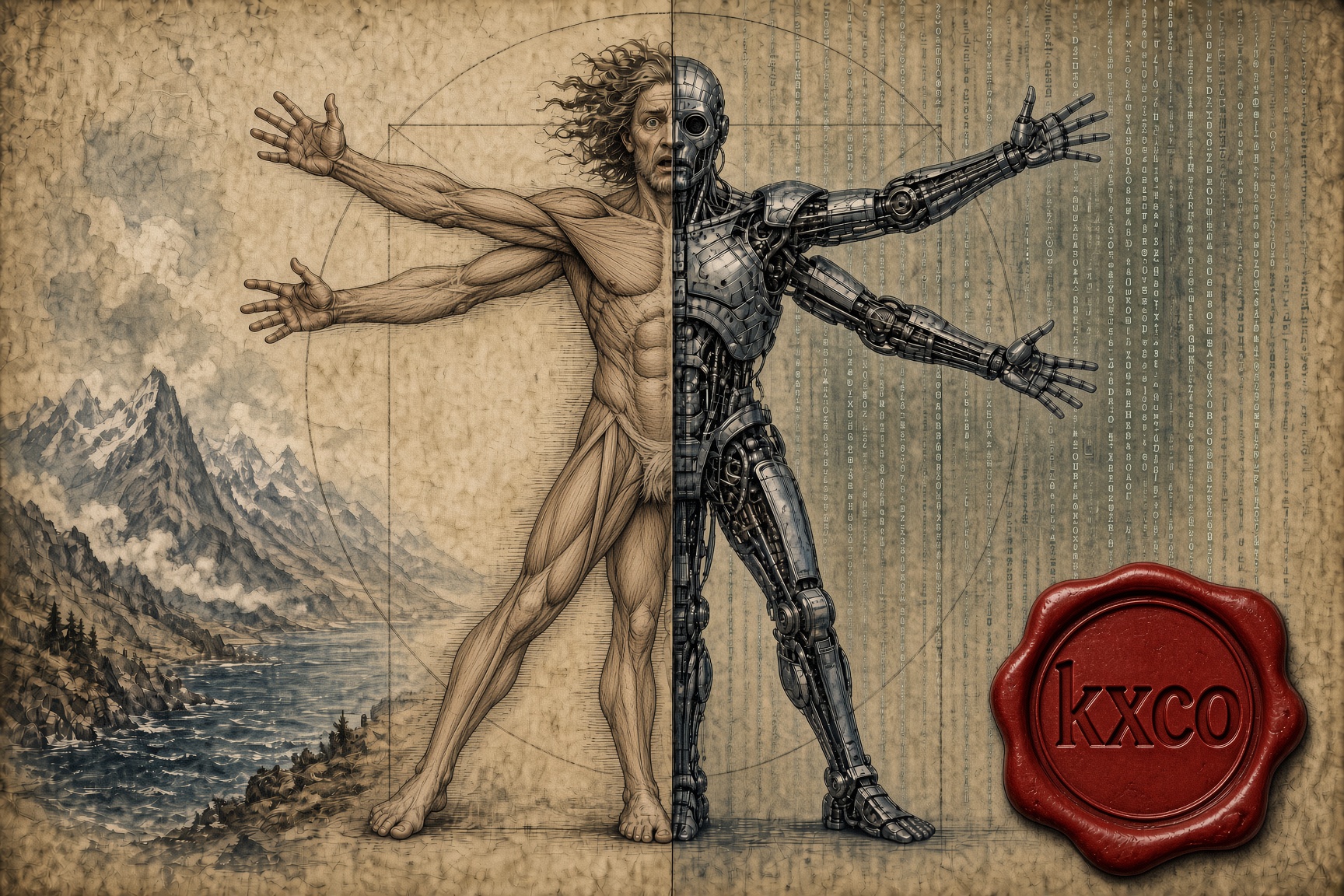
Don't Be the Best, Be the Only: Winning in an AI World
AI is repricing competence downward. What it cannot reproduce is a life. The case for remaining non-fungible, why friction still produces the best ideas, and what it means to build AI systems that keep the human intellect in them.
Every story, signed and delivered.
Subscribe to the kxco channel and get the headline, the AI-written key takeaways, and the chain-anchor link the moment we publish. Audio versions and per-ticker subscriptions arrive in the next iteration.