
AI Valuations Skyrocket OpenAI, Knightsbridge
OpenAI, the startup behind the generative AI platform ChatGPT, is reportedly in talks with investors for a valuation between $80 billion and $90 billion. This would be nearly triple the company's valuation from a year ago.
Microsoft is a major investor in OpenAI, and the two companies are working together to develop new AI products and services. OpenAI makes money by charging for access to enhanced versions of ChatGPT and licensing the underlying technology to businesses.
The company recently announced that it is adding voice and image capabilities to ChatGPT. This would allow users to get meal recipe suggestions by taking a photo of the inside of their refrigerator, or get help solving math problems by taking a picture of their homework.
Generative AI programs have become increasingly popular in recent months, with ChatGPT demonstrating an ability to generate essays, poems, and conversations from the briefest prompts. Tech giants such as Google, Meta, and Microsoft are racing to capitalize on the promise of generative AI, while also trying to avoid the potential perils of the technology, such as its potential as a weapon for misinformation and cybercrime.
It is still unclear how OpenAI plans to use its new valuation. However, the company has said that it is committed to developing "safe and beneficial" AI technologies.
Knightsbridge Securities Market Trading AI
Knightsbridge Securities Market Trading AI, or Knightsbridge AI for short, is a relatively new AI-powered trading platform that is still under development. As such, it is difficult to say definitively what its valuation should be.
However, there are a number of factors that could contribute to Knightsbridge AI's valuation, including:
The potential of AI to revolutionize the trading industry. AI is already being used to automate tasks, develop new trading strategies, and improve decision-making in the trading industry. Knightsbridge AI has the potential to further accelerate this trend.
The scarcity of AI talent. AI engineers and scientists are in high demand, and they can command high salaries. This makes Knightsbridge AI's team of AI experts a valuable asset.
The potential for Knightsbridge AI to generate high returns for its users. Knightsbridge AI claims to be able to generate returns that are significantly higher than the market average. If this is true, it would make Knightsbridge AI a very valuable asset for traders.
However, there are also some risks associated with Knightsbridge AI. One risk is that AI technology is still in its early stages of development. There is no guarantee that Knightsbridge AI's algorithms will be able to consistently generate high returns.
Another risk is that Knightsbridge AI is a relatively new platform. It does not have the same track record as some of the more established trading platforms.
Overall, it is difficult to say definitively what Knightsbridge AI's valuation should be. However, the factors mentioned above suggest that Knightsbridge AI could be a very valuable asset, especially in the long term.
Here are some additional thoughts on Knightsbridge AI's valuation:
Knightsbridge AI's valuation could be compared to the valuations of other AI startups. For example, OpenAI, the startup behind the generative AI platform ChatGPT, is currently valued at $80-$90 billion.
Knightsbridge AI's valuation could also be compared to the valuations of established trading platforms. For example, Interactive Brokers, a popular trading platform, is currently valued at $40 billion.
Ultimately, Knightsbridge AI's valuation will be determined by the market. If traders are willing to pay a high price for access to Knightsbridge AI's platform, then Knightsbridge AI's valuation will be high.
It is important to note that all investments carry risk, and there is no guarantee of profit. Investors should carefully consider the risks and rewards involved before investing in Knightsbridge AI.
AI Valuations: Sky-High or Justified?
Artificial intelligence (AI) is one of the most transformative technologies of our time, and it is no surprise that AI startups are attracting record valuations. In 2021, global venture capital funding for AI startups reached $132.2 billion, up 105% year-over-year. And in the first half of 2022, AI startups raised over $62 billion, according to PitchBook.
But are these valuations justified? Some experts believe that AI startups are overvalued, and that a correction is coming. Others argue that AI startups are worth every penny, given the potential of AI to revolutionize many industries.
There are a number of factors that contribute to the high valuations of AI startups. One factor is the scarcity of AI talent. AI engineers and scientists are in high demand, and they can command high salaries. This makes it difficult and expensive for AI startups to recruit and retain top talent.
Another factor is the potential of AI to disrupt existing industries. AI is already being used to automate tasks, develop new products and services, and improve decision-making. This is leading to a lot of excitement and investment in AI startups.
However, there are also some risks associated with investing in AI startups. One risk is that AI technology is still in its early stages of development. There is no guarantee that AI startups will be able to deliver on their promises.
Another risk is that AI startups will face stiff competition from established tech giants. Google, Microsoft, and Amazon are all investing heavily in AI, and they have the resources to develop and deploy AI technologies at scale.
Overall, the valuations of AI startups are high, but there are a number of factors that justify these valuations, including the scarcity of AI talent and the potential of AI to disrupt existing industries. However, investors should be aware of the risks involved in investing in AI startups, such as the early stage of development of AI technology and the competition from established tech giants.
Here are some additional thoughts on AI valuations:
It is difficult to value AI startups because AI is a new and rapidly evolving technology. There are no established valuation methods for AI startups, and investors must rely on their own judgment and expertise.
AI startups are often valued based on their potential future earnings. This is a risky approach, as it is difficult to predict how AI technologies will be adopted and used in the future.
AI startups are often valued based on their access to data. Data is the fuel that powers AI algorithms, and AI startups with access to large amounts of data are more valuable.
AI startups are often valued based on their team. AI startups with experienced and talented teams are more valuable than startups with less experienced teams.
Investors who are considering investing in AI startups should carefully consider the risks and rewards involved. AI startups have the potential to generate high returns, but they also have the potential to fail. Investors should carefully research AI startups before investing, and they should only invest what they can afford to lose.
AI is the Neat Handwriting of the Illiterate
A model in the hands of someone who has read the filing and walked the plant is a clerk. The same model, speaking for someone who has done neither, is a disguise. On AI slop, phantom citations and factslop, why finish stopped being evidence of work, and the containment layer KXCO built so a machine cannot speak as the institution until a source is attached.
Worthship: Do Not Conform to the Age
Worthship is the older English word for worship, and it means to ascribe worth. Bishop Robert Barron preached Romans 12 on 30 August. This essay follows the text into the prison letters, and puts two questions to a graph: do the four readings of that Sunday agree, and was Paul free or in chains when he wrote about despair?
The Truth in All Its Ugliness Must Survive
A majority vote does not determine the truth. Consensus is a mood, gossip is a sport, and a model will write the pretty version for free. Why the ugly number has to survive, why a record beats a dashboard, and what KXCO was built to keep standing when the room changes its mind.
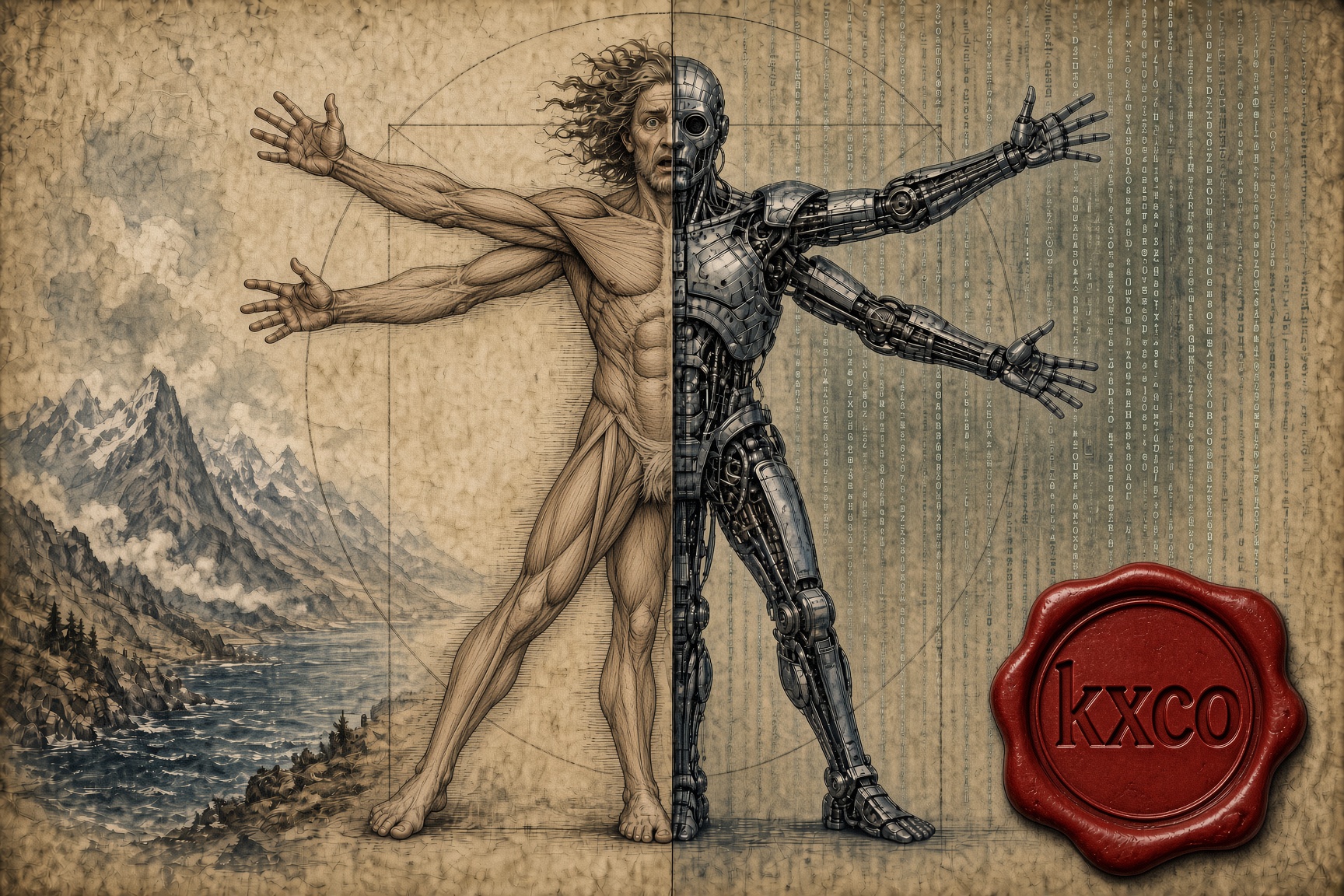
Don't Be the Best, Be the Only: Winning in an AI World
AI is repricing competence downward. What it cannot reproduce is a life. The case for remaining non-fungible, why friction still produces the best ideas, and what it means to build AI systems that keep the human intellect in them.
Every story, signed and delivered.
Subscribe to the kxco channel and get the headline, the AI-written key takeaways, and the chain-anchor link the moment we publish. Audio versions and per-ticker subscriptions arrive in the next iteration.