
23rd China International Fair for Investment and Trade
The 23rd China International Fair for Investment and Trade (CIFIT) opened Friday in Xiamen, east China's Fujian Province, to boost investment and bolster global economic recovery.
The four-day event, themed "Open and Integrated: Key to High-Quality Development," kicked off with an opening ceremony, and will encompass a range of activities including forums, seminars, exhibitions, and business matching sessions.
The theme of this year's CIFIT reveals China's resolution to advance high-standard opening up and desire to promote international exchanges and cooperation, while sharing opportunities in its vast market with the rest of the world, said Chen Chunjiang, assistant minister of commerce, at the opening ceremony.
Cross-border investment is a crucial force in driving global economic growth, technological advancement and industrial upgrading, Chen said, stressing that "boosting investment confidence and promoting open cooperation have become more urgent than ever given the uncertain global economic recovery."
Chen noted that the country will implement the 24 measures unveiled by the State Council to beef up foreign investment inflow, leverage the role of roundtable meetings with foreign enterprises, and create a market-oriented, law-based and first-class business environment that is up to international standards.
"China's investment environment has always been good and it continues to be good," said Harley Seyedin, president of the American Chamber of Commerce in South China, adding that the new policies introduced by the government made it easier and more preferable for foreign companies to invest in China.

Data from the Ministry of Commerce (MOC) showed that 24,000 new foreign firms established themselves in China in the first half of the year, marking a 35.7-percent rise year on year. Investments from developed countries continued to grow, with investments from France, the United Kingdom, Japan, and Germany increasing by 173.3 percent, 135.3 percent, 53 percent, and 14.2 percent, respectively, during the period.
Electric Glass (Xiamen) Co., Ltd., a leading Japanese manufacturer and supplier of liquid crystal glass blocks, and participant of this year's CIFIT, expressed confidence in the Chinese economy and expansion of investment.
Ohashi Nobuo, general manager of Electric Glass (Xiamen), said the company had completed capital increases and capacity expansion four times up to now in the world's second-largest economy, and is currently stepping up its Phase V project, which is planned to start operation next year.
"We will invest about 500 million yuan (69.3 million US dollars), and after completion, the output value will increase accordingly," he said. Over the past eight years, the company's total investment in China has reached more than 8 billion yuan.
Covering around 120,000 square meters, this year's CIFIT has a distinct focus on the digital economy, intelligent manufacturing, green and low-carbon development, as well as rural revitalization. Various research reports on investment will also be released during the event.
More than 1,000 organizations and enterprises from all over the world participated in the exhibitions.
With several international organizations, including the United Nations Industrial Development Organization, present at the fair, this year has seen an increase in both the number and level of participation compared to previous editions.
Rebeca Grynspan, secretary-general of the United Nations Conference on Trade and Development, hailed China's dynamism, development perspective and scale in promoting inclusive and sustainable growth and investment.
"Your commitment to the principles of multilateralism and open markets can help shape a better future, especially through the Global Development Initiative," Rebeca Grynspan said.
Brazil, Serbia and Qatar are the guest countries of honor at this year's fair.
"In 2024, we will celebrate 50 years of diplomatic relations between Brazil and China and, in this half century, we have developed a deep and strategic relationship," said Geraldo Alckmin, Brazilian Vice President and Minister of Development, Industry, Trade and Services, via video.
"China has been our largest trading partner since 2009. Brazil is the fourth highest recipient of Chinese investment," he said.
Data from the MOC revealed that China-funded enterprises in foreign countries pay more than 50 billion U.S. dollars of taxes and fees to the host countries every year, creating nearly 2.5 million local jobs and making positive contributions to the economic recovery of the host countries and the world at large.
Chen said that China will continuously improve the quality and level of outbound investment cooperation, continue to promote the high-quality development of the Belt and Road Initiative, and actively participate in the formulation of global economic and trade rules.
China's non-financial outbound direct investment increased 18.1 percent year on year to 500.94 billion yuan in the first seven months of the year, MOC data showed.
First launched in 1997, the CIFIT has become an important platform to boost bilateral investment and facilitate global development.
AI is the Neat Handwriting of the Illiterate
A model in the hands of someone who has read the filing and walked the plant is a clerk. The same model, speaking for someone who has done neither, is a disguise. On AI slop, phantom citations and factslop, why finish stopped being evidence of work, and the containment layer KXCO built so a machine cannot speak as the institution until a source is attached.
Worthship: Do Not Conform to the Age
Worthship is the older English word for worship, and it means to ascribe worth. Bishop Robert Barron preached Romans 12 on 30 August. This essay follows the text into the prison letters, and puts two questions to a graph: do the four readings of that Sunday agree, and was Paul free or in chains when he wrote about despair?
The Truth in All Its Ugliness Must Survive
A majority vote does not determine the truth. Consensus is a mood, gossip is a sport, and a model will write the pretty version for free. Why the ugly number has to survive, why a record beats a dashboard, and what KXCO was built to keep standing when the room changes its mind.
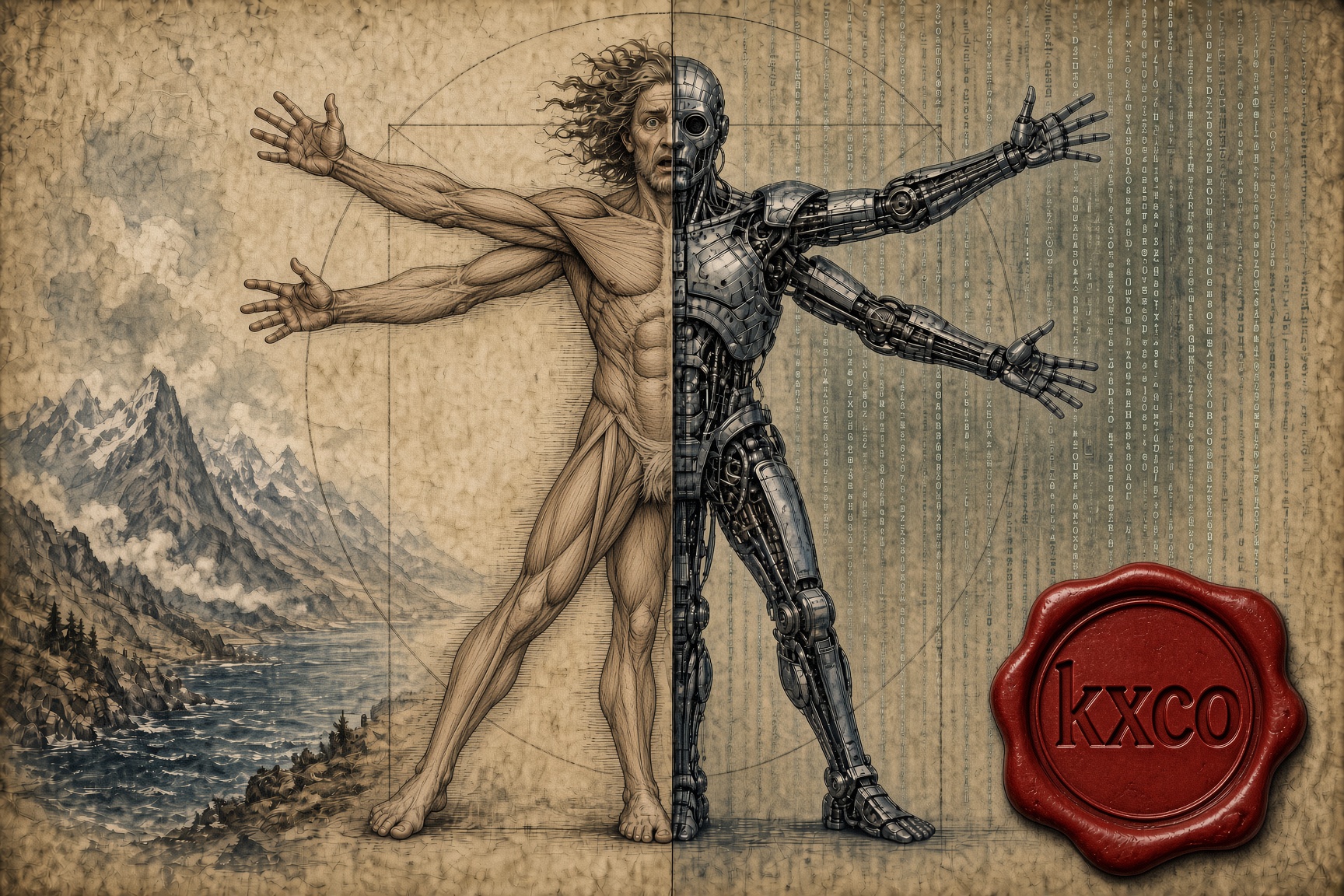
Don't Be the Best, Be the Only: Winning in an AI World
AI is repricing competence downward. What it cannot reproduce is a life. The case for remaining non-fungible, why friction still produces the best ideas, and what it means to build AI systems that keep the human intellect in them.
Every story, signed and delivered.
Subscribe to the kxco channel and get the headline, the AI-written key takeaways, and the chain-anchor link the moment we publish. Audio versions and per-ticker subscriptions arrive in the next iteration.