
LVMH, Kering and Prada: Luxury's Reckoning
The luxury slump is structural, not just cyclical: audiences have grown immune to advertising, the influencer economy has aged into the mainstream, and value is migrating to craftsmanship and credible people. Shayne Heffernan on LVMH, Kering and Prada — with US tickers and a valuation scorecard.
Part of theStocks Center
The global luxury industry is in its worst slump since the pandemic, and the easy explanation — a soft economy and a weak Chinese consumer — is only half the story. Something slower and more structural is happening underneath the cycle: shoppers have grown immune to being marketed at. A decade of celebrity endorsements, influencer partnerships and glossy campaign imagery has lost much of its power to move people, and the brands most dependent on that machinery are the ones bleeding the most.
This is not a story about a clever new marketing theory. It is the opposite. Social-media advertising is no longer novel — it is the mainstream, and it has aged remarkably fast. The influencer model that felt fresh in 2016 now feels like wallpaper, and the flood of AI-generated imagery pouring into every feed has stripped away whatever scarcity or specialness branded content once had. When anyone with a laptop can produce a photorealistic fashion campaign for nothing, a real one stops feeling rare. What people increasingly want instead is simpler and harder to fake: facts, and a person they actually trust. In luxury, that shift is now showing up in the numbers.
The downturn, in figures
According to Bain & Company's annual study with Altagamma, the global market for personal luxury goods slipped roughly 2% in 2024 to about €364 billion, and Bain expects a further ~2% erosion in 2025 to around €358 billion — well below the €380–390 billion analysts had penciled in. KPMG's 2025 report confirmed that 2024 was the first annual decline in luxury sales since the pandemic, and a broad-based one across regions and categories. Morgan Stanley described an industry in "a challenging phase," and Forbes went further, declaring the "luxury supercycle" over.
The United States is central to the story, not a footnote — and all of these houses are investable there. LVMH, Kering, Prada and Hermès trade as over-the-counter ADRs in the US (LVMUY, PPRUY, PRDSY and HESAY respectively) alongside their home listings in Paris and Hong Kong. The US personal-luxury market itself contracted from roughly $109 billion in 2023 to about $99.6 billion in 2024, per Forbes' reading of Interbrand data, which also flagged a 5% drop in top luxury brand valuations. Chinese demand, the engine of the last decade, cooled hard, with some estimates putting sales to Chinese consumers down 18–20% year on year. Visa's analytics arm confirmed the pace of luxury purchasing slowed materially across major markets into 2025.
The deeper drivers are generational. The aspirational middle-class buyer who powered the 2010s boom is pulling back, and Gen Z — now entering its prime spending years — is markedly cooler on logo-driven status symbols, more sceptical of marketing claims, and more insistent on authenticity. That is exactly the behaviour you would expect from the first cohort raised inside an always-on, AI-saturated feed: the least moved by advertising and the most responsive to something that reads as genuine.
LVMH: scale as both shield and anchor
LVMH remains the giant of the sector, with more than 75 houses spanning Louis Vuitton, Dior, Tiffany & Co., Moët Hennessy, Sephora and more. It reported 2025 revenue of about €80.8 billion — essentially flat and a respectable result in a hard year — with net profit near €10.9 billion and a retail network beyond 6,280 stores. But the pressure is visible at the edges: Q1 2026 revenue of €19.1 billion was down 6% as reported (a slim +1% organic), and the shares (LVMUY in the US; MC.PA in Paris) have fallen roughly 26% year to date, with market value down to about €230 billion from north of €400 billion at the 2023 peak.
Louis Vuitton is the group's centre of gravity, and its men's studio is now led by Pharrell Williams, appointed in 2023. Pharrell is instructive precisely because he is not a rented face: he designs the collections, stages the shows and makes the calls. Whatever one thinks of the output, it is the work of a credible creative with three decades of cultural standing, not a paid post. That is the kind of association that still carries weight when audiences have stopped believing the ad — though it also raises the bar, because a working creative director is judged on substance, and every misstep is scrutinised in real time. LVMH's problem is not authenticity at the top of the house; it is that its sheer scale ties it to the mass-affluent shopper who is pulling back hardest.
Kering: the cost of leaning on the old playbook
Kering — Gucci, Saint Laurent, Bottega Veneta, Balenciaga, Alexander McQueen — is the clearest casualty. Group revenue fell to about €14.7 billion in 2025, down roughly 10% on a comparable basis, and operating income collapsed to €1.63 billion, under a third of its 2022 level, with the group swinging toward a loss. Gucci, some 41% of revenue, is the wound: sales down around 22% to €5.99 billion. New CEO Luca de Meo has called the recovery "fragile" and set 2026 as a year of stabilisation before any return to growth in 2027.
Kering's pain is partly geography — an outsized China and Gucci concentration — but it is also the sharpest example of the marketing-immunity effect. Gucci rode the 2010s on maximalist spectacle and celebrity heat; when the audience cooled on being dazzled, the brand had less underneath. Its share collapse tells the story: Kering's market value has fallen toward €9 billion from over €70 billion at the peak, and, as the valuation picture below shows, its shares now carry a distressed rather than a growth profile.
Prada: the exception that proves the point
Prada Group has been the standout, growing revenue about 9% in 2025 to €5.72 billion with net income up to roughly €852 million, and Q1 2026 revenue of €1.43 billion up 14% at constant currency. The engine is Miu Miu, which has become one of the hottest names in fashion by doing the opposite of formula marketing — a distinctive point of view, creative risk and communication that reads as real to younger shoppers rather than staged. Prada's 2025 acquisition of Versace adds another storied house to the portfolio. Listed in Hong Kong (1913.HK) and traded in the US as PRDSY, Prada is the rare luxury name whose momentum is building, not fading.
Two privately held houses fill in the picture. Chanel, which does not disclose quarterly detail, returned to growth with 2025 revenue of about $19.3 billion and operating profit up 5% to $4.71 billion, credited largely to new creative director Matthieu Blazy — again, a credible creative rather than a marketing push. Hermès, the sector's benchmark, grew sales about 9.8% to €16 billion; its model of scarcity, craftsmanship and controlled distribution is the purest expression of the qualities shoppers now reward, and the market prices it accordingly.
Creative authority beats rented reach
The celebrity question is being quietly rewritten. Every major house still has ambassadors — Zendaya and Pharrell at Louis Vuitton, Jungkook and Anya Taylor-Joy at Dior, Bad Bunny at Gucci, Jennie and Margot Robbie at Chanel — but follower counts are no longer the point. Christian Louboutin's 2025 appointment of Jaden Smith as its first-ever men's creative director, whose debut "Molten Trapman" capsule landed in June 2026, is telling: with 19 million Instagram followers he brings reach, but the bet is on his creative credibility and willingness to take risks, not his audience size. The partnerships that work now are the ones audiences read as genuine; the ones that read as transactional increasingly land with a shrug. Put simply, a trusted, credible person attached to real creative work is worth more than a large but rented audience — and that person is also held to a far higher standard, because inauthenticity is now spotted and amplified within hours.
Geography and generations
The map is uneven. China, the decade's growth engine, is the weakest major market as a slower economy, softer confidence and a cultural turn away from conspicuous consumption bite — punishing Kering's Gucci exposure most. Europe has held up on tourist spending; Japan has been a bright spot on a weak yen; and the US, soft through 2024, is stabilising into a more selective, value-conscious buyer — Prada's Americas strength in early 2026 is the tell. On demographics, Gen Z's scepticism and millennials' shift toward quality, provenance and craftsmanship over logos both point the same way: toward brands with genuine substance and away from those that lean on marketing volume.
The valuation picture
For investors, the divergence is written into the multiples. Prada trades at the lowest trailing price/earnings of the group — around 12× — despite the fastest growth, LVMH sits near 22×, and Hermès commands a premium near 38× as the market's chosen quality name. Kering is the outlier: its trailing P/E balloons to roughly 410× not because investors expect explosive growth, but because 2025 earnings collapsed toward zero — a distressed multiple, not a confident one.
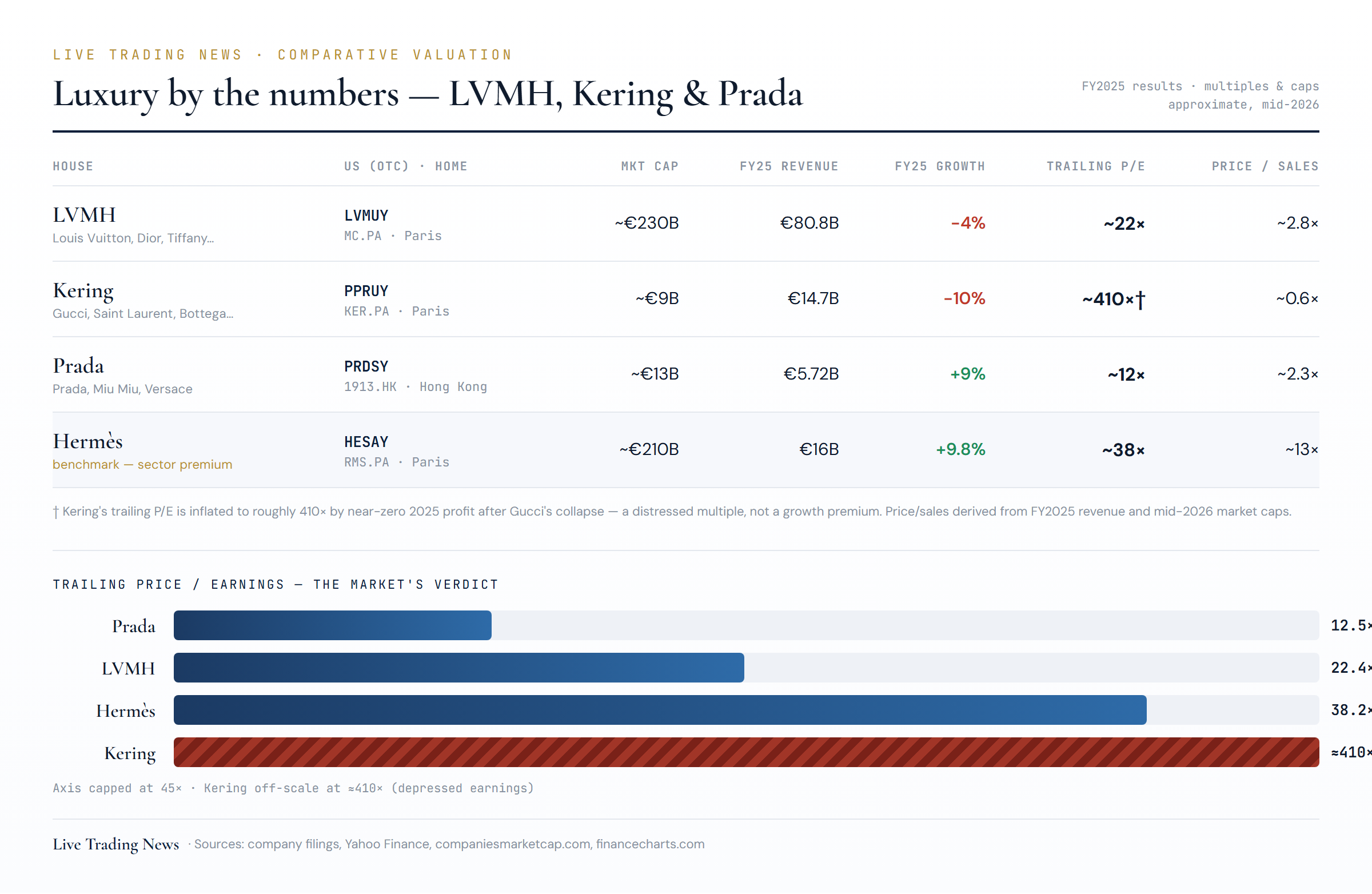
The scorecard makes the split plain: the houses built on genuine creative authority and scarcity (Prada/Miu Miu, Hermès, and to a degree LVMH and Chanel) are being rewarded, while the house that leaned hardest on the old spectacle-and-celebrity model (Kering's Gucci) trades on distress. All four are accessible to US investors through their OTC ADRs, making the comparison directly actionable for American portfolios.
A note on the data lens
This analysis is informed by the mapping approach behind the KXCO AI Sector Ontology — a live, independently verifiable graph of companies, people, capital and dependencies. It is worth being precise about scope: KXCO has publicly released only its AI Sector Ontology. Its ontologies of other sectors — including luxury and consumer goods — are built with the same methodology but kept private, so the structural reading of the luxury market here draws on that method rather than a published KXCO luxury dataset. The AI-sector map is the one public window into how KXCO models an industry's real relationships; the rest, by design, is not yet open.
The bottom line
The luxury slump is cyclical at the surface and structural underneath. As audiences grow immune to advertising and the once-novel influencer economy settles into tired middle age, the value has migrated to the things that cannot be faked cheaply: real craftsmanship, genuine scarcity, and credible people doing credible creative work. That is why Prada is climbing while Gucci is convalescing, why Hermès keeps its premium, and why LVMH's fortunes rest more on the substance of Louis Vuitton and Dior than on any campaign. In a world drowning in synthetic content, the scarcest thing a luxury brand can offer is something a shopper can actually believe.
Sources and References
Bain & Company, "Finding a New Longevity for Luxury," 2025. Link
KPMG, "Luxury in the Midst of Change," September 2025. Link
McKinsey & Company, "State of Luxury: US and China Outlook." Link
Morgan Stanley, "Luxury's Delay in Regaining Its Sparkle," 2025. Link
Forbes, "Declining Consumer Demand Pulls Luxury Brand Valuations Down," October 2025. Link
LVMH, "2025 Full Year Results." Link
S&P Global, "LVMH Post-Earnings Review: 2025 Results Beat Forecast, 2026 Outlook Cloudier." Link
Kering, "2025 Results: Sequential Improvement." Link
Reuters, "Kering shares surge as De Meo flags Gucci-owner's 'fragile' revival," February 2026. Link
Chanel, "Financial Results for the Year Ended 31 December 2025." Link
Reuters, "Chanel returns to growth as Blazy's designs win over new shoppers," May 2026. Link
Business of Fashion, "Prada Sales Climb 9% in 2025 as Versace Era Begins." Link
Prada Group, "Q1 2026 Revenue: Gradual Improvement and Focus on Execution." Link
Christian Louboutin, "First Men's Creative Director: Jaden Smith." Link
WWD, "Christian Louboutin Men's Fall/Winter 2026 Campaign." Link
Visa Consulting & Analytics, "Luxury Shopping Is No Longer Just for the Affluent." Link
Houlihan Lokey, "Luxury Goods Market Update, June 2025." Link
Morningstar / Nasdaq, "LVMH ADR (LVMUY) quote and data." Link
Yahoo Finance, "Prada S.p.A. (PRDSY) ADR quote." Link
companiesmarketcap.com, "LVMH (MC.PA) P/E ratio." Link
financecharts.com, "LVMH (LVMUY) P/E ratio — current and historical." Link
KXCO, "KXCO AI Sector Ontology." Live interactive map: kxco.ai/ontology-live

KXCO is Enhanced Intelligence, Not Artificial
I never wanted artificial intelligence. I wanted enhanced intelligence, and they are not the same product. Artificial means the machine does the thinking and hands you the answer. Enhanced means I do the thinking, with more of my own mind in the room than I have ever had at one time. Forty years of reading, recallable in the second I need it. Patterns across law, credit, physics and markets that no specialist sees, because the useful ones sit between the fields rather than inside them.
The AI Safety Argument Is Being Held in the Wrong Room
The people who will be blamed for what AI does are not in the room where its safety is argued. A jailbreak escapes a policy. The failure that costs money is an action that escapes an owner, a payment sent or a record altered. Tokens are not authority. Intelligence got cheap and judgment did not, and there is no organ of standing you can copy into a model. Shayne Heffernan on the objection worth taking seriously, and the questions to take into a vendor meeting.
NIST Graded Our Post-Quantum Cryptography. Zero Failures.
NIST's Algorithm Validation Test System generated test vectors nobody had seen, we answered them over the ACVP protocol, and NIST graded the result: 2,130 cases across ML-KEM, ML-DSA and SLH-DSA in every parameter set offered, zero failures, demo certificate A11025. This is what that proves, where we deliberately drew the claim narrower than NIST's own matrix, and why the FIPS 140-2 sunset on 21 September makes the distinction between being graded and grading yourself worth understanding.

The Problem Is Not the Problem
People treat the Jack Sparrow line as a joke. The attribution is a joke. The sentence is not. Forty years in markets says the same thing Epictetus said in 125 CE and Robert Merton named in 1948: the event is finite, and the story you appoint to govern it is not. This essay walks the quote back to its actual sources, draws the loop that turns a feeling into an order, and sets out the four places a rule written in advance cuts the loop. Faith is not a hedge. It is a stance.
Every story, signed and delivered.
Subscribe to the kxco channel and get the headline, the AI-written key takeaways, and the chain-anchor link the moment we publish. Audio versions and per-ticker subscriptions arrive in the next iteration.