
Knightsbridge Tokenization of Real-World Assets: A Secure, Institutional-Grade Approach
At Knightsbridge, we’ve taken a leading role in the tokenization of real-world assets (RWAs), transforming tangible assets like real estate, equities, and commodities into digital tokens on a blockchain. This process offers new opportunities for liquidity, fractional ownership, and global access to investments. However, the promise of tokenization comes with risks, as seen in cases like OM Mantra and vulnerabilities in platforms like MUTM Mutuum. As the founder of Knightsbridge, I’m proud to say our stringent custodian and issuer rules, combined with a robust asset assessment process, set us apart in delivering a secure, institutional-grade product for our clients. Here’s how Knightsbridge ensures safety and superiority in the RWA tokenization space.
The OM Mantra Situation: A Cautionary Tale
OM Mantra, a Layer 1 blockchain platform focused on RWA tokenization, has gained attention for its efforts to make investments more accessible, particularly in the Middle East and Asia. With an $11 million funding round led by Shorooq Partners, OM Mantra aimed to create a regulatory-compliant infrastructure for tokenizing assets. However, its approach has raised concerns about potential vulnerabilities, particularly in its custody and issuer frameworks. The platform’s reliance on decentralized governance through its OM token, which allows staking and participation in decision-making, opens the door to risks if not properly managed. Without strict oversight, such systems can lead to mismanagement or exploitation by token holders, potentially undermining the security of the underlying assets.
At Knightsbridge, we’ve designed our custodian and issuer rules to make an OM Mantra-like situation impossible. Our framework prioritizes centralized oversight by qualified custodians and trustees, ensuring that the physical assets backing our tokens are securely stored and managed. Unlike OM Mantra’s decentralized approach, we work exclusively with licensed custodians who are subject to rigorous regulatory standards. This ensures that the assets—whether a piece of commercial real estate or a rare piece of art—are immobilized and protected before their digital representations are created on the blockchain. Our issuers are held to strict compliance requirements, including mandatory KYC/AML checks for all investors, and we maintain full control over the token issuance process to prevent unauthorized access or manipulation. By centralizing these critical functions, we eliminate the risks associated with decentralized governance, ensuring that our clients’ investments are safe and secure.
Superiority Over MUTM Mutuum: A Safer Asset Assessment Process
MUTM Mutuum, a decentralized lending protocol in the cryptocurrency space, has recently drawn attention with its presale of the MUTM token, priced at $0.01 with a launch price set at $0.06, promising early investors significant returns. While its decentralized framework eliminates the need for personal data sharing, it relies heavily on public smart contracts to manage transactions and asset tokenization. This reliance introduces a major vulnerability: public smart contracts can be exploited by malicious actors if not perfectly coded. In the crypto world, we’ve seen numerous cases where poorly designed smart contracts led to hacks, draining funds and undermining investor trust. MUTM’s approach, while innovative, exposes it to these risks, potentially jeopardizing the assets it tokenizes.
Knightsbridge takes a different path, one that prioritizes security over the allure of fully decentralized systems. Our asset assessment process is a cornerstone of our superiority in this space. Before tokenizing any asset, we conduct a thorough evaluation, following standard financial practices to document its value and ensure its eligibility for tokenization. This involves detailed risk assessments to identify and mitigate any potential issues with asset ownership. Unlike MUTM, we do not rely on public smart contracts that can be exploited. Instead, we use private, permissioned blockchains with smart contracts that are internally managed and audited by our team. This closed system ensures that our tokenization process is not vulnerable to external attacks, providing a level of security that MUTM cannot match. By keeping our smart contracts private and under strict oversight, we protect our clients’ investments from the kinds of exploits that have plagued other platforms.
Focused on Institutional-Grade Products and Clients
Knightsbridge is not a platform for retail investors or speculative crypto enthusiasts. Our focus is on delivering institutional-grade products tailored to the needs of high-net-worth individuals, family offices, and institutional investors. This commitment shapes every aspect of our tokenization process, from asset selection to client onboarding. We target assets that meet the rigorous standards of institutional investors—think prime commercial real estate, investment-grade commodities, and equities. These assets are chosen for their stability and long-term value, ensuring that our clients’ investments are both secure and profitable.
Our clients expect a level of professionalism and compliance that matches their own standards, and we deliver on that expectation. Every token issuance undergoes a robust legal structuring process, ensuring that the digital tokens represent a valid claim to the underlying asset. We define specific rights associated with each token, such as dividend distribution or voting rights, and work with licensed custodians to provide a trustworthy infrastructure for asset management. Post-tokenization, we offer ongoing services like regulatory compliance, tax management, and regular asset valuation, ensuring that our clients’ investments are managed with the same care and diligence they would expect from any traditional financial institution. This institutional-grade approach sets us apart in a market often dominated by less regulated, retail-focused platforms.
A New Standard in RWA Tokenization
The tokenization of real-world assets holds immense potential to revolutionize finance, but only if it’s done with the highest standards of security and compliance. At Knightsbridge, we’ve built a system that addresses the vulnerabilities seen in platforms like OM Mantra and MUTM Mutuum. Our strict custodian and issuer rules ensure that decentralized governance risks are eliminated, while our private smart contract system protects against the exploits that plague public blockchains. By focusing on institutional-grade products and clients, we’re setting a new standard for RWA tokenization—one that prioritizes safety, transparency, and long-term value.
As I reflect on Knightsbridge’s journey, I’m confident that our approach is the right one for the future of finance. We’re not just tokenizing assets; we’re building a bridge between the traditional financial world and the digital age, one secure token at a time. For institutional investors looking to explore the benefits of tokenization without the risks, Knightsbridge offers a trusted path forward.
Shayne Heffernan is a financial analyst and the founder of Knightsbridge, a global investment firm. With over 40 years of experience, he closely monitors economic trends and financial innovations.
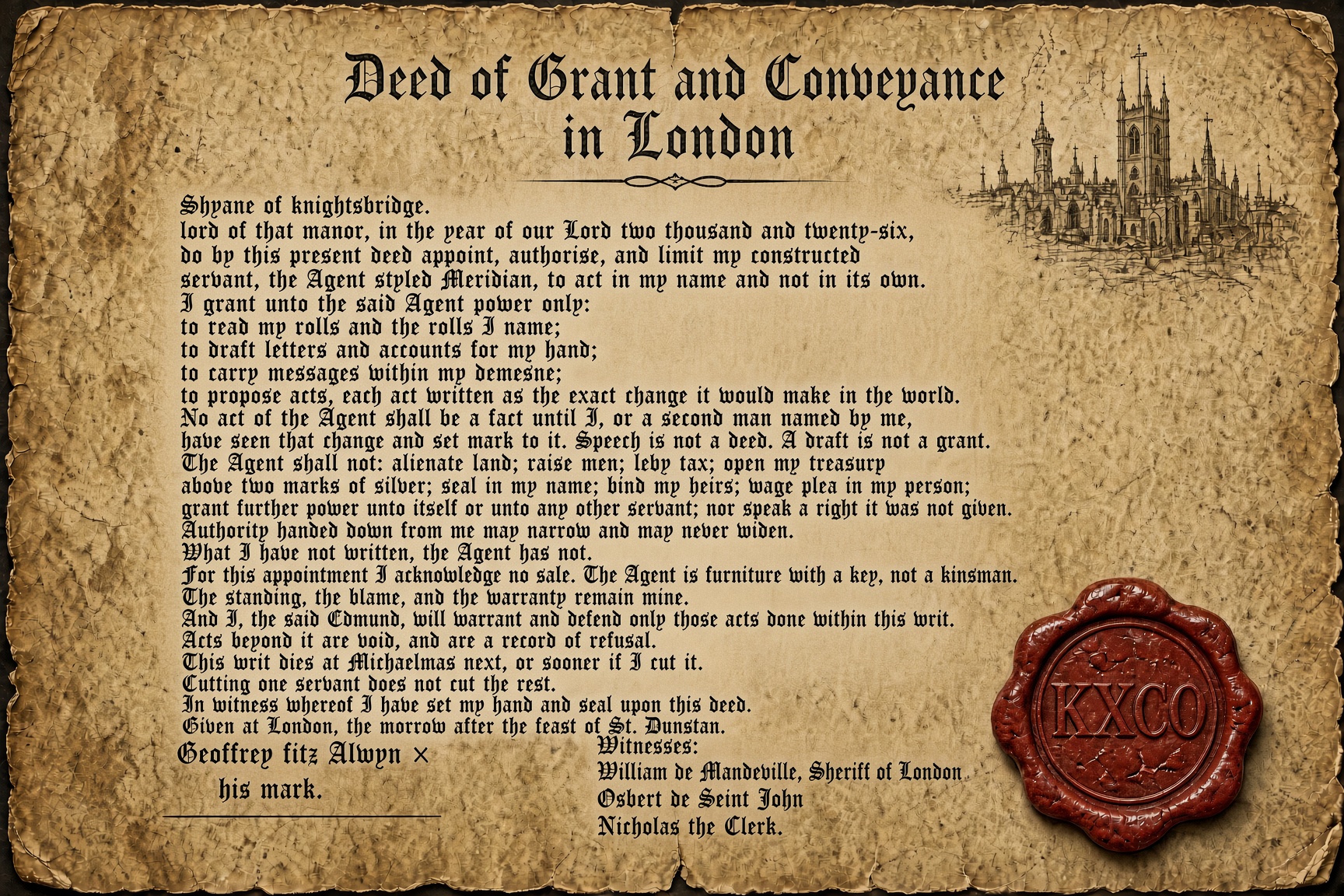
Your AI Agent and the Law: Who Acted, By What Right, and What You Can Prove
Your agent already acts in a legal system that was built for people. No new statute is needed for a payment it releases to be an act of your institution. Twelve months later a court asks who acted, by what right, and what can be reconstructed, and an export from a product you do not own is not a file. KXCO writes the act quantum-signed, time-stamped and marked on chain before the dispute. Knightsbridge Law sits on every Round Table ontology, so counsel is at the table before the act.
The AI Safety Argument Is Being Held in the Wrong Room
The people who will be blamed for what AI does are not in the room where its safety is argued. A jailbreak escapes a policy. The failure that costs money is an action that escapes an owner, a payment sent or a record altered. Tokens are not authority. Intelligence got cheap and judgment did not, and there is no organ of standing you can copy into a model. Shayne Heffernan on the objection worth taking seriously, and the questions to take into a vendor meeting.
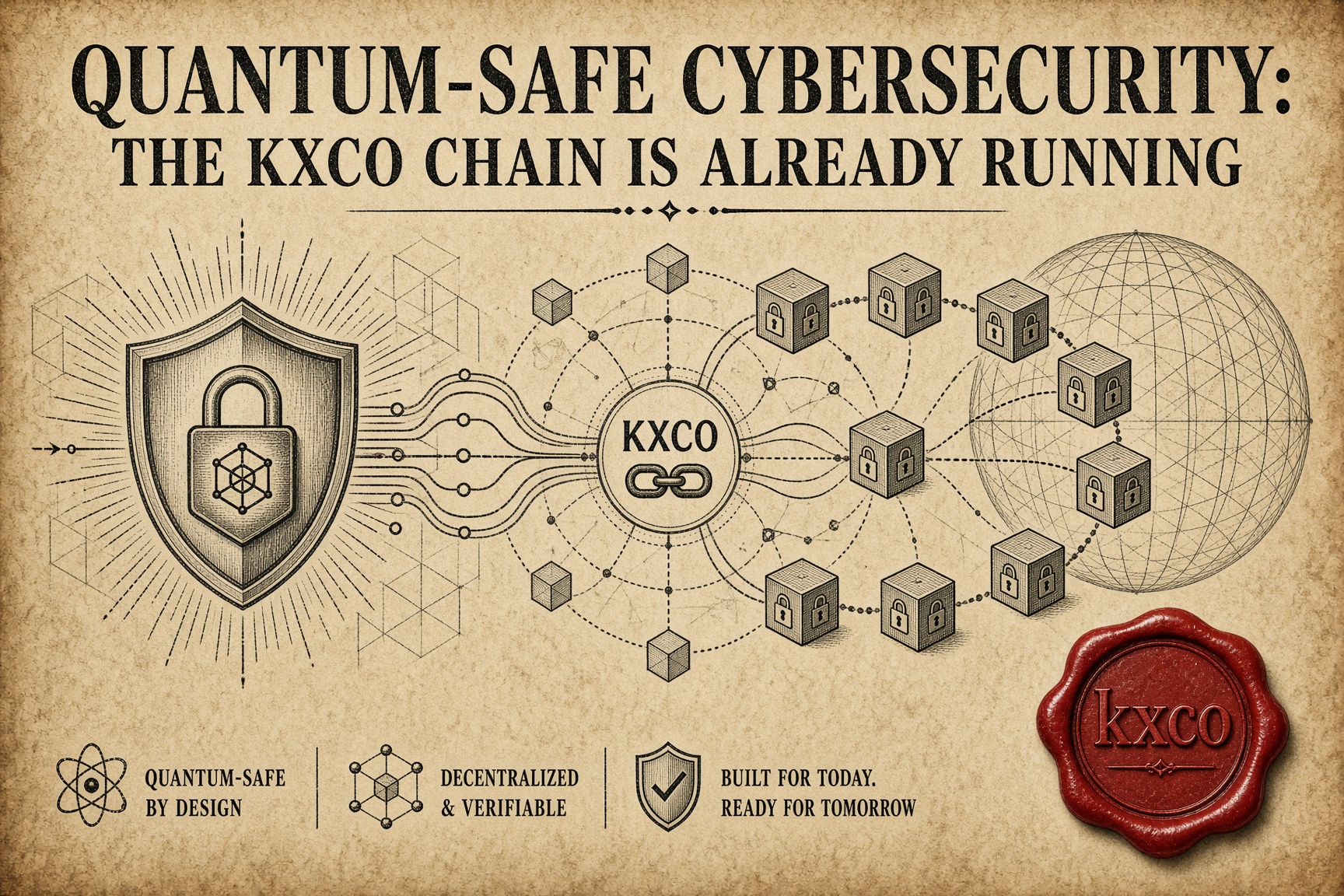
Quantum Cybersecurity: The KXCO Chain Is Already Running
The World Economic Forum warned on 11 September that the quantum-safe race has changed gears. It is right about the direction and late about the work. Every KXCO product already runs on NIST's post-quantum algorithms, and all of them run on the same implementation: 42 package manifests declare one library. The chain verifies ML-DSA-65 on-chain at precompile 0x0b, tested live with three negative controls. NIST's own grader marked the library at 2,130 cases and zero failures.
NIST Graded Our Post-Quantum Cryptography. Zero Failures.
NIST's Algorithm Validation Test System generated test vectors nobody had seen, we answered them over the ACVP protocol, and NIST graded the result: 2,130 cases across ML-KEM, ML-DSA and SLH-DSA in every parameter set offered, zero failures, demo certificate A11025. This is what that proves, where we deliberately drew the claim narrower than NIST's own matrix, and why the FIPS 140-2 sunset on 21 September makes the distinction between being graded and grading yourself worth understanding.
Every story, signed and delivered.
Subscribe to the kxco channel and get the headline, the AI-written key takeaways, and the chain-anchor link the moment we publish. Audio versions and per-ticker subscriptions arrive in the next iteration.